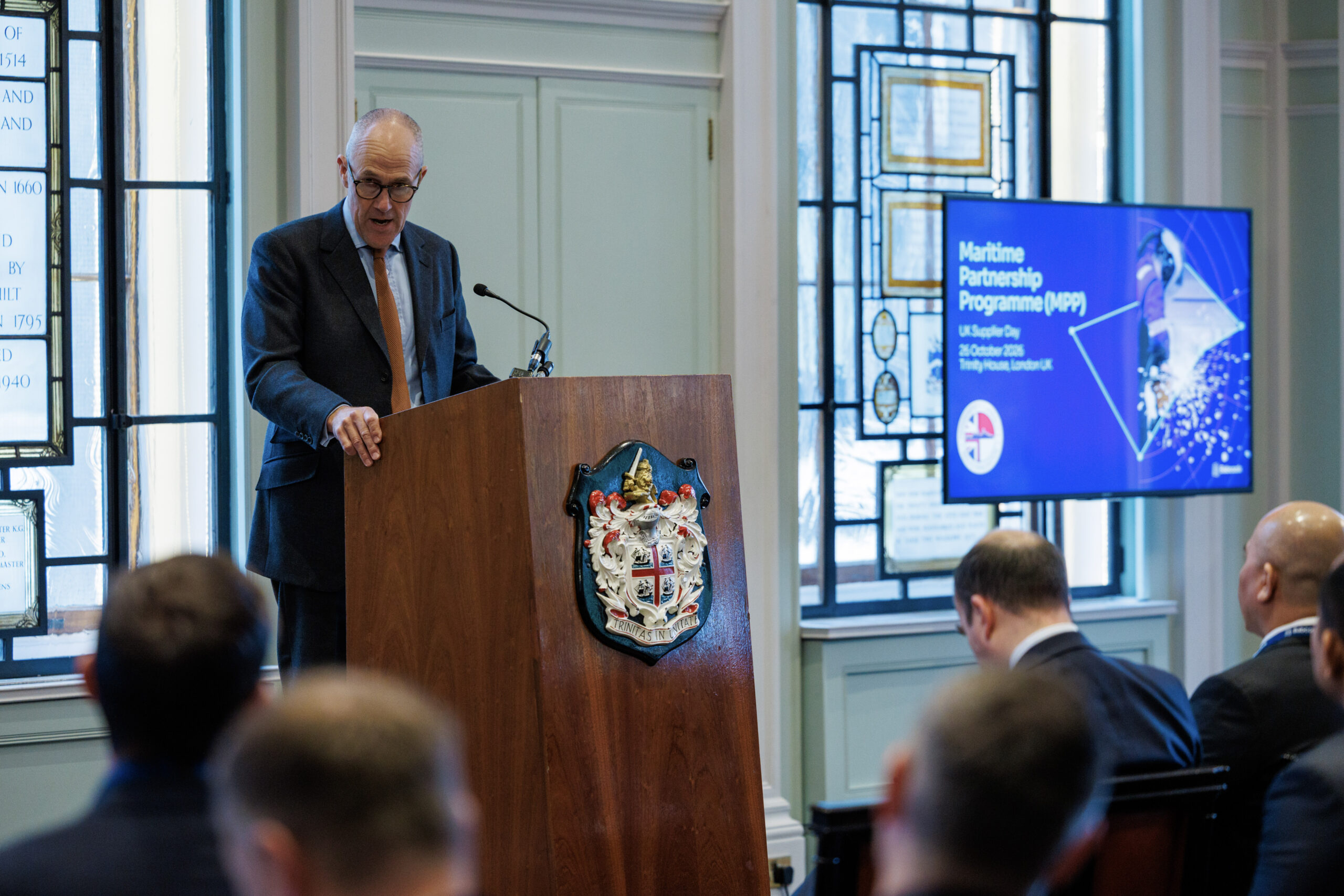
IN Brief:
- Babcock held a UK–Indonesia Supplier Day in London involving industry and government representatives.
- The £4bn Maritime Partnership Programme includes shipbuilding, maritime technology and workforce development.
- Existing Arrowhead 140 licences and April agreements provide the basis for future supplier opportunities.
Babcock International Group has convened British suppliers, industry partners and Indonesian and UK government representatives in London to examine work opportunities associated with Indonesia’s £4 billion Maritime Partnership Programme (MPP). The UK–Indonesia Supplier Day brought shipbuilding, naval engineering, technology and skills organisations into the programme’s supply-chain discussions. No new vessel order, supplier contract or additional funding was announced at the event.
Babcock is the programme’s lead industrial partner, supporting plans to develop maritime capability, domestic shipbuilding capacity and the Indonesian workforce. The company is seeking participation from British businesses while building industrial capabilities within Indonesia. Group chief executive Harry Holt delivered a keynote address at the London event, which also involved representatives from academia and both governments.
The supplier discussions follow Babcock’s January agreement for two further Arrowhead 140 frigate design licences. They supplement two licences originally exported in 2021, which underpin Indonesia’s Merah Putih frigate programme. The latest licence agreement sits within a maritime partnership announced in November 2025; those earlier commitments provide the contractual background to the supplier day but were not newly awarded in London.
An export design licence can provide the basis for domestic construction while leaving substantial industrial decisions with the buying country. Shipyards must prepare production engineering, steel fabrication, block assembly, outfitting, propulsion integration, electrical installations and test procedures around the chosen vessel design. The transfer of a reference design does not on its own establish how every system will be procured, which companies will supply equipment or how the finished vessel will be supported.
Indonesia’s ambitions extend beyond individual frigates to the domestic skills and industrial infrastructure needed to build and sustain maritime assets. Babcock formally launched the partnership in Jakarta in April 2026 with Indonesian organisations, the British Embassy and business representatives. That event produced four memoranda of understanding spanning naval and maritime technology, shipbuilding cooperation, university research and student scholarships. These were cooperation frameworks, not evidence of completed production or signed supply orders.
One of the April agreements brought Babcock together with PT Len Industri to explore naval technology development, including possible use of DEFEND ID facilities. A separate memorandum with PT Citra Shipyard addressed shipbuilding, technology transfer, training and supply-chain cooperation. Both provide potential industrial routes into Indonesian production and support work, but their precise future scopes remain dependent on the projects and commercial agreements that follow.
The education agreements provide a parallel route to developing specialist maritime skills. Babcock committed to funding 30 Chevening Scholarships for Indonesian students over three years. A six-university consortium brings together Newcastle University, the universities of Strathclyde, Edinburgh and Glasgow, Universitas Indonesia, and Institut Teknologi Sepuluh Nopember. Its proposed work spans education, research and innovation, although the partners have not quantified shipyard training placements or engineering qualifications already delivered under the arrangement.
Supply-chain participation will require companies to meet the demands of defence and maritime work, including controlled specifications, documented quality assurance, reliable delivery and compliance with relevant security and export requirements. A supplier meeting can introduce capability and identify potential partners, but entry into a defence programme still depends on qualification, bidding and the award of individual work packages. Babcock has not disclosed any supplier contracts arising specifically from the London event.
Babcock has also established an SME Engagement Charter intended to simplify access to its defence supply chains, and has held supplier engagement events in New Zealand, Australia and the UK. Such mechanisms can help smaller engineering companies identify the relevant commercial contacts and technical requirements. They do not substitute for supplier qualification or for individual contracts defining specifications, delivery responsibilities and any required technology transfer.
The partnership has a civilian maritime dimension alongside naval defence. Its scope includes fisheries infrastructure and maritime economic development, which create different procurement and engineering requirements from combat ships. Facilities, workforce development and local supplier qualifications may therefore be useful across several maritime sectors, although suppliers cannot assume that participation in one automatically provides access to another.
Holt linked the programme’s industrial ambitions to skills, technology transfer and long-term partnerships across both countries. The announced agreements now cover frigate design licences, technology and shipbuilding cooperation, scholarships and university collaboration. Work for suppliers attending the London event will depend on which projects are developed into defined procurement packages, and on the subsequent decisions made by Babcock and Indonesian customers.