IN Brief:
- Lockheed Martin has delivered initial safety-test articles supporting qualification of its QuadStar Next-Generation Short-Range Interceptor.
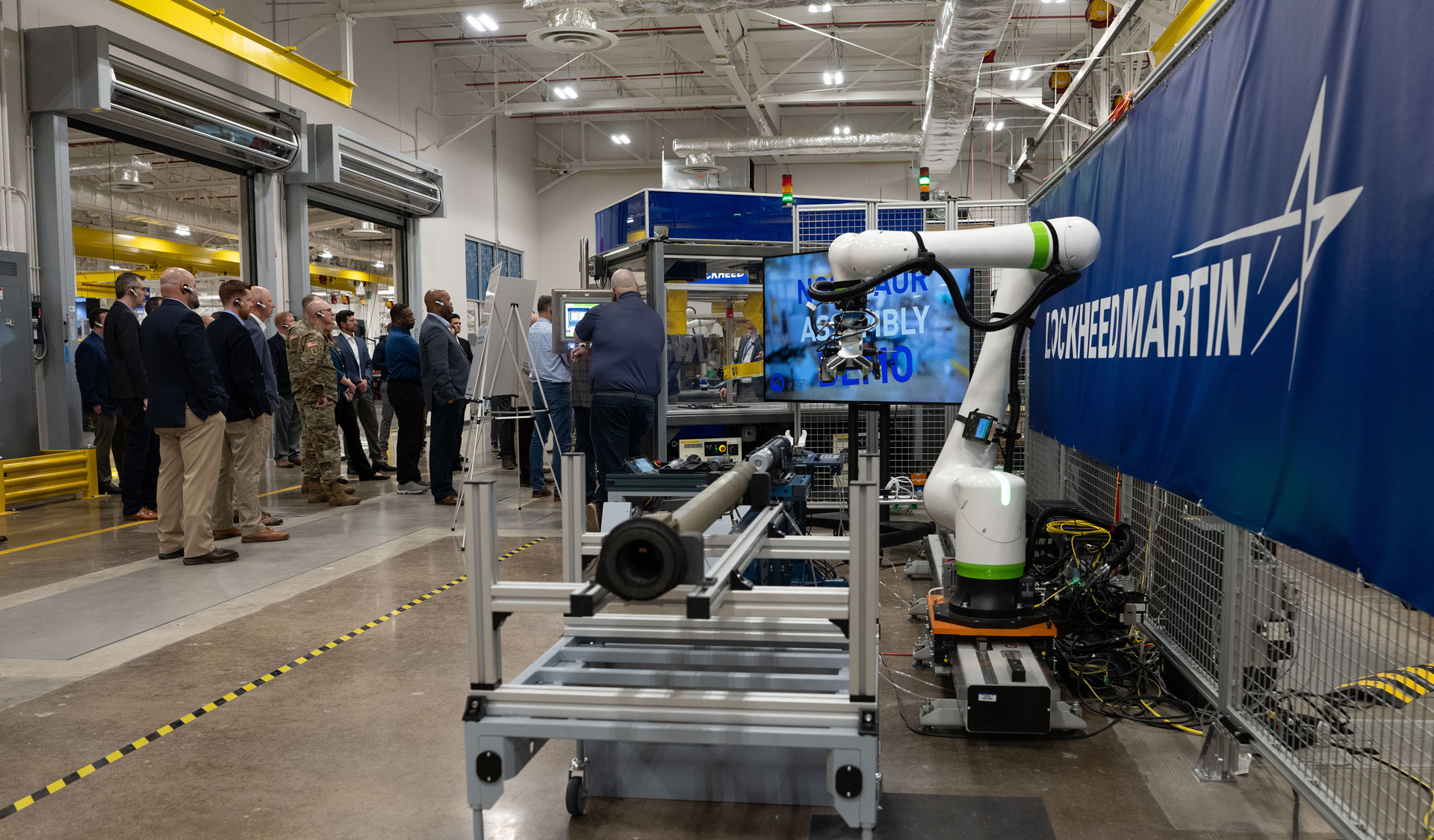
- A dedicated automation cell at Camden, Arkansas, provides production data used to refine manufacturing processes and a digital twin of the assembly operation.
- Dedicated tooling and additional component suppliers are intended to support future QuadStar production without interrupting existing missile programmes.
Lockheed Martin has delivered initial safety-test articles for its QuadStar interceptor and established an automated manufacturing cell at its Camden, Arkansas, facility. The developments support qualification and production preparation for the company’s Next-Generation Short-Range Interceptor (NGSRI), which is being developed as a potential replacement for the US Army’s Stinger missile.
The manufacturing work was detailed on 2 November following an automation demonstration and deliveries associated with the programme’s qualification phase. Lockheed Martin is developing production equipment and processes alongside its interceptor hardware, allowing information obtained during initial manufacturing activity to inform subsequent engineering and assembly arrangements.
QuadStar is Lockheed Martin’s proposed interceptor for the Army’s next-generation short-range air defence requirement. The programme is intended to provide a successor to the FIM-92 Stinger, with competing designs progressing through development and evaluation. The recent safety-test articles support that process while providing manufactured hardware for examining the production system.
Building qualification hardware requires the components and assemblies to conform to controlled configurations. Engineering drawings, manufacturing instructions, inspection requirements, and test records connect each article to the design being evaluated. The resulting hardware can then be used in the prescribed qualification activities, with findings feeding into further engineering work.
Lockheed Martin has introduced a dedicated automation cell alongside its NGSRI final assembly activity. The equipment operates in parallel with tactical hardware builds, collecting information about manufacturing operations and providing feedback to engineers. This approach allows the production process to be examined and refined while development hardware is still being manufactured.
The automation cell contributes to a digital twin of the QuadStar assembly process. Manufacturing data is used to represent operations within a digital environment, allowing engineers to examine process behaviour, production sequences, and the potential effects of changes before those changes are applied more widely.
Connecting the digital model with physical manufacturing activity requires accurate information about the equipment and operations involved. The sequence in which components are handled, positioned, assembled, and inspected determines how work progresses through the production line. Measurements and process records provide a basis for assessing whether individual operations can be simplified or reorganised.
Component alignment and manufacturing tolerances influence the consistency of finished assemblies. Where parts require adjustment or correction during manufacture, that work can interrupt the planned process and increase the time needed to complete a unit. Changes to tooling, component design, or assembly methods can reduce recurring problems when the revised process continues to satisfy the required engineering specification.
Lockheed Martin reports that its manufacturing work has identified bottlenecks and reduced rework and labour requirements during early builds. The company also states that its approach has shortened the first-unit manufacturing flow to nearly half the duration associated with its traditional process. Those results concern the production methods being developed for QuadStar rather than a completed full-rate manufacturing programme.
The Camden facility provides an established industrial setting for the work. Lockheed Martin manufactures equipment associated with Patriot Advanced Capability-3 Missile Segment Enhancement (PAC-3 MSE) and Guided Multiple Launch Rocket System (GMLRS) programmes, giving the site experience in complex missile production and the manufacturing controls required for defence equipment.
Experience from those programmes informs the approach being developed for NGSRI, including how suppliers, engineers, and production personnel coordinate the introduction of components. The company is placing particular emphasis on producibility, examining whether new parts can be manufactured and assembled consistently before they become established elements of the production process.
Missile manufacturing involves specialised components and tightly controlled assembly operations. Guidance electronics, mechanical structures, propulsion equipment, and supporting assemblies must be produced to the appropriate specifications, with inspection and testing used to establish whether they meet the required configuration. The production sequence also has to accommodate the safe handling of equipment subject to particular manufacturing restrictions.
Lockheed Martin is preparing dedicated NGSRI tooling, fixtures, and supplier arrangements rather than depending entirely on production resources shared with its existing missile programmes. That separation is intended to allow additional QuadStar manufacturing activity to develop without interfering with the output of PAC-3 MSE, GMLRS, or other established products at Camden.
The supply chain is also being expanded through the introduction of additional component manufacturers. Lockheed Martin is developing dual-source arrangements for selected interceptor parts, giving the programme access to more than one potential supplier where those arrangements can be qualified. The approach is intended to increase manufacturing flexibility and reduce dependence on a single source for particular components.
Adding suppliers requires coordination of design information, manufacturing processes, component inspection, and acceptance requirements. Parts produced by different companies must meet the same applicable specifications so that the completed interceptor remains consistent with its approved configuration. Supplier development is consequently proceeding alongside the internal manufacturing work.
The digital production model provides another means of evaluating how these arrangements may affect output. Changes to assembly sequences, equipment availability, or component supply can be assessed against the developing manufacturing process, helping engineers identify constraints before larger production volumes are required.
The production preparations follow earlier QuadStar flight testing. Lockheed Martin conducted an initial NGSRI flight test at White Sands Missile Range in January 2026 and a subsequent seeker-characterisation flight in May. Those activities contributed to evaluation of the interceptor and its subsystems, while the recent Camden work concentrates on qualification hardware and the industrial processes supporting future manufacture.
Qualification and manufacturing development remain separate but connected parts of the programme. Testing will continue to examine whether the interceptor satisfies its technical requirements, while the manufacturing organisation develops the processes needed to produce consistent hardware. Design changes arising from testing may require corresponding adjustments to tooling, assembly procedures, or component specifications.
The delivery of safety-test articles establishes a further hardware milestone within NGSRI, while the automation cell and supplier expansion prepare the programme for potential higher-volume production. Lockheed Martin’s Camden operation will continue developing those capabilities as QuadStar progresses through the Army’s interceptor evaluation and procurement process.