IN Brief:
- Saab's CB90 CX introduces three configurations for ISR, anti-ship warfare, and short-range air defence.
- The 18-metre vessel integrates Autonomous Ocean Core technology, with options including Sea Giraffe 1X radar, MARTE ER missiles, and a SeaSnake 30 cannon.
- Sweden is the launch customer, with production under way alongside the established CB90 NG combat boat family.
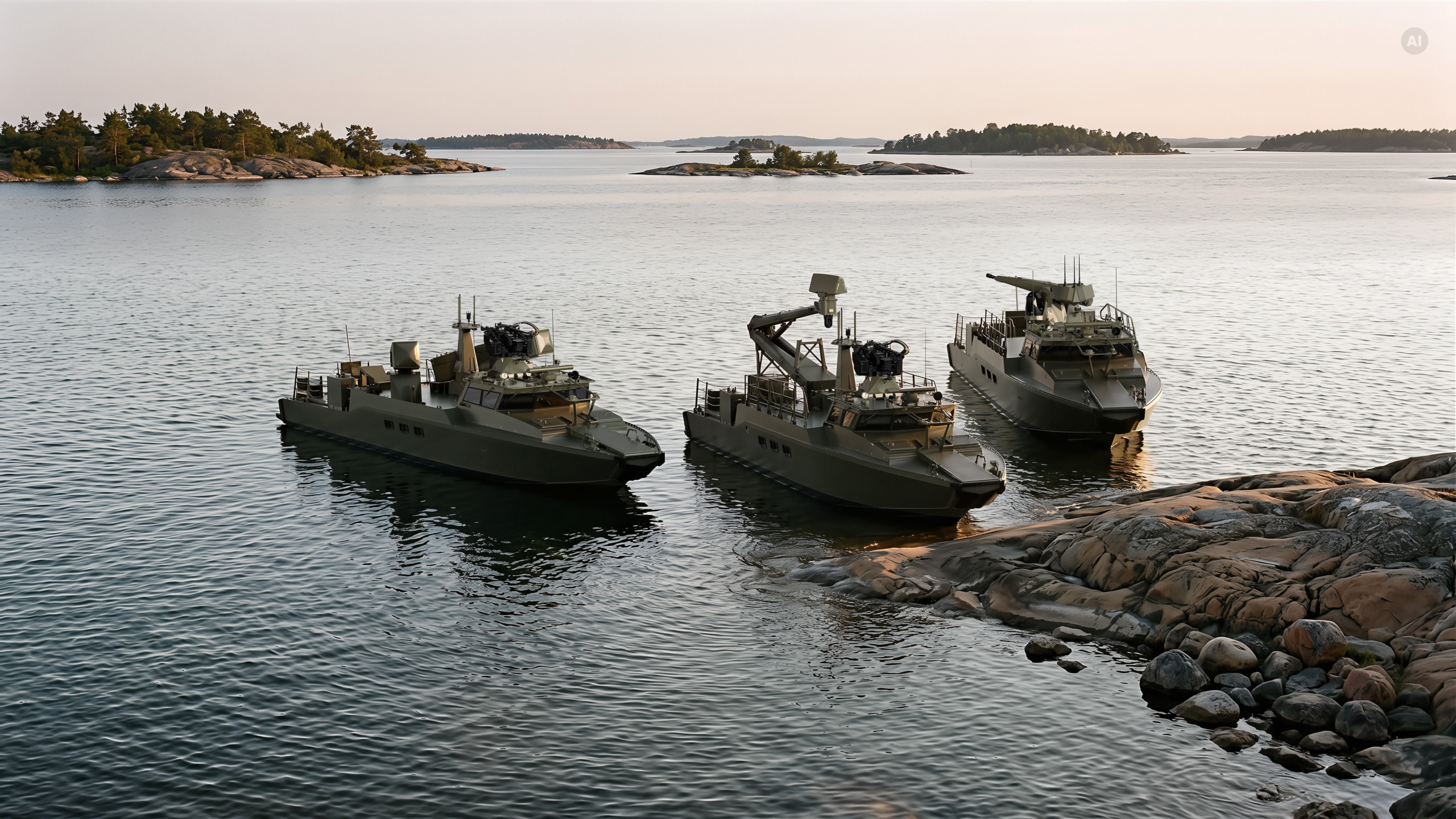
Saab has introduced the Combat Boat 90 Capability X (CB90 CX), an optionally crewed naval platform offered in three mission configurations covering intelligence, surveillance and reconnaissance (ISR), anti-ship warfare, and short-range air defence. The vessel incorporates the company’s Autonomous Ocean Core technology and updated onboard infrastructure, extending the established CB90 family into a broader range of naval operations.
The new model, introduced on 2 November, is already in production for Sweden as the launch customer. Saab will manufacture CB90 CX alongside the smaller CB90 Next Generation (CB90 NG), retaining the existing combat boat family while adding a larger platform designed to accommodate more extensive sensor, weapon, and mission equipment.
CB90 CX measures 18 metres in length and four metres in beam, with a draught of approximately 1.1 metres. Saab specifies two engines rated at 1,100 horsepower each, giving the vessel a speed exceeding 40 knots. The design supports operation with between zero and ten personnel aboard, allowing its operating arrangement to be adapted to the selected mission.
The larger hull creates additional capacity for equipment that would be difficult to accommodate on a smaller combat boat. Radar installations, missile launchers, weapon stations, communications systems, and autonomous control equipment all place demands on available space, electrical power, structural support, and weight distribution. Saab has developed the new vessel infrastructure to support these configurations while retaining the high-speed characteristics of the CB90 family.
Autonomous Ocean Core provides the technology foundation for optionally crewed operation. The system is intended to support naval missions conducted with personnel aboard or through uncrewed operation, depending on the required configuration. Navigation, vessel control, communications, and onboard monitoring must be integrated so that the boat can perform the functions associated with its selected mode of operation.
Operating without an embarked crew changes the demands placed on the vessel’s control systems. Functions normally supervised directly by personnel aboard the boat require suitable monitoring and control arrangements, while communications support coordination with other platforms and command authorities. The autonomous architecture must operate alongside the installed sensors and mission equipment rather than as a separate system.
The first CB90 CX configuration concentrates on surveillance and the coordination of sensor information. It incorporates Saab’s Sea Giraffe 1X radar and a Trackfire remote weapon station, combining radar coverage with electro-optical observation and stabilised weapon control. The arrangement is intended to support the detection, tracking, and classification of airborne and surface contacts.
Sea Giraffe 1X provides continuous 360-degree surveillance with a stated technical range exceeding 100 kilometres. The radar is designed to monitor different types of targets, including unmanned aircraft, small vessels, and fast-moving airborne threats. Detection performance depends on the characteristics of the target and the operating environment, while the radar’s installation determines the coverage available from the vessel.
The Trackfire remote weapon station adds electro-optical sensors, stabilisation, and integrated fire control. Combining information from the radar and optical equipment allows the system to support target observation and tracking through complementary sensing methods. The equipment also gives the surveillance configuration an engagement capability suited to its installed weapon arrangement.
Information collected by the vessel can be shared with other compatible platforms, allowing individual sensors to contribute to a wider operating picture. This creates opportunities for dispersed boats to coordinate their surveillance activities and exchange target information. Communications performance and the quality of the underlying sensor data determine how effectively information can be distributed between participating systems.
The second configuration adds an anti-ship warfare capability based on MBDA’s MARTE ER missile. Saab specifies a surface engagement range exceeding 100 kilometres, providing the vessel with an over-the-horizon strike option. The missile uses active radar guidance and is designed to approach its target at low altitude over the sea.
Engagement beyond the vessel’s own radar horizon requires target information from external sensors. Those observations can be supplied by other platforms participating in the wider surveillance and command network, allowing the missile system to receive information about targets outside the boat’s immediate detection range. The missile’s guidance equipment then supports the engagement after launch.
Integrating the missile system involves more than accommodating its launch equipment on the hull. Structural loads, electrical connections, safety requirements, and communications interfaces must be incorporated into the vessel’s design. The installation must also operate within the boat’s stability and handling limits, with missile equipment and supporting systems forming part of the overall platform configuration.
The third CB90 CX variant provides short-range air defence using Rheinmetall’s SeaSnake 30 remote-controlled weapon station. Its stabilised 30mm automatic cannon is supported by electro-optical and infrared sensors, integrated fire control, and programmable airburst ammunition. Saab identifies unmanned aircraft, helicopters, and loitering munitions among the intended targets, alongside selected surface and land threats.
Programmable airburst ammunition allows the weapon system to control the point at which a projectile’s effect is initiated. This provides an engagement method suited to certain small or moving targets, with the fire-control system responsible for coordinating the available target information and weapon operation. Stabilisation supports accurate pointing despite vessel movement caused by waves or manoeuvring.
The three configurations place different demands on a common vessel architecture. Surveillance equipment requires sensor coverage and processing capacity, the anti-ship installation adds missile handling and external targeting interfaces, and the air defence variant combines stabilised gun equipment with its associated sensors and ammunition systems. The common platform provides an industrial basis for developing these different mission configurations.
Saab’s Docksta business manufactures the CB90 family, which is already operated by nine navies across several regions. The existing fleet provides experience in combat boat production, maintenance, and operation, while the new CX model adds greater payload capacity and updated control systems to the product range.
Introducing CB90 CX alongside CB90 NG allows the manufacturer to continue supplying the established smaller vessel while developing the larger variant for customers requiring additional combat equipment. Manufacturing will involve different integration and acceptance activities according to the selected mission configuration, with sensors, weapons, propulsion, and control systems requiring coordinated testing.
Sweden’s production programme establishes the first industrial application of CB90 CX. The vessel combines high-speed combat boat characteristics with optionally crewed operation and three defined mission configurations, providing Saab with a new platform for naval surveillance, surface strike, and short-range air defence requirements.