IN Brief:
- France's DGA has published a procurement award notice identifying MBDA France as the supplier under a seven-year VL MICA framework.
- The agreement covers surface-to-air missile systems, MICA ammunition, and associated services for France and eligible partner states.
- Its €5bn maximum represents contractual capacity rather than confirmed expenditure, with the contractor selection dating to December 2025.
France’s Direction générale de l’armement (DGA) has published details of a seven-year procurement framework awarded to MBDA France for VL MICA air defence systems, MICA missile ammunition, and associated services. The agreement covers requirements from the French armed forces and partner states, including countries outside the European Union, with a maximum framework value of €5 billion.
The award notice appeared in the Official Journal of the European Union on 2 November under reference 759026-2026. MBDA France was selected as contractor on 2 December 2025, making the publication of the award record the latest documented development. The €5 billion figure represents the maximum value available under the framework, rather than a newly placed order of that amount.
The agreement establishes a procurement structure through which the DGA can obtain complete VL MICA systems, missile ammunition, and related services. Its stated scope also provides for the requirements of eligible government partners, allowing the contractual arrangement to support more than one national customer. Individual orders and associated programme decisions will determine the equipment and services ultimately supplied.
The procurement record identifies an 84-month duration, equivalent to seven years. It also records the use of a negotiated arrangement justified by technical circumstances involving a particular economic operator. MBDA France is named as the selected contractor, with the notice establishing a common contractual basis for the covered products and services.
VL MICA is MBDA’s vertically launched surface-to-air missile system, developed from the MICA air-to-air missile family. Its ground-based configuration combines missile launchers with radar, command-and-control equipment, and the communications required to coordinate engagements. The system is designed to protect military units and fixed installations against airborne threats, using sensors to provide target information before a missile is launched.
The established VL MICA family uses missiles with infrared or active radar seekers. Infrared guidance detects the thermal characteristics of a target, while active radar guidance uses radio-frequency measurements to support target tracking. The alternative seeker configurations provide different methods of acquiring and following an airborne target, with their effectiveness determined by the operating conditions and the characteristics of the threat.
A ground-based engagement begins with surveillance equipment detecting and tracking an object of interest. The command system processes the available information and determines which weapon and launcher can support an authorised engagement. Once the required information has been established, the missile is launched vertically and follows its guidance sequence towards the selected target.
Vertical launching allows a missile to depart its container without the complete launcher first being pointed towards the target. The missile’s subsequent manoeuvring and guidance determine the interception trajectory. This arrangement allows launchers to support engagements approaching from different directions, with the overall response governed by the system’s sensor coverage, command arrangements, and available weapons.
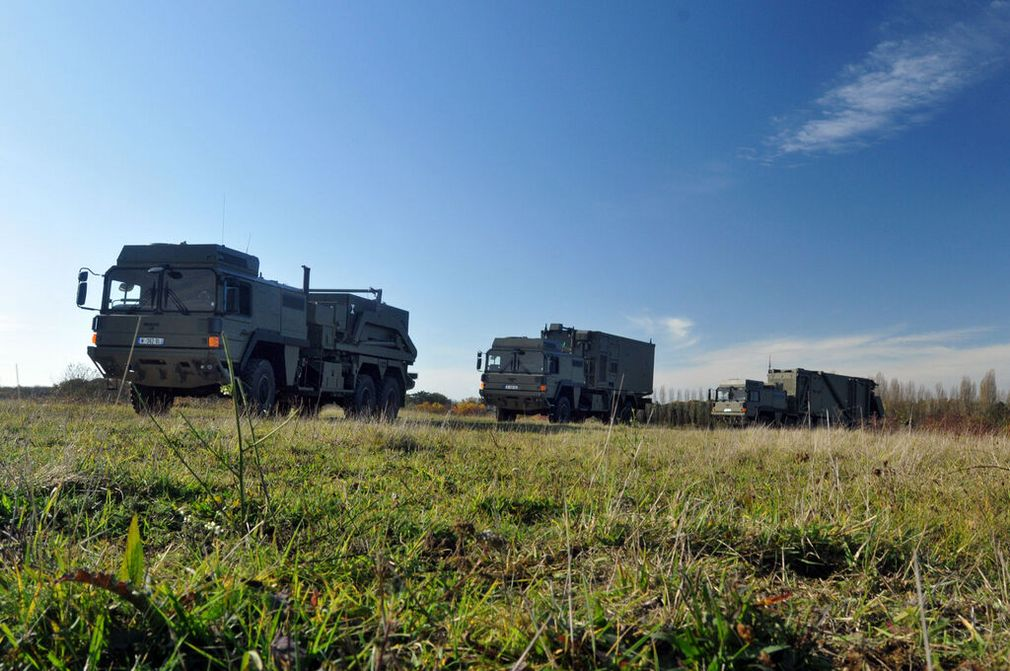
MBDA’s ground-based VL MICA configuration uses a tactical operations centre connected to surveillance radar and multiple launch vehicles. The operations centre provides command and engagement management functions, while the radar supplies information about airborne activity. Communications between these elements allow distributed equipment to operate as a coordinated air defence system.
The installation of separate radar, command, and launcher components creates requirements for electrical power, communications, positioning, and coordination. Each element must exchange the information needed for the system to operate within its approved configuration. Deployment arrangements and the location of the equipment affect the coverage available and the ability to respond to threats across the defended area.
The missile family has also evolved through MBDA’s development of VL MICA NG. The next-generation version introduces updated missile technology, including a dual-pulse rocket motor and revised guidance equipment, intended to improve performance compared with earlier configurations. Changes to the associated ground system are intended to support the newer weapon within the wider air defence architecture.
The published procurement framework covers VL MICA systems, MICA ammunition, and associated services without providing a public breakdown of orders by individual equipment configuration. The notice therefore establishes the contractual scope of the arrangement but does not specify quantities of existing VL MICA missiles, next-generation systems, launchers, or other equipment to be delivered.
The framework sits within France’s broader development of layered ground-based air defence. Separately, OCCAR has contracted Eurosam to develop a configuration integrating VL MICA with the SAMP/T NG system. That work is intended to bring missile types with different engagement characteristics into a coordinated air defence architecture, with modifications to the SAMP/T NG engagement module supporting the integration.
Within such a configuration, missile systems are selected according to the characteristics of the target and the available engagement options. Integrating multiple weapons requires compatible command interfaces, surveillance information, and procedures for assigning targets to suitable effectors. The separate SAMP/T NG development programme addresses those system-integration requirements, while the DGA’s VL MICA framework governs the supply of equipment and services covered by its own contract.
Manufacturing activity under the framework will depend on orders placed for missiles, launchers, associated systems, and support. Missile production involves specialist propulsion, guidance, electronic, and mechanical components, together with assembly, inspection, and qualification procedures. Complete air defence systems also require coordination with suppliers of vehicles, radar equipment, command hardware, communications, and supporting infrastructure.
Long-duration procurement arrangements can accommodate requirements arising over several years, including initial equipment acquisition, additional ammunition, and continuing technical services. Production planning and delivery schedules will depend on the nature of each order, the configuration selected, and the availability of the required equipment and components.
The inclusion of partner states extends the framework’s potential application beyond French national requirements. Equipment supplied to another government would remain subject to the relevant contractual arrangements, technical specifications, and applicable export requirements. The public notice establishes the procurement scope and contractor without identifying a complete list of future purchasing countries or their individual requirements.
The award record confirms MBDA France’s position within the seven-year procurement arrangement and establishes its maximum contractual value. The actual industrial workload will be determined by orders placed during the framework period, with subsequent purchasing activity defining equipment quantities, expenditure, production schedules, and delivery milestones.