
IN Brief:
- Elbit Systems has won an approximately $260 million PULS rocket artillery contract from an unnamed European NATO member.
- The modular two-pod launch platform can accommodate different rocket and missile families on wheeled or tracked carriers.
- The five-year agreement covers launchers and munitions; customer identity, quantities and delivery schedule were not disclosed.
Elbit Systems has secured an approximately $260 million agreement to supply Precise and Universal Launching System rocket artillery equipment and munitions to a European NATO member. The five-year contract adds to the Israeli defence manufacturer’s European ground systems business, although neither the customer nor the number of launchers and missiles has been disclosed.
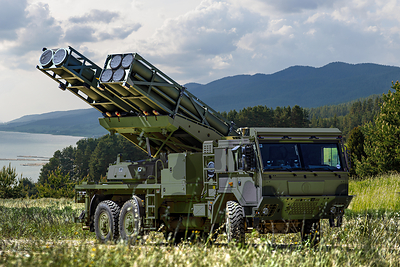
PULS is a modular multiple rocket launcher designed to accommodate several classes of guided and unguided ammunition through interchangeable launch pods. It can be integrated with suitable wheeled or tracked military vehicles rather than requiring every customer to adopt the same dedicated carrier. That approach gives customers options when planning the relationship between their existing vehicle fleets, fire-control equipment and new artillery capability.
Elbit’s standard PULS configuration has two launch pods, each selected for a particular munition family. The company’s published product information describes options including 122mm and 160mm Accular rockets, EXTRA guided rockets and Predator Hawk missiles. Those examples define the launcher family; they do not establish which missiles, pod combinations or warhead types are included in the new NATO order.
The manufacturer’s stated range options extend from approximately 35 kilometres for Accular 122mm to as much as 300 kilometres for Predator Hawk. Accular 160mm and EXTRA are listed at approximately 40 and 150 kilometres respectively. Actual employment depends on the selected weapon, launch platform, mission configuration and applicable operating limits. A headline range figure cannot be assigned to every PULS munition or every customer installation.
Each standard PULS launcher carries two pods, and pod choice determines the number of ready rounds. Elbit lists capacities of 18 Accular 122mm rockets, ten Accular 160mm rockets, four EXTRA weapons, or two Predator Hawk missiles per pod. A formation selecting a longer-range munition therefore carries fewer rounds ready to fire, while resupply arrangements depend on the particular pod and ammunition mix. The company has not identified which combinations this NATO customer ordered.
A launcher integrated onto an existing vehicle needs more than mechanical mounting points. Electrical power, stabilisation, navigation data, communications, firing controls and crew protection must be compatible with the carrier. Weight distribution and vehicle mobility can also restrict what a particular installation can carry. Elbit says PULS is adaptable to existing platforms; it has not identified the vehicle type selected by this customer or announced its final qualification status.
Fire-control integration connects rocket artillery to target information and the unit’s command structure. The equipment has to receive usable coordinates and mission instructions, verify the selected ammunition, and manage the launch sequence in accordance with the operator’s procedures. A modular launcher offers several types of effect from one platform, but interoperability with national command systems is a separate integration and testing requirement.
Elbit lists execution of a typical firing mission in less than one minute from initiation. That is a manufacturer’s product specification, not a published acceptance result for the newly ordered equipment. Actual response time depends on target information, communications, command authority, launcher status, and availability of the required ammunition; no customer-specific test result accompanied the November award.
The agreement runs for five years, allowing time for manufacture, delivery, and integration of launchers and munitions, but Elbit has not disclosed an annual production schedule or first delivery date. The headline value is not divided between launch systems, individual munition types, training, or support. Nor has the company announced any local manufacturing participation under this particular contract.
Training and sustainment can vary substantially between customer configurations. Crews must understand the fire-control interface and handling procedures for each rocket family, while maintainers need compatible diagnostic equipment, spares and documentation. If the launcher is mounted on an established national vehicle fleet, some carrier support infrastructure may be retained, though any savings would depend on the actual integration design and supplier agreement.
European investment in long-range fires places requirements on both launcher production and replenishment of ammunition inventories. Guided rockets bring separate manufacturing dependencies involving propulsion materials, precision components, and electronic controls, which may constrain the number of usable rounds even when launch vehicles are available. This contract establishes an additional five-year supply commitment without specifying stockpile quantities or anticipated consumption rates.
Manufacturing complexity extends beyond the vehicle and launcher. Guided rocket production involves propulsion materials, flight-control electronics, sensors where fitted, structural components and verification procedures, with distinct safety and quality requirements for the munition and its packaging. Launchers and ammunition are normally subject to separate acceptance and storage arrangements; the supplier’s announcement does not disclose how these stages are scheduled under the agreement.
Elbit president and chief executive Bezhalel Machlis attributed the award to continuing European demand for PULS. The company has not named the purchasing country, announced the carrier vehicle selected, or confirmed domestic production involvement. Its general description of the launcher family therefore cannot establish the exact equipment configuration that will be delivered under the contract.
The $260 million agreement commits Elbit to supply artillery launchers and munitions over five years, while the customer’s identity, the number of systems, and delivery milestones remain undisclosed. Those details will determine the scale of manufacture and support work associated with this particular order; none can yet be inferred from the published contract value.
