IN Brief:
- Allen Control Systems is creating a dedicated directed-energy business led by two former US Army Space and Missile Defense Command personnel.
- The company lists a future Bullfrog 3kW laser and a dual-band dazzler alongside currently available machine-gun configurations.
- Technical qualification, target-tracking integration, laser safety, and procurement commitments have not been disclosed for the proposed systems.
US defence equipment manufacturer Allen Control Systems has established a directed-energy division to develop laser countermeasures alongside its existing Bullfrog weapon stations. The company has appointed two former US Army Space and Missile Defense Command personnel to lead the work. Its published development portfolio includes a proposed Bullfrog variant fitted with a 3kW laser and a dual-band dazzler, neither of which has a confirmed production order or operational deployment.
Amanda Clark has been appointed vice president for directed energy, while John Mason has been named programme director for high-energy laser. Their appointments were disclosed on 10 November, with the new organisation following ACS’s expansion of conventional Bullfrog manufacturing. The company has not published an initial contract value, a qualification timetable, or customer acceptance criteria for either laser-related system. Existing Bullfrog M240 and M2 configurations remain separate products built around conventional weapons.
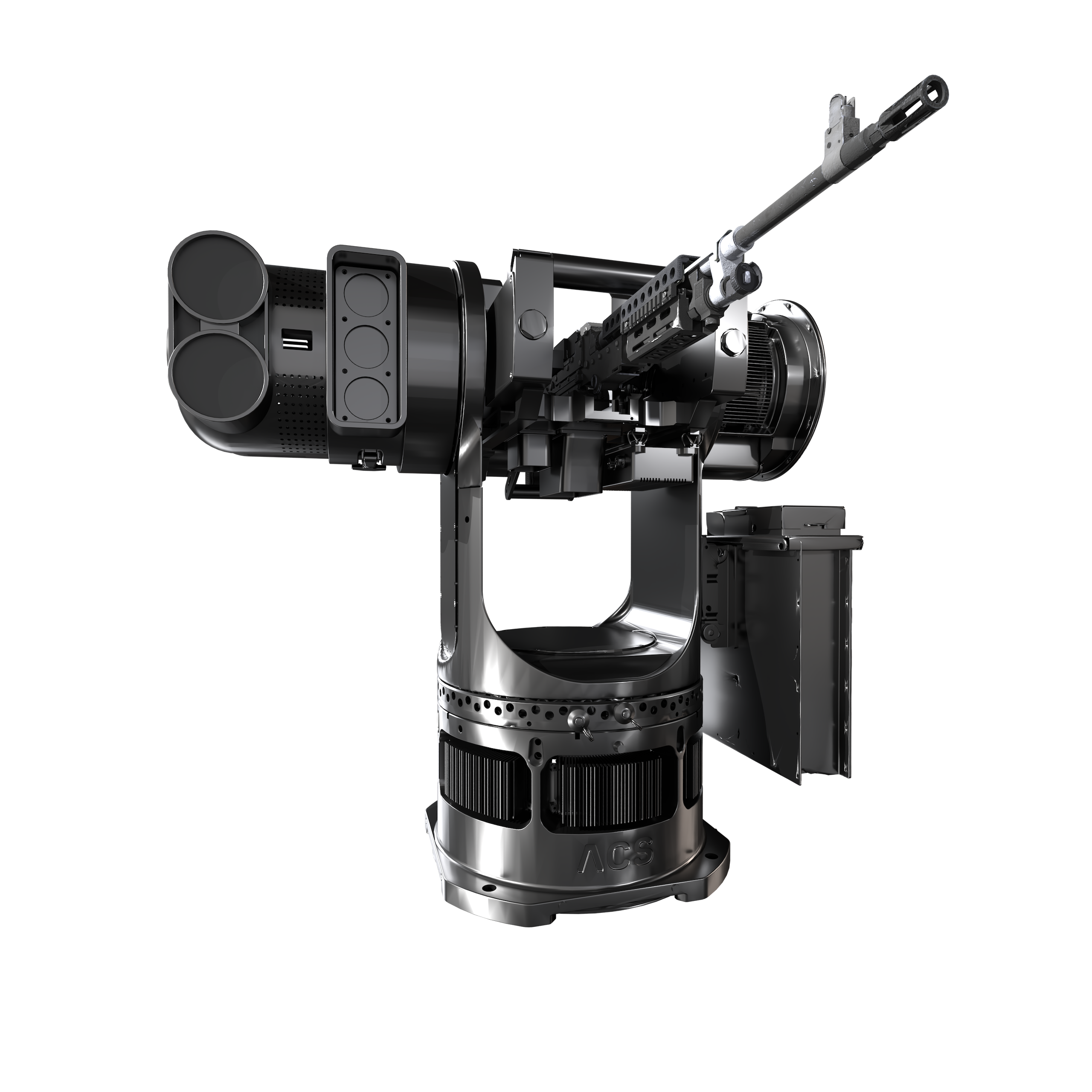
Bullfrog combines sensors, tracking software, and an electronically controlled weapon station to detect and follow airborne threats. ACS describes computer vision and passive electro-optical sensing as part of its existing architecture, with engagement dependent on operator authorisation. The system’s tracking and stabilisation functions provide a potential foundation for alternative effectors, but common software does not mean that a new laser has already passed integration or safety testing.
Adding directed energy would change several aspects of the weapon station while retaining the need for accurate target information. A laser countermeasure requires the system to maintain a controlled beam on a moving object for the period needed to achieve the specified effect. That task depends on stabilised pointing, target tracking, optical alignment, and an understanding of how atmospheric conditions influence transmission between the emitter and its target.
The proposed 3kW figure identifies the laser power class stated in the development portfolio. It does not provide a verified interception range, average time to disable a target, or number of repeated engagements possible under field conditions. Optical output and electrical input power are also different quantities, making cooling and conversion losses important to the final installation. ACS has not published the beam quality, thermal design, measured performance, or power budget for the planned configuration.
A dazzler is a different form of directed-energy countermeasure. Such equipment is intended to interfere with optical sensing, rather than necessarily applying sufficient energy to cause structural failure. Its effectiveness depends on the target’s sensor type and wavelength sensitivity, how the light reaches that sensor, and the particular operating environment. ACS identifies a dual-band dazzler as a future product but has not disclosed wavelengths, tested performance boundaries, or an approval status for this configuration.
Power and heat rejection are central integration constraints. Electrical energy must be supplied to the laser and associated control equipment, and losses from conversion and optical components have to be managed. A vehicle or fixed installation may have sufficient space for additional power electronics and thermal control, while a small autonomous platform can face tighter restrictions on mass, volume, and auxiliary generation. ACS has not identified the power architecture or host platforms for its laser configuration.
Tracking requirements can also differ between kinetic and laser effectors. A gun-based station predicts a target’s movement and positions the weapon to account for projectile flight. A laser installation instead needs continuous line-of-sight control and must account for vibrations, mechanical movement, and changing target orientation throughout an engagement. Existing computer vision and stabilisation can provide a starting point, but a common autonomy stack does not by itself establish that the laser variant has been integrated and tested.
A laser-equipped weapon station would also require safety controls appropriate to the host site, operating authority, and foreseeable exposure of personnel or friendly equipment. Engineering measures can include inhibit functions, controlled operating states, fault monitoring, and mechanisms to prevent unintended illumination. The technical and regulatory arrangements cannot be specified from a product listing alone. ACS has disclosed no qualification record establishing that its 3kW Bullfrog has completed those assessments.
The directed-energy division follows ACS’s September plans to expand its Austin, Texas, manufacturing operations and develop an additional engineering presence in Silicon Valley. Those company-wide facilities are not evidence of a dedicated laser manufacturing line. ACS has not explained whether the new division will manufacture optical sources and thermal equipment itself, source them from specialist suppliers, or limit its work to systems integration and control software.
Combining conventional and directed-energy effectors could give an integrator additional configuration choices within a common sensing and control architecture. Each option nevertheless involves separate manufacturing, environmental testing, maintenance, and acceptance requirements. Lasers require optical alignment and thermal management procedures that are different from those associated with ammunition handling and a machine-gun mechanism, even if elements of the targeting software are shared.
Before either proposed laser product can enter service, ACS would need to demonstrate a representative installation, complete the relevant safety and environmental tests, and establish accepted performance against specified threats. Its immediate confirmed step is organisational: a specialist division with named leadership and two laser-related configurations identified for development. Contracted quantities, integration partners, and a timetable for operational delivery have not been made public.