IN Brief:
- A 10 November presolicitation sets out a possible multiple-award IDIQ competition for AN/SPY-6(V) radar work covering fiscal years 2027–2036.
- Potential tasks encompass development, prototyping, fabrication, testing, integration, maintenance, and support across multiple SPY-6 variants.
- The notice is not an award or funding commitment, and a formal solicitation may follow later if the Navy proceeds.
The US Navy has moved its planned AN/SPY-6(V) radar procurement into a presolicitation phase for hardware, production, and sustainment work spanning fiscal years 2027 to 2036. A notice posted on 10 November describes a proposed competitive, multiple-award indefinite-delivery, indefinite-quantity contract covering development, fabrication, integration, testing, maintenance, and support for several variants of the naval radar family.
The notice, N61750-27-R-1402, follows earlier sources-sought activity and describes a possible future solicitation, not a contract award. The Navy explicitly states that it has not committed to issue a solicitation or reimburse respondents for preparing information. No ceiling value, winning supplier, quantity of radar modules, or newly funded production order is given. This distinction is necessary because Raytheon already has SPY-6 manufacturing and sustainment awards under separate arrangements.
The proposed contract route is intended to support current and future AN/SPY-6(V) systems, with scope extending across design, development, prototyping, production, integration, testing, and sustainment. The shift from sources-sought activity to presolicitation supplies more detail about the Navy’s intended competition, but it does not determine which tasks will be competed, their timing, or how work would be divided among successful contractors. Those details depend on the terms of a final request for proposals and subsequent funded orders.
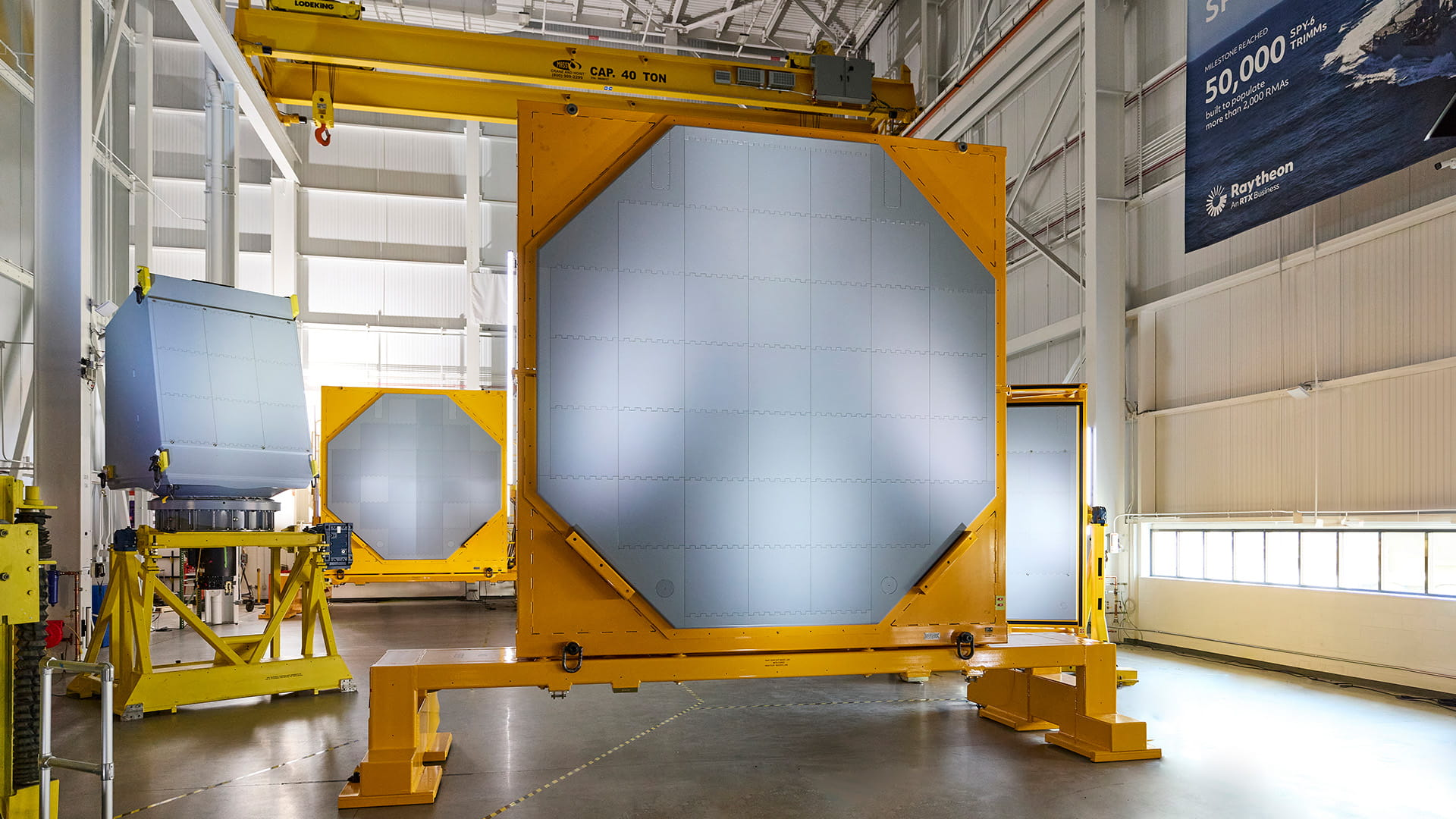
SPY-6 is a family of active electronically scanned array radars intended to support naval air and missile defence. Rather than one fixed-size antenna suitable for every warship, the architecture uses radar modular assemblies that can be combined into differently sized arrays. The manufacturer, Raytheon, describes each assembly as a self-contained radar building block, providing a common hardware basis for variants used by destroyers, aircraft carriers, and amphibious vessels.
Modular radar construction has consequences for both manufacturing and fleet integration. Common assemblies can support repeatable production and testing processes while different array sizes meet varying space, power, cooling, and combat-system requirements. Nevertheless, assembling a radar from shared modules does not remove the qualification work needed for each ship installation. Mechanical interfaces, electrical distribution, electromagnetic compatibility, and the ship’s combat-system software must all be verified in the intended configuration.
The SPY-6(V)1 is designed for Flight III Arleigh Burke-class destroyers and uses four fixed arrays, each with 37 radar modular assemblies. The SPY-6(V)4 configuration is intended for the older Flight IIA destroyers undergoing modernisation and uses four arrays with 24 assemblies apiece. Other members of the family use rotating or fixed-face configurations for carriers and amphibious ships. These differences mean the Navy’s stated ten-year horizon could involve several distinct production and support streams rather than one uniform hardware order.
A radar upgrade also affects the vessel surrounding it. Electrical generation and distribution systems must support the equipment’s operational demand, while cooling arrangements remove heat from electronic modules. Changes to antenna installation can affect structural loads and maintenance access. On an existing destroyer, these constraints must be resolved within a hull designed before the newer radar became available, whereas a newly built ship can incorporate more of the necessary infrastructure during construction.
Raytheon’s current SPY-6 manufacturing programme already includes vertically integrated production processes at its Andover facility. The company has described automated assembly, calibration, and testing of radar electronics, along with substantial investment in production infrastructure. Those facilities are relevant industrial context, but the 10 November presolicitation does not award Raytheon another production quantity or instruct it to expand a particular factory. Future competition rules and contractor responsibilities remain to be determined.
The prospective framework also sits alongside existing funded production. Raytheon reported a $1.8 billion hardware production and sustainment award in July 2026, and IN Defence has previously covered SPY-6 manufacturing arrangements extending into 2031. Neither amount can be added to the newly described procurement as though it were fresh contracted expenditure. The 10 November notice instead sets out an acquisition route with a longer fiscal-year horizon and potentially broader competition.
The presolicitation refers suppliers to previously issued sources-sought notices, draft solicitation materials, and unclassified government-furnished information. Responses are indicated by 24 November 2026. Before any proposal can result in an award, the Navy must establish final technical requirements, evaluation rules, contractual terms, and funding arrangements. Suppliers may also need to show that their manufacturing, testing, cyber, security, and support processes meet the requirements of particular radar components or installations.
Sustainment can represent a substantial portion of the lifecycle workload for complex radar systems. Replaceable electronic modules, software updates, diagnostic tools, spares, configuration records, and field-support services all have to remain available as ships and radar variants evolve. A long procurement horizon can help the customer organise that work, but it does not guarantee a specific annual demand profile or exclusive production rights to any particular supplier.
The next formal procurement milestone would be an issued solicitation specifying the competition, followed by evaluation and funded awards if the Navy proceeds. Until those decisions are made, the 10 November change is an acquisition-planning development, not evidence that the number of SPY-6 systems ordered or Raytheon’s production backlog has increased.