IN Brief:
- Boeing’s MQ-28 completed three autonomous operational flight tests from Naval Base Ventura County, Point Mugu.
- The flights demonstrated deployment and sustained operation from an allied location outside Australia.
- The aircraft’s future will depend on autonomy integration, payload flexibility, export controls, and repeatable production discipline.
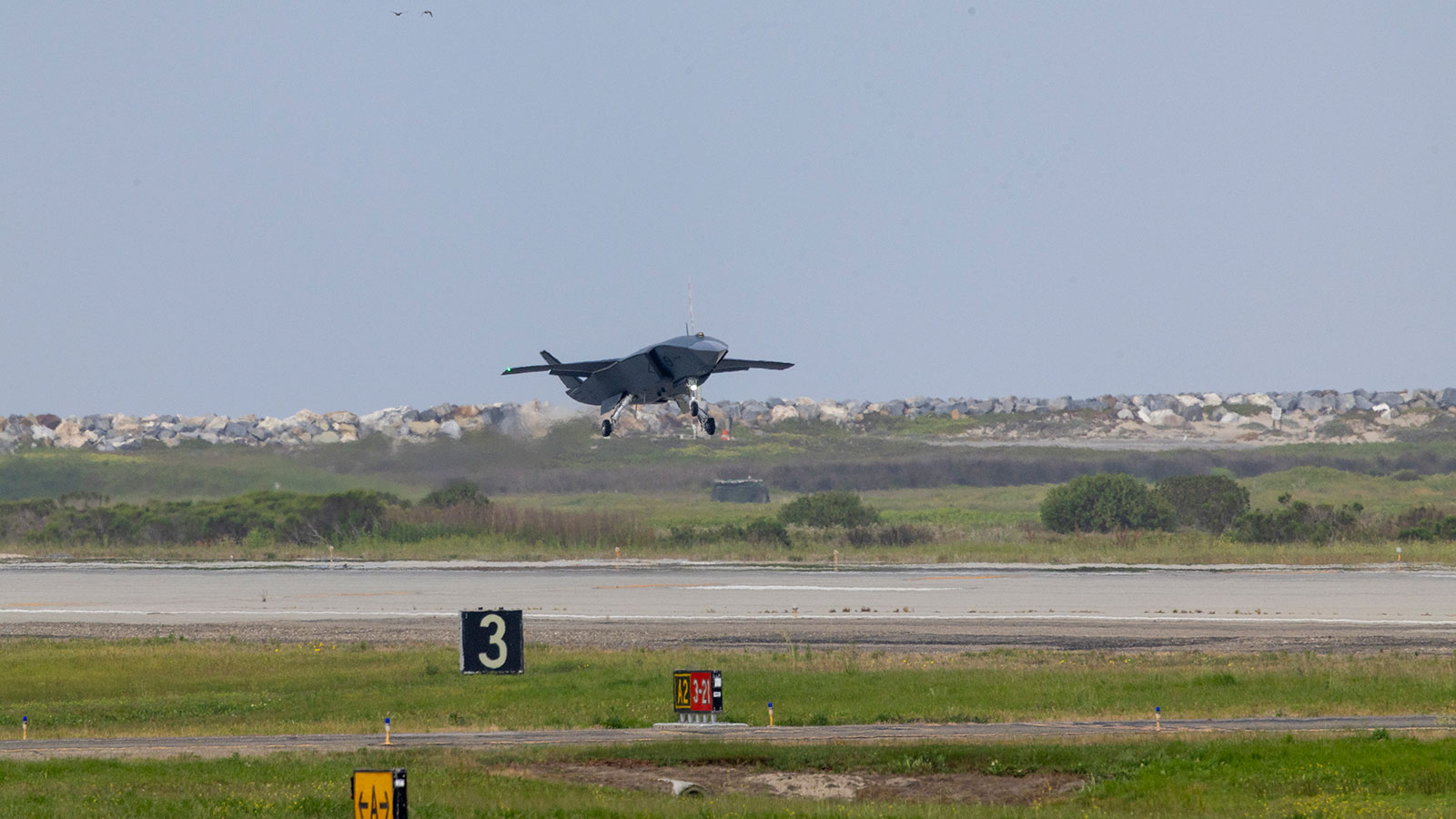
Boeing’s MQ-28 has completed three autonomous operational flight tests from Naval Base Ventura County, Point Mugu, marking the Australia-developed aircraft’s first international operation in allied airspace.
The flights over the Point Mugu Sea Range validated autonomous operations, range safety procedures, deployment processes, and sustained test activity from a location outside Australia. Developed by Boeing Australia with the Royal Australian Air Force, the MQ-28 is designed as a modular uncrewed aircraft able to operate alongside crewed platforms while carrying customer-specific payloads.
For an autonomous combat aircraft, overseas test activity is more than a flight demonstration. It shows whether the aircraft, ground systems, software, maintenance package, logistics equipment, and operating procedures can move into another allied environment and still function within local range, regulatory, and safety constraints. That becomes central to exportability, especially as allied air forces look for collaborative combat aircraft that can be integrated into existing fleets without forcing a complete redesign of doctrine, infrastructure, or support systems.
The MQ-28 sits in a market that is changing quickly. Collaborative combat aircraft are no longer judged only on whether they can fly useful profiles. Air forces now need to understand whether they can be manufactured at scale, adapted for national payloads, updated safely, supported from dispersed bases, and kept affordable enough to deliver force mass. A technically impressive aircraft that cannot be produced or integrated efficiently will struggle to meet the role being asked of it.
The F-35 and MQ-20 CCA integration trial showed how crewed-uncrewed teaming is moving into the cockpit, software, and mission-systems layer. The MQ-28 flights add a different part of the picture: how a collaborative aircraft developed by one ally can begin to operate from another’s test infrastructure. That is where autonomy becomes a product, not simply a national programme.
Manufacturers working in this space face a demanding integration balance. Customers want sovereign payloads, national datalinks, specific mission systems, tailored autonomy behaviours, and control over sensitive data. The production system, however, needs common architectures, disciplined interfaces, and repeatable builds. If every export customer requires extensive redesign, cost and delivery tempo will erode the attraction of the platform.
The MQ-28’s modular pitch depends on those interfaces holding under pressure. Payload bays, cooling systems, onboard processing, electrical power, secure communications, mission-planning tools, autonomy logic, and maintenance diagnostics all need to be flexible without compromising airworthiness or software assurance. That is a manufacturing discipline as much as an engineering preference.
Allied test ranges are also becoming part of the competitive landscape. Autonomous aircraft need airspace, telemetry, chase assets, range safety systems, electronic environments, and regulatory approval pathways. Access to US test infrastructure gives Boeing a useful proving ground, while giving potential customers a clearer view of how the aircraft behaves within US and allied processes. Those processes matter because future combat aircraft will not be assessed in isolation; they will be judged by how well they connect to fighters, command systems, sensors, and weapons already in service.
The export market will not be quiet. The US, Europe, Australia, South Korea, Türkiye, and other suppliers are moving into CCA or CCA-adjacent programmes, often tying aircraft procurement to local production, technology transfer, and sustainment. Indonesia’s Kizilelma procurement plan reflects that wider pattern, with uncrewed combat aircraft increasingly treated as industrial strategy rather than conventional platform acquisition.
For Boeing, the Point Mugu flights strengthen the MQ-28’s maturity case, but the next phase will be more demanding. The aircraft has to show that autonomy can be validated, software can be updated safely, payloads can be integrated without repeated redesign, and production can move beyond demonstration quantities. Exportability in this sector will come from the factory, the software pipeline, the test range, and the support model working as one system.