IN Brief:
- ASELSAN has displayed DRONEDEF as a layered counter-UAS system for mobile and fixed defence.
- The architecture combines radar, jamming, airburst ammunition, laser, high-power electromagnetic systems, and interceptor UAVs.
- The industrial challenge is integrating multiple sensors and effectors into a repeatable, supportable package.
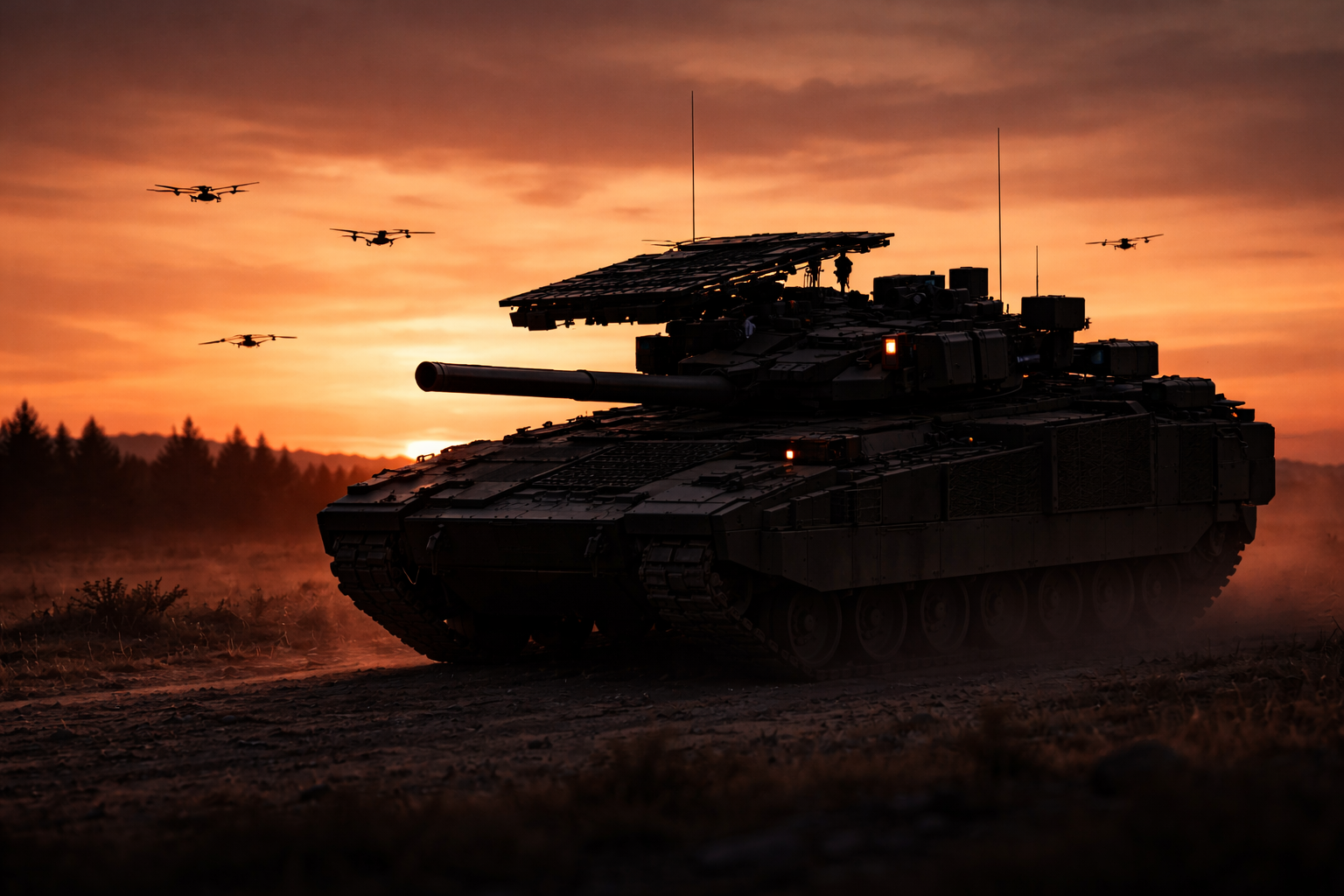
ASELSAN has displayed DRONEDEF at Eurosatory 2026, bringing radar, soft-kill systems, hard-kill weapons, laser effectors, high-power electromagnetic technology, and interceptor UAVs into a single layered counter-UAS architecture.
The system can operate as part of Turkey’s Steel Dome air-defence structure or as an independent counter-drone package. Its components include KORKUT 25 SB, ŞAHİN LITE, ŞAHİN DUAL, the GÖKALP interceptor UAV system, a revised İHTAR jammer, the EJDERHA/AD high-power electromagnetic system, the GÖKBERK laser, and the MİĞFER helmet-cued remote-controlled weapon station.
That breadth gives DRONEDEF a different industrial profile from a standalone jammer or gun system. Counter-UAS buyers increasingly need layered packages because the target set is so varied. A commercial quadcopter, FPV strike drone, larger rotary UAV, fixed-wing reconnaissance drone, and coordinated swarm place different demands on detection, tracking, identification, electronic attack, kinetic defeat, and command-and-control.
The hard-kill layer uses systems such as KORKUT 25 SB, a lighter member of the KORKUT family using ATOM 25 airburst ammunition, onboard AESA radars, and mast-mounted optics. ŞAHİN LITE and ŞAHİN DUAL extend the airburst approach around 40mm grenade launchers, with compact AESA radar integration and, in the dual version, a 12.7mm machine gun. GÖKALP adds an interceptor-drone layer, giving operators another option where guns, jamming, or directed energy may not provide the right engagement profile.
Soft-kill and directed-energy systems bring their own production demands. The revised İHTAR jammer uses small AESA radars and a new antenna layout intended to provide constant 360-degree coverage, while GÖKBERK and EJDERHA/AD add laser and high-power electromagnetic options. Those systems depend on power generation, thermal management, beam control, signal processing, rugged electronics, software, and safe operating procedures.
For a manufacturer, the task is not only to produce each element, but to make the layers work together in a way that can be installed, maintained, upgraded, and exported. Radar data has to feed engagement decisions, electronic attack must avoid interfering with friendly systems, guns need accurate fire-control, lasers require stable tracking, interceptor drones need launch and guidance arrangements, and operators need a coherent interface rather than a collection of separate consoles.
The same production logic is visible in other counter-UAS systems now entering the market, where proximity-guided rockets, protected navigation equipment, and compact remote fire-control are being combined into denser defensive layers. The market is moving away from isolated defeat mechanisms toward modular architectures that can be adapted to air bases, borders, convoys, naval facilities, and critical infrastructure.
Ukraine has accelerated that shift. Cheap drones have forced militaries to think in terms of engagement economics, saturation, repairability, and rapid upgrade cycles. A counter-UAS system that works in a demonstration environment but cannot be produced, supplied, and repaired at scale will struggle against threats that evolve in weeks. Manufacturers must therefore treat counter-drone equipment as a sustained production and software-support business.
Turkey’s defence industry has already established export momentum across UAVs, armoured vehicles, sensors, munitions, and electronic systems. DRONEDEF builds on that pattern by offering buyers a packaged defensive ecosystem rather than a single product. For customers with limited integration capacity, that can reduce acquisition risk, provided the supplier can adapt the package to local vehicles, command systems, and operating environments.
The supply chain behind a system such as DRONEDEF is wide. AESA radar modules, optics, programmable ammunition, launcher structures, drone airframes, batteries, actuators, antennas, processors, power systems, cooling components, cables, software, and test equipment all need to be available in repeatable quantities. Export versions may also require different frequency management, vehicle interfaces, operating languages, and national communications integration.
Counter-UAS is therefore becoming a manufacturing discipline in its own right. The front end may be detection and defeat, but the back end is production volume, configuration control, maintenance access, ammunition availability, software updates, and operator training. DRONEDEF reflects that transition, with ASELSAN combining a broad range of national systems into an architecture aimed at customers who need more than a single answer to the drone problem.