IN Brief:
- An FN Herstal-led consortium will establish French production of 5.56×45mm and 7.62×51mm ammunition.
- The Clérieux facility is expected to reach annual capacity of approximately 75 million rounds from 2029.
- Sustainable output will depend on cases, bullets, primers, propellant, inspection equipment, proof testing, and long-term orders.
France has selected an FN Herstal-led consortium to establish domestic production of 5.56×45mm and 7.62×51mm military ammunition at Clérieux in the Drôme department.
The consortium includes Italian cartridge and component manufacturer Cheddite and French ammunition producer NobelSport. Once fully operational from 2029, the facility is expected to reach an annual capacity of approximately 75 million rounds.
Final loading, assembly, inspection, and packaging will take place in France, supported by components sourced from European suppliers. The project restores a capability that had become increasingly dependent on production outside the country.
An output of 75 million cartridges a year is sufficient to support recurring training demand, stock replenishment, reserve building, and potential allied or export orders. Achieving that volume requires a continuous-flow industrial operation rather than occasional production batches assembled around individual contracts.
Although a rifle cartridge is mechanically simpler than a missile or guided munition, dependable mass production relies on several tightly controlled processes. Cases must be drawn and formed to precise dimensions, projectiles require consistent mass and geometry, and primers and propellants must retain stable performance across storage periods and environmental conditions.
Those components then pass through high-speed loading equipment while maintaining tolerances that allow the finished rounds to function safely across different weapons, temperatures, and operating environments.
Quality is built throughout the line
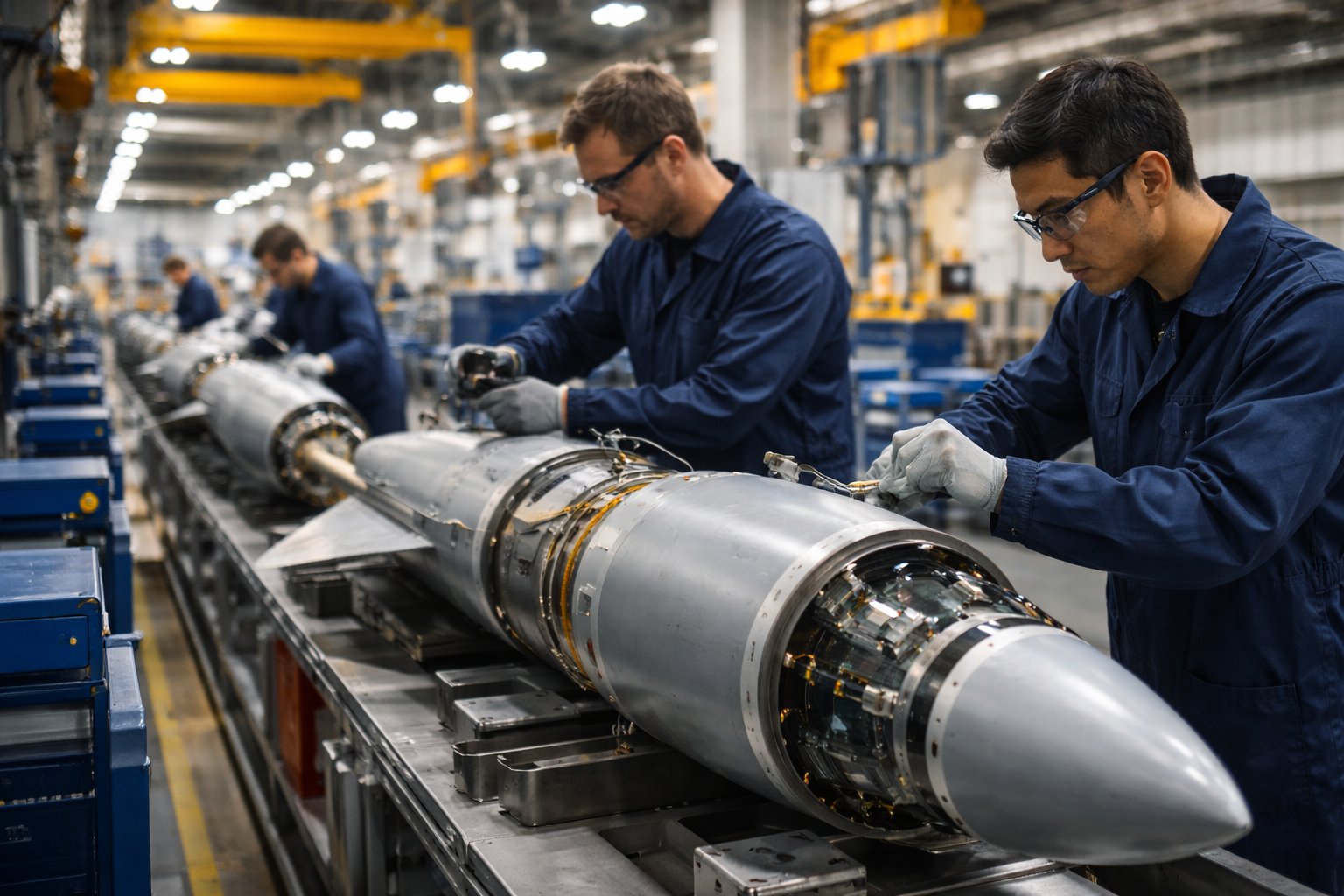
A modern cartridge factory includes case forming, cleaning, annealing, primer insertion, propellant loading, bullet seating, crimping, inspection, and packaging. Testing finished rounds alone cannot compensate for poor control earlier in the process.
Case dimensions affect chambering, extraction, pressure containment, and sealing. Variations in propellant charge alter muzzle velocity and chamber pressure, while primer position and ignition performance influence reliability.
Automated optical systems can detect dimensional errors, damaged cases, incorrect seating, and surface defects at production speed. Ballistic proof remains essential, with samples fired to confirm pressure, velocity, accuracy, function, and performance after environmental conditioning.
Military customers also require lot traceability. Records must connect finished ammunition with component batches, machine settings, inspections, and proof results so that any problem can be isolated without withdrawing unrelated production.
Energetic materials place strict requirements on factory layout. Primer and propellant handling areas need separation, blast protection, controlled storage, fire prevention, and limits on the amount of energetic material present at each processing station.
Automation can reduce direct worker exposure while improving throughput, although it increases dependence on sensors, control systems, robotics, and specialist maintenance. A failure in one loading or inspection stage can stop the entire line.
The production challenge differs from the qualification of more complex rounds such as Saab’s HEAT 758 ammunition for Carl-Gustaf. Clérieux will manufacture a less technically elaborate product, but it must hold quality across tens of millions of units.
Domestic assembly still depends on upstream supply
Sovereign loading capacity does not provide complete independence when primers, propellant ingredients, brass strip, steel, or projectile components remain unavailable.
The consortium combines expertise from France, Belgium, and Italy, creating a broader European supply arrangement while locating final production domestically. French procurement authorities will still need to understand which components have single sources and how quickly alternatives can be qualified.
Primer and propellant supply may prove especially sensitive because energetic-material production has long investment cycles, environmental requirements, and limited spare capacity. Demand from artillery, missiles, and commercial ammunition draws on some of the same chemical and metals sectors.
Europe’s wider rearmament has concentrated attention on large-calibre shells, yet small-arms ammunition is consumed continually through training, exercises, readiness, and operational stockpiling.
A plant designed for 75 million rounds needs predictable orders after the immediate replenishment cycle. Capital investment, specialist staff, environmental permits, and safety systems cannot be supported economically by a brief surge followed by prolonged inactivity.
Multi-year procurement agreements allow suppliers to invest in machinery, qualify second sources, and retain trained personnel. Annual competitions based largely on unit price risk weakening the same domestic capability that France is paying to restore.
Export orders could maintain utilisation during quieter periods, although they may compete with French requirements when several countries seek replenishment simultaneously. Contracts will need clear provisions covering national priority and surge capacity.
Workforce development represents another constraint. Ammunition production combines mechanical engineering, chemical handling, explosive safety, ballistics, laboratory testing, quality assurance, and maintenance.
Experienced staff cannot be created as quickly as machinery can be installed, so training and retention will have to begin before the facility reaches full production.
The 2029 target reflects the work required to design, permit, equip, commission, and qualify the line. Accelerating construction without stable component supplies and proven processes would create nominal capacity rather than dependable output.
France is rebuilding a capability that appeared economical to outsource when demand was predictable and allied supply chains seemed assured. Simultaneous rearmament has changed that calculation.
Clérieux will be judged by its ability to maintain millions of qualified cartridges each month, secure its component routes, and remain commercially viable after the present surge in defence spending has passed.