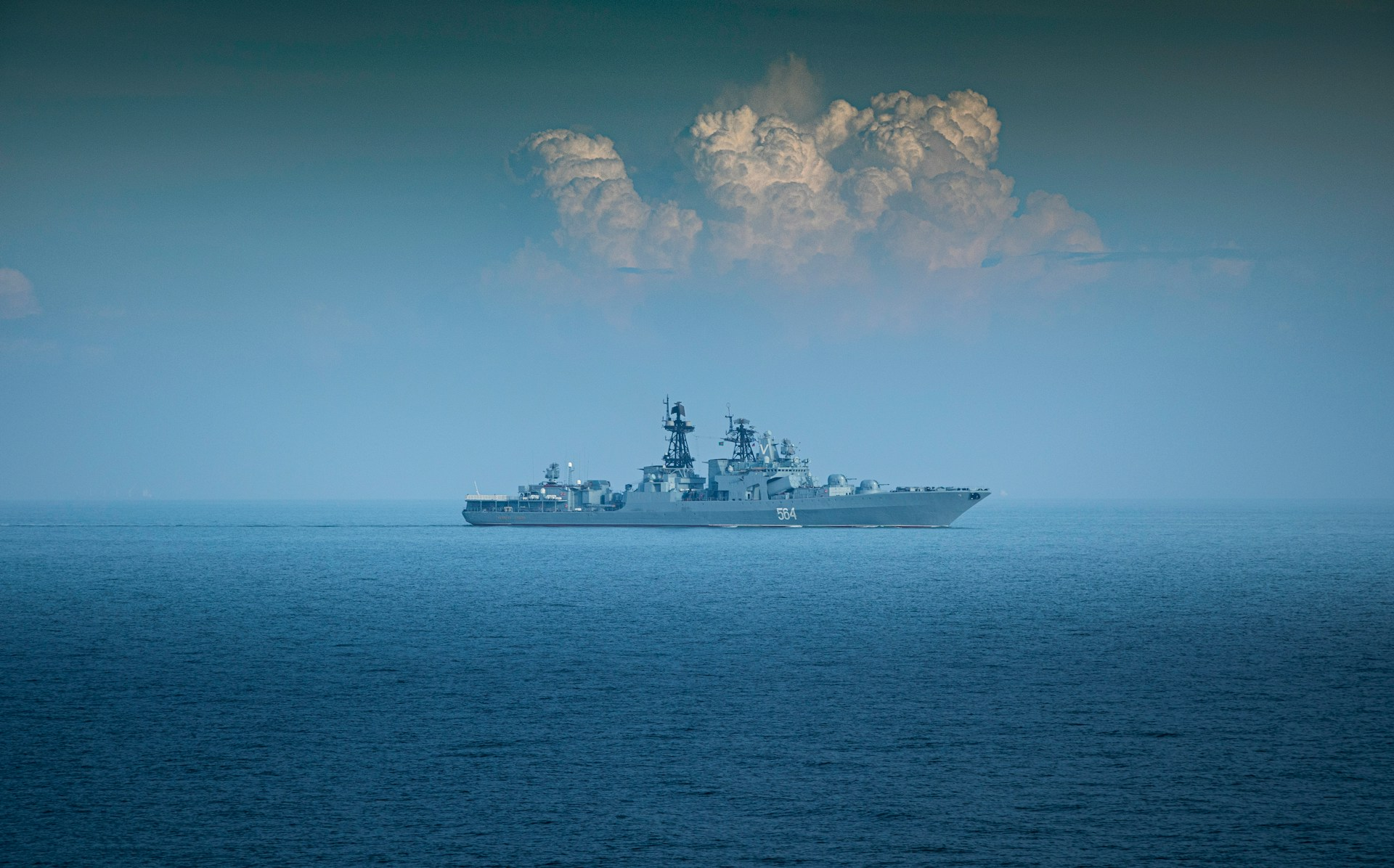
IN Brief:
- The Type 076 Sichuan combines a full-length flight deck, amphibious facilities, and a displacement exceeding 40,000 tonnes.
- Electromagnetic launch and arresting equipment will support larger fixed-wing unmanned aircraft alongside helicopters.
- Repeat production would establish a new Chinese naval platform between conventional assault ships and full-sized aircraft carriers.
New footage of China’s Type 076 amphibious assault ship has exposed the extent to which its hull, electrical architecture, and flight deck have been designed around fixed-wing unmanned aviation.
Sichuan carries a full-length flight deck, twin island superstructures, an electromagnetic catapult, and arresting equipment within a vessel displacing more than 40,000 tonnes. Flight-deck markings and visible launch infrastructure indicate that the ship is progressing towards a configuration capable of operating aircraft beyond the helicopters and short-take-off platforms associated with conventional amphibious assault ships.
By accelerating an aircraft along the deck, the electromagnetic catapult should allow the ship to launch heavier fixed-wing unmanned aircraft carrying larger sensor, communications, electronic-warfare, or weapons payloads. Arresting gear will enable recovered aircraft to return without relying on vertical landing, expanding the range of airframes that can form part of the embarked group.
Hudong-Zhonghua Shipbuilding constructed the vessel in Shanghai after delivering the preceding Type 075 amphibious assault ships. Although Type 076 retains facilities for amphibious operations, its aviation arrangements draw more heavily on technologies developed for China’s Fujian aircraft carrier, particularly the use of electromagnetic launch equipment.
Transferring that equipment into a smaller and more densely packed hull creates a different engineering problem from fitting it aboard a fleet carrier. Electrical generation, energy storage, power conditioning, cooling, flight-deck machinery, and aviation support must coexist with command spaces, accommodation, vehicle capacity, landing craft, and other amphibious systems.
Electrical power shapes the entire ship
Electromagnetic launch is not an isolated deck installation. Each launch requires a rapid, controlled release of electrical energy, which places substantial demands on generation and distribution equipment elsewhere in the vessel.
Power-conditioning systems must deliver repeatable acceleration across aircraft with different weights and launch speeds, while the associated electronics require cooling and protection from vibration, shock, saltwater, and electromagnetic interference. Redundancy is essential because failure in a small number of electrical components could interrupt flight operations even when the ship remains otherwise operational.
Arrested recovery imposes equally severe structural loads. Energy generated when an aircraft catches an arresting wire must pass through deck machinery and into the hull without damaging adjacent spaces or distorting the flight deck. The equipment must also cope with repeated use, changing aircraft weights, and the more abrupt control behaviour that can accompany autonomous landings.
Twin island structures separate navigation and aviation-control functions, while also creating more space for sensors, communications, and exhaust management. Their manufacture requires close coordination between steelwork, radar installation, cable routing, ventilation, and flight-deck sightlines, leaving little room for late design changes.
The air vehicles will need their own naval adaptations. Catapult attachment points, strengthened landing gear, corrosion protection, folding wings, secure data links, deck-handling interfaces, and autonomous recovery software all have to be incorporated into the aircraft before reliable embarked operations become possible.
Rather than adapting a land-based drone after the ship is complete, Chinese designers appear to be developing the vessel and prospective air wing as a connected system. That approach transfers development risk into the early design phase, but it avoids many of the compromises associated with adding aircraft to a platform whose power, deck, and maintenance facilities were never intended to support them.
China’s wider combat-air activity, including the emerging aircraft examined in coverage of its sixth-generation fighter development, points towards an operating model in which autonomous platforms extend the reach of crewed aircraft and major naval vessels.
A Type 076 air group could support surveillance, communications relay, electronic attack, targeting, and strike missions without consuming the space or support infrastructure required by a full complement of crewed carrier aircraft. Unmanned aircraft may also remain airborne longer, accept greater risk, and operate farther from the vessel.
Repeat construction will determine industrial value
One ship can prove an architecture, although the greater industrial benefit would come from repeat production. Successive vessels allow shipyards to refine modular construction, stabilise cable and pipe routes, improve installation sequences, and reduce the labour required for major electrical and aviation assemblies.
Suppliers also gain a more dependable market for catapult components, radar arrays, power electronics, arresting machinery, flight-control equipment, and specialist composite structures. Without follow-on orders, many of those products remain expensive low-volume items supported by small engineering teams.
Type 076 will not replace the full-sized aircraft carrier. Its smaller hull cannot match a fleet carrier’s fuel storage, weapons magazines, maintenance depth, or sortie generation, while its amphibious facilities continue to consume internal volume.
The vessel instead occupies an industrial and operational space between helicopter assault ships and conventional carriers. A navy could gain fixed-wing unmanned aviation without accepting the cost, infrastructure, and crew demands associated with a larger carrier, although the resulting platform remains considerably more complex than a conventional landing helicopter dock.
Reliability will decide whether that compromise is useful. Launch availability, deck-cycle efficiency, aircraft compatibility, and maintainability will carry more weight than the visual novelty of the completed flight deck.
China has already shown that its shipyards can construct large naval vessels at an accelerating rate. Sichuan will test whether the same industrial system can integrate high-demand electrical equipment, autonomous aircraft, and amphibious capability without allowing complexity to erode availability.
If the design enters repeat production, Type 076 could establish a distinct class of unmanned aviation ship rather than remain an experimental hybrid. The production line, supplier network, and embarked aircraft programme would then become as consequential as the first vessel itself.