IN Brief:
- Hermeus and Northrop Grumman have formed a strategic teaming arrangement for reusable, uncrewed high-Mach military aircraft.
- Northrop will provide mission-system engineering and integration around Hermeus’ modular mission management architecture.
- No customer production order, agreement value or initial payload configuration has been disclosed.
Hermeus and Northrop Grumman have signed a strategic teaming agreement to develop and integrate military mission systems for reusable, uncrewed high-Mach aircraft. The arrangement brings Northrop Grumman’s sensing, electronic warfare, communications and systems engineering capabilities into the Hermeus aircraft programme, with the companies seeking future US military development opportunities.
Announced on 12 November, the agreement assigns Northrop Grumman responsibility for mission systems design, development, integration and sustainment. Neither partner has disclosed a contract value, a first customer order or the specific mission equipment that will be fitted. It is a technology and programme-development relationship, rather than an award to manufacture a defined fleet of operational aircraft.
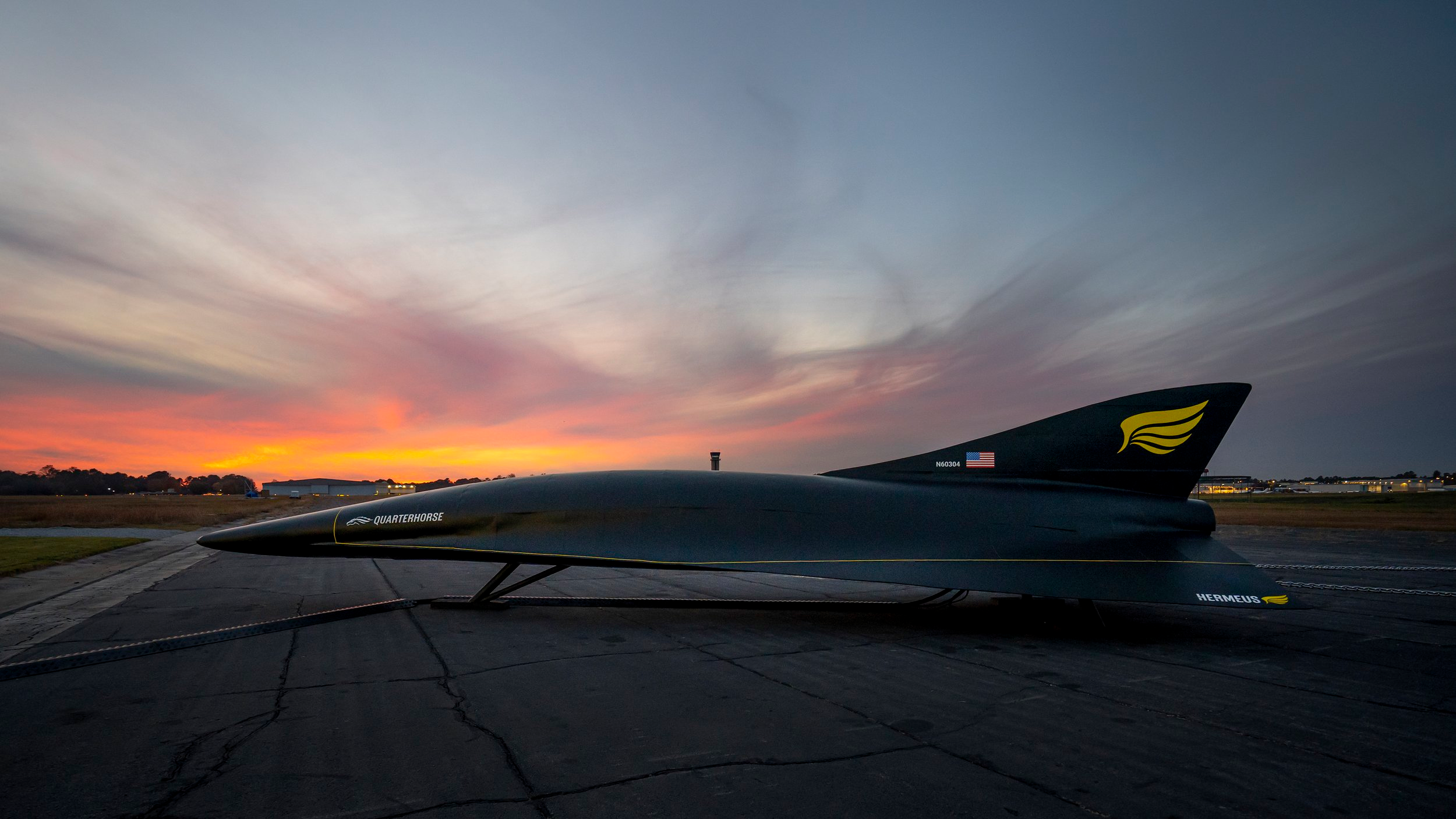
Hermeus has used successive Quarterhorse experimental aircraft to expand the performance envelope towards sustained high-supersonic flight. Its Mk 2.1 demonstrator reached Mach 1.21 in May 2026, and the company subsequently reported Mach 1.6 on its fourth flight, followed by a demonstration payload release. Those tests establish progress in airframe control and payload carriage, rather than a fielded aircraft with the Northrop Grumman mission systems now proposed.
Speed alone cannot establish the military usefulness of an uncrewed aircraft. Sensors, communications, navigation, and processing equipment must continue to operate while propulsion and airframe conditions change rapidly, including the thermal and vibration environment. Installation design needs to account for electrical supply, cooling, software interfaces, and system qualification rather than attaching equipment after the flight configuration has been fixed.
Hermeus’ in-house mission management system provides the proposed integration foundation. The company describes an open, modular architecture that separates flight-critical control functions from mission applications, allowing equipment changes to be managed through defined interfaces. In practice, the separation still needs validation against the computing, communications, and fault-handling demands of any specific mission installation.
Flight functions maintain stable vehicle control and navigation, while mission applications process sensor data and support assigned tasks. Although those functions can be separated in software architecture, the aircraft still needs predictable behaviour if a mission computer restarts or a payload creates unexpected demand on its data network. Maintaining those boundaries is particularly important during experimental flight campaigns, when airframe and onboard software are both changing.
Hermeus says its system has been developed against US government Agile Mission Suite and Autonomy Government Reference Architectures, identified as AMS-GRA and A-GRA, as well as Open Mission Systems and Universal Command and Control Interface standards. The design approach aims to support equipment changes through defined interfaces. Compliance with an architectural approach, however, is not a substitute for acceptance testing of a particular equipment installation.
Northrop Grumman brings experience in sensing, communications, electronic warfare, navigation, and command systems. The partners have not selected a publicly identified radar, datalink, electronic support system, or processor for an initial fit. The scope permits different mission configurations, but the agreement itself makes no claim that a particular mission kit has been manufactured, installed, or flown on a Quarterhorse aircraft.
At high speed, external and internal operating conditions become more demanding. Heating can affect sensor apertures and equipment cooling, while airflow and aircraft manoeuvres complicate the performance of antennas or other external installations. Designing the mission system therefore involves physical placement, electromagnetic compatibility, power supply, software interfaces and maintainability as well as selecting a suitable sensor.
Reliability also depends on how the aircraft manages information. A mission management layer may have to combine data from sensors and navigation systems with commands received over a communications link, retaining a clear distinction between verified observations and instructions. Latency, time synchronisation and data quality become relevant whenever an autonomous platform needs to act on information from different subsystems.
Development of the airframe continues separately from the teaming agreement. Hermeus began the Mk 2.2 flight campaign in September 2026 with additional fuel capacity, revised avionics and software, and the Gryphon propulsion system. The latter uses an actuated spike inlet to condition airflow ahead of the engine as the company works towards higher Mach numbers. Its flight testing is not evidence that the new military mission architecture has been installed or accepted.
Separate government funding has supported the development effort. In May, the US Defense Innovation Unit raised a Hermeus contract ceiling to $219 million through a $159 million modification for high-Mach flight and payload release demonstrations. That earlier award is distinct from the newly announced Northrop Grumman agreement, whose financial terms have not been published.
Common interfaces could reduce the effort required to compare alternative mission payloads, provided the airframe and equipment suppliers maintain compatible electrical, software, and data arrangements. Verification must also establish responsibility for cyber security, electromagnetic compatibility, safety, and software changes. Neither company has published a first Northrop-equipped test aircraft configuration or an integration acceptance schedule.
The partnership now connects Northrop Grumman’s mission systems engineering with Hermeus’ ongoing high-speed flight development. Named payload selections, integration trials, and customer commitments will determine the first operational configuration, while the existing Quarterhorse flight milestones remain demonstrator results rather than military service acceptance.