IN Brief:
- US Marines have conducted HIMARS training at Camp Fuji, Japan, reinforcing mobile long-range fires in the Indo-Pacific.
- The exercise highlights demand for launchers, precision munitions, fire-control systems, data links, and resilient logistics.
- Distributed missile operations are pushing industry towards faster production, lighter support models, and more survivable deployment concepts.
US Marines have used Camp Fuji in Japan to sharpen HIMARS long-range fires, placing mobile missile operations at the centre of the Indo-Pacific’s evolving deterrence model.
The training involved Marines from 3rd Battalion, 12th Marine Regiment, 3rd Marine Division, operating M142 High Mobility Artillery Rocket Systems at the East Fuji Maneuver Area. Although the system is now familiar from Ukraine and other high-profile deployments, its Indo-Pacific role is developing around a different set of pressures: distance, concealment, island access, maritime chokepoints, contested airspace, and the need to move before an adversary’s sensor-to-shooter chain can close.
HIMARS combines a wheeled chassis, a podded rocket or missile load, a fire-control system, communications equipment, and rapid displacement after launch. The platform’s value lies in that combination rather than in any single component. A launcher can fire quickly, but the wider system has to find targets, receive data, move across rough terrain, reload, reconnect, and remain serviceable under operational stress.
In the Pacific, those demands become more severe. An island-chain operating model leaves little room for large, static logistics footprints, while the geography stretches supply lines and complicates ammunition movement. Reload pods, tyres, spares, vehicle components, software updates, electronics, radios, batteries, support tools, and trained maintainers all become part of the fires system. The launcher is only the visible end of a much deeper production and sustainment chain.
Camp Fuji offers a useful setting for that model because it allows forces to practise live and simulated activity around movement, firing, range coordination, and crew proficiency. In a more contested environment, the same sequence would have to occur under drone observation, electronic interference, satellite surveillance, and missile threat. That places a premium on equipment that can be maintained by smaller teams, supported from dispersed locations, and integrated with broader command networks without creating heavy infrastructure demands.
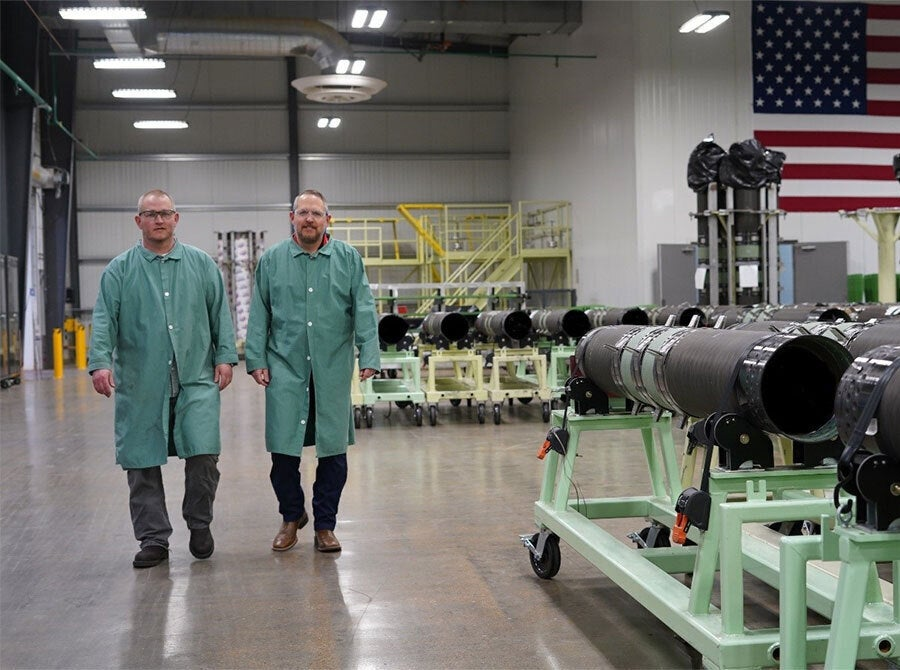
Precision fires are also reshaping ammunition production. HIMARS can employ different guided rockets and missiles, with longer-range options pushing the system into deeper strike roles. Greater range draws in more complex propulsion, guidance, seeker, control, and test requirements. As munition designs become more capable, their supply chains become more specialised, and the gap between operational ambition and factory throughput becomes harder to ignore.
The same dispersed operating pressure is visible in the recent VAMPIRE counter-UAS production case, where vehicle-mounted capability, lower-cost effectors, and standardised integration are being used to protect forces away from fixed air-defence sites. HIMARS sits on the offensive side of that pattern. It gives commanders reach from smaller footprints, but only when the wider industrial system can support movement, reload, targeting, and repair at comparable speed.
Fire-control and data links are now part of the manufacturing story. Long-range fires depend on target-quality information, secure communications, accurate positioning, and resilient software. A launcher that cannot receive usable data, or that loses connectivity in a dense electronic warfare environment, becomes less effective regardless of its mechanical reliability. That means suppliers of radios, processors, GPS alternatives, rugged displays, crypto systems, and mission-planning tools sit close to the centre of the capability.
The logistical burden also extends across allies. Japan’s ranges, roads, ports, storage arrangements, airfields, and host-nation coordination influence how quickly systems can be deployed and repositioned. For manufacturers, the operating environment increasingly shapes design assumptions. Equipment has to be shippable, air-transportable, maintainable in austere settings, and compatible with allied procedures.
As the United States and its partners adapt long-range fires for the Indo-Pacific, production capacity will remain a constraint. Ukraine has already pulled heavily on guided-munition stocks, while NATO replenishment, Middle East commitments, and Pacific deterrence all compete for the same classes of components, propellants, electronics, and manufacturing slots. A Pacific fires model built around mobility still relies on an industrial base capable of supplying volume.
HIMARS training at Camp Fuji therefore sits within a broader shift from platform procurement to operating-system procurement. The truck, launcher, pod, missile, fire-control software, communications equipment, maintenance package, and supply route all have to be treated as one capability. In the Indo-Pacific, long-range fires are becoming an industrial endurance test as much as a tactical one.