IN Brief:
- The engine was designed by DRDO’s Gas Turbine Research Establishment and manufactured with Azad Engineering.
- Expendable propulsion combines demanding turbine tolerances with the cost limits imposed by single-use platforms.
- Series production could reduce India’s reliance on imported engines for missiles, drones, decoys, and target systems.
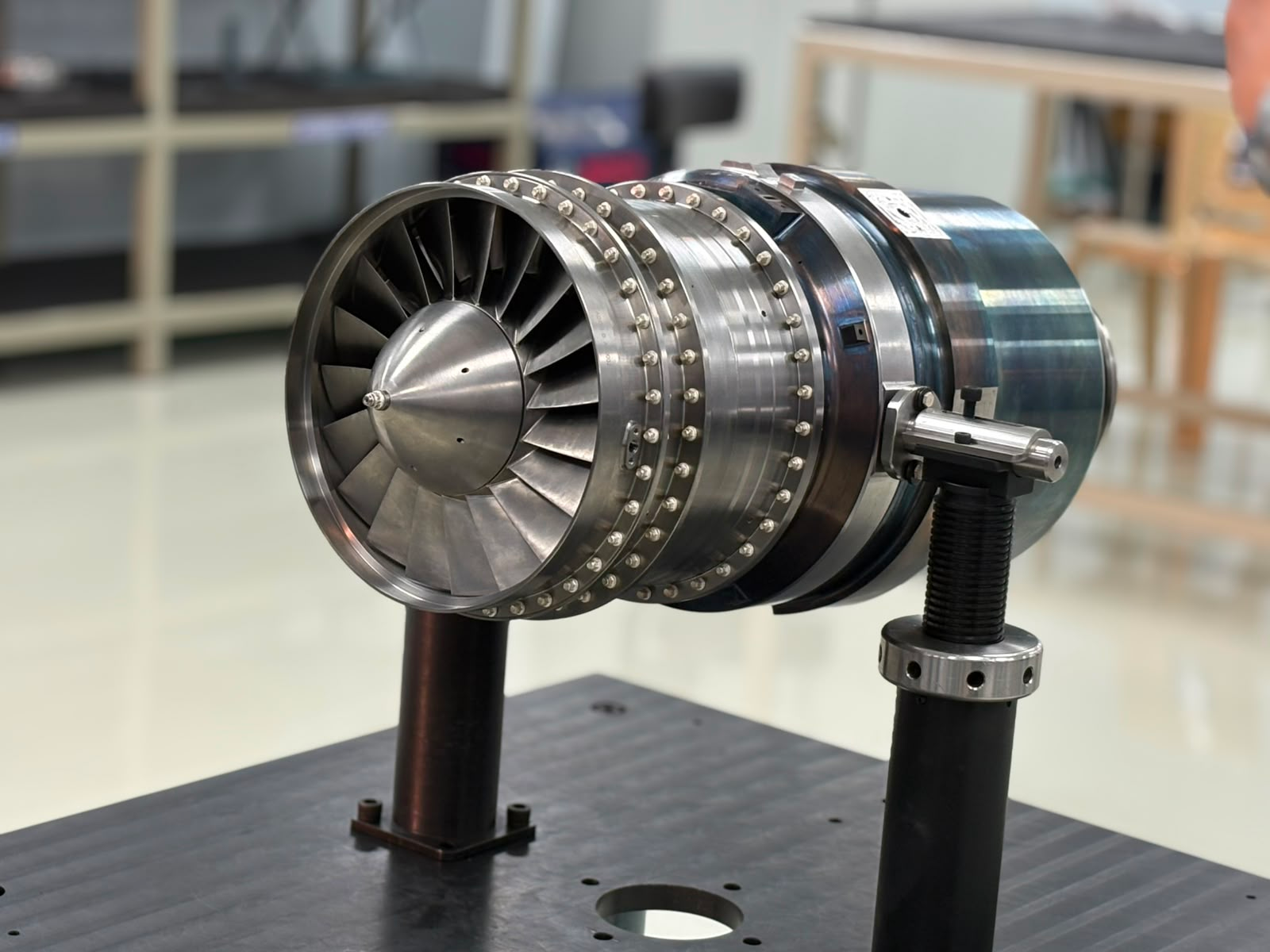
India has completed the first manufactured example of a domestically designed expendable turbojet engine, moving a strategically important propulsion technology from research into an industrial production environment.
The 350kg-thrust-class engine was designed by the Gas Turbine Research Establishment, part of India’s Defence Research and Development Organisation, while Hyderabad-based Azad Engineering undertook manufacturing and assembly. The completed unit was delivered to GTRE on 22 July, establishing an Indian route for turning the government-owned design into physical hardware.
Although expendable engines do not require the overhaul lives expected from aircraft propulsion, they still have to deliver reliable thrust, stable combustion, controlled vibration, and predictable performance throughout a weapon’s flight. Their production economics are less forgiving, however, because every engine is consumed with the missile, target, decoy, or unmanned aircraft that carries it.
Materials, machining routes, inspection requirements, and component lives must consequently be matched to a mission measured in hours rather than decades. Excess durability adds weight and cost, yet any reduction in manufacturing discipline risks an engine failure that would render the complete weapon unusable.
Within a compact turbojet, compressor and turbine components rotate at high speed while bearings, fuel systems, combustion hardware, and electronic controls operate across rapidly changing temperatures and pressures. Small dimensional errors can alter airflow, reduce output, increase vibration, or create local thermal stresses, leaving little margin for poorly controlled machining or assembly.
Azad Engineering’s involvement places these processes inside an established precision-manufacturing business rather than leaving production wholly within a state research establishment. Design drawings must now be translated into stable work instructions, tooling, material specifications, inspection plans, and acceptance criteria that can be applied consistently by technicians outside the original development team.
A development engine can absorb repeated inspection and engineering adjustment, whereas a production batch must leave the line without constant intervention from its designers. Fixtures, measurement systems, non-destructive testing, rotor balancing, and supplier traceability therefore become central to the programme as output rises.
The supply chain extends well beyond final assembly. Castings, forgings, bearings, pumps, electronic control units, fasteners, specialist alloys, and protective coatings must arrive with consistent properties, while any proposed substitution requires technical assessment against the qualified design. A component that appears commercially minor can halt deliveries when no approved alternative exists.
Precision at an expendable price
Propulsion has remained one of the more difficult areas within India’s effort to expand sovereign missile and unmanned-aircraft production. Domestic control over the engine would give system designers greater freedom to balance range, speed, payload, intake geometry, fuel volume, and airframe packaging without designing around an externally supplied powerplant.
Engineering changes could also be handled within a shorter national decision chain. Mounting arrangements, fuel interfaces, control software, intake geometry, and exhaust configuration often change as an air vehicle matures, and imported propulsion can introduce licensing, data-access, or supplier-approval barriers during each revision.
The programme must now establish repeatability across storage, transport, and use. A missile engine may remain sealed for years before being started under operational conditions, with no opportunity for the routine maintenance applied to aircraft propulsion. Seals, bearings, fuels, electronics, and energetic starting systems must remain dependable after long periods of inactivity and exposure to military storage environments.
Production capacity will also need to follow procurement demand without becoming uneconomic between orders. Reusable aircraft engines generate decades of overhaul and spares work, while expendable engines depend on stockpile policy, replenishment, training expenditure, and the rate at which customers build war reserves.
A manufacturing line configured only for a modest initial batch could struggle if a missile programme enters accelerated procurement. Conversely, facilities and supplier commitments sized for sustained high output become expensive when annual orders fall, requiring production planners to share equipment, labour, and component families across several engine or air-vehicle programmes.
Common tooling and standardised subsystems could reduce that exposure. Bearings, control electronics, pumps, and manufacturing methods reused across multiple thrust classes would broaden the demand base, provided commonality did not impose unnecessary performance compromises on each airframe.
Qualification will provide the first indication of whether the industrial model is mature. Engines must demonstrate performance across temperature, altitude, vibration, storage, and flight conditions, while production acceptance testing has to detect defects without consuming a disproportionate share of each unit’s life.
The delivered engine is therefore an opening production milestone rather than a completed weapons capability. Its longer-term value will be measured through stable quality, repeatable output, and an Indian supplier base capable of supporting quantity orders.
Should those conditions be met, India will have added another difficult subsystem to its domestic defence-industrial portfolio. The decisive measure will not be the appearance of the first engine, but whether the next hundred can be produced to the same standard, at the required rate, and at a cost compatible with an aircraft designed to be used once.