IN Brief:
- Japan’s XEC-2 has entered formal flight testing with the Air Development and Test Wing at Gifu Air Base.
- The converted Kawasaki C-2 must safely accommodate high-power transmitters, processors, operator stations, cooling, and power-conditioning equipment.
- A planned four-aircraft EC-2 fleet would give Japan an operational stand-off jamming capability and a domestic upgrade base.
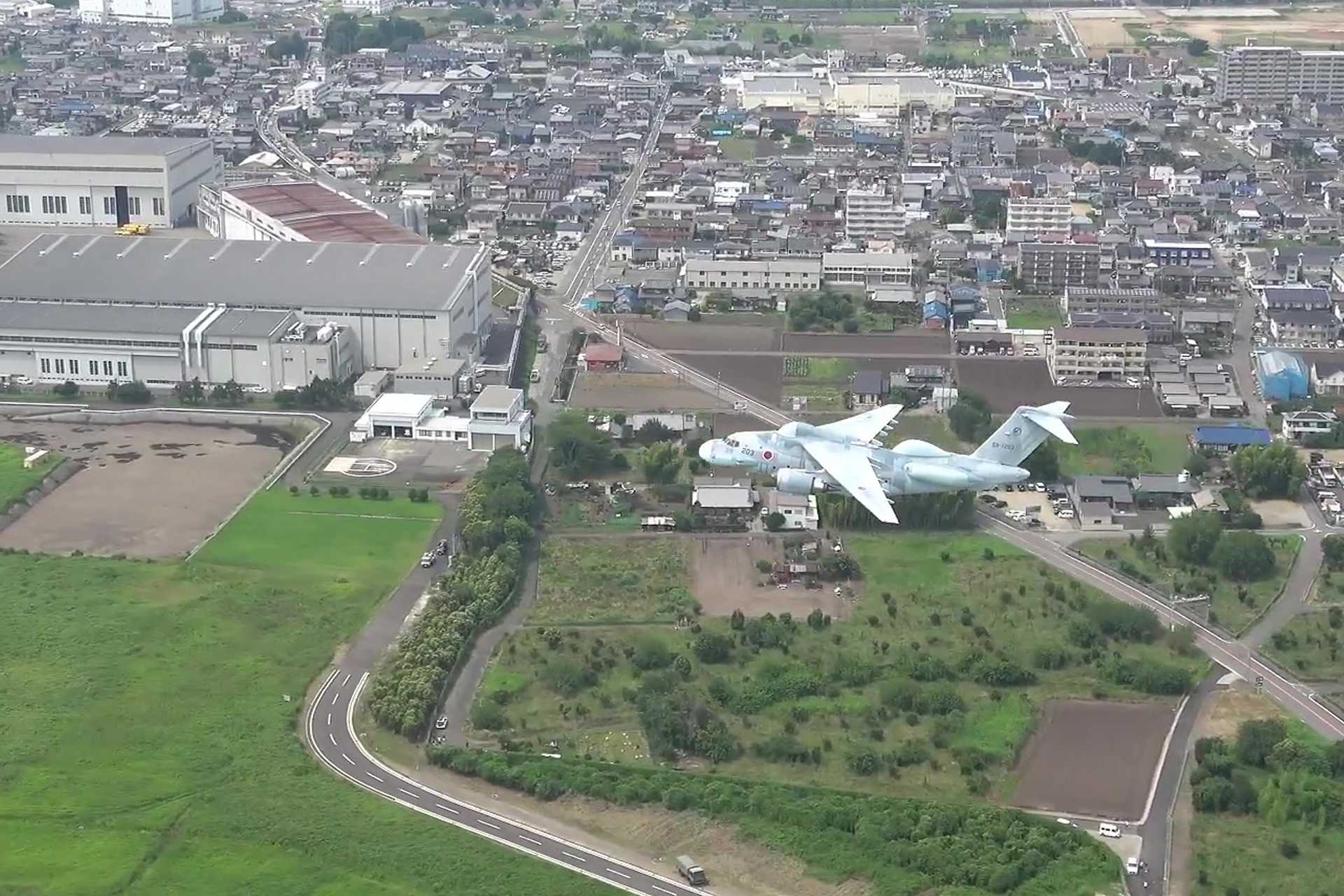
Japan has begun formal military flight testing of the XEC-2 stand-off electronic-warfare aircraft, opening the next stage of a programme intended to turn Kawasaki’s C-2 transport platform into an operational airborne jamming system.
Operating from Gifu Air Base under the Japan Air Self-Defense Force’s Air Development and Test Wing, the aircraft will now undergo evaluation of its military flight envelope, mission-system reliability, electromagnetic compatibility, crew workload, maintenance requirements, and operational suitability. Contractor-led development flights began earlier in 2026, before the prototype transferred to the military test organisation in June.
The XEC-2 is based on C-2 serial 68-1203, the first production example of Kawasaki’s domestically developed transport aircraft. Its conversion retains the large twin-engine airframe and much of the established C-2 support base, while replacing the transport configuration with a distributed electronic-warfare suite designed to detect, classify, and disrupt hostile emitters from stand-off range.
A large radome replaces the standard C-2 nose, with further antenna housings positioned along the upper fuselage and around the rear section. Rather than concentrating the mission system around a single forward-facing array, the arrangement is intended to provide broader coverage across several sectors and frequency ranges.
Inside the aircraft, part of the original cargo volume is occupied by electronic receivers, high-power transmitters, processing equipment, operator consoles, power-conditioning systems, cooling hardware, and extensive cabling. Integrating those elements requires far more than installing mission equipment in available cabin space, because their combined electrical, thermal, structural, and electromagnetic demands affect the aircraft as a complete system.
High-power radio-frequency transmitters can interfere with navigation equipment, communications, sensors, flight controls, and other onboard electronics unless shielding, grounding, antenna separation, and cable routing are carefully controlled. Every operating mode must therefore be tested against the aircraft’s own systems, including combinations of transmitters that may produce effects not encountered during isolated component trials.
Weight distribution and drag have also changed, while electrical demand and heat generation have risen sharply. Flight testing will measure how the external fairings and internal equipment affect centre of gravity, handling, endurance, fuel consumption, structural loading, and engine margins. Those results will shape operating limits, emergency procedures, inspection intervals, and maintenance schedules for the production configuration.
Building an operational fleet
Japan plans to acquire four operational EC-2 aircraft, replacing the single EC-1 that retired in 2025 after almost four decades of service. Although four aircraft remain a modest fleet, they would allow capacity to be divided between operations, training, maintenance, and continuing development instead of disappearing whenever one platform enters depot work.
Commonality with the C-2 provides a substantial industrial advantage. Engines, landing gear, flight controls, structural systems, and much of the airframe support chain already have established tooling, engineering data, inspection processes, and maintenance experience. Kawasaki and its suppliers can therefore build the electronic-warfare fleet around an existing aircraft rather than sustain an entirely unique platform.
The mission equipment will require its own support structure, because airborne electronic warfare is shaped as much by software and threat data as by the aircraft carrying it. Receivers, processors, transmitter modules, cooling systems, and programmable waveforms must evolve as hostile radars and communications networks change.
Japan will consequently need laboratories capable of reproducing complex electromagnetic environments, secure software-development processes, representative threat emitters, and a dependable supply of replaceable electronic modules. Availability will be determined partly by how quickly faults can be diagnosed and repaired, and partly by how rapidly new jamming techniques can be validated and loaded onto operational aircraft.
The country is already expanding the infrastructure surrounding those tasks. Work with Northrop Grumman on electronic-warfare simulation, spectrum detection, and threat replication indicates that aircraft development is being supported by a wider investment in test and training capability.
XEC-2 is intended to operate outside the most heavily defended airspace while disrupting the radars, communications links, and command networks that allow air-defence systems to function collectively. From that position, it could support F-35A, F-15J, and F-2 formations by reducing the accuracy, reach, or timeliness of hostile targeting information.
Such missions place a premium on endurance, broad frequency coverage, software adaptability, and electrical generation rather than close-in manoeuvrability. The C-2 supplies volume and payload, but the programme still has to demonstrate that the mission system can produce useful electronic effects without overwhelming the aircraft’s power and thermal architecture.
Formal military testing will determine whether the prototype can become a repeatable and maintainable operational configuration. The decisive work will take place across shielding, cooling, cabling, software, module replacement, and support equipment as much as within the jammer itself.