IN Brief:
- Northrop Grumman and Japan’s Ministry of Defense are exploring cooperation on advanced electronic warfare capabilities.
- The discussions cover technologies for detecting, disrupting, deceiving, and denying adversary use of the electromagnetic spectrum.
- CEESIM and Joint Threat Emitter systems point to wider work around simulation, validation, training, and software-defined threat replication.
Northrop Grumman and Japan’s Ministry of Defense are exploring deeper cooperation on electronic warfare capabilities as Tokyo strengthens its ability to operate in contested electromagnetic environments.
The discussions have focused on technologies that detect, disrupt, deceive, and deny threats across the electromagnetic spectrum. Japanese embassy officials were also involved, reflecting the role of electronic warfare in Japan’s wider defence modernisation programme.
Japan is investing in defence infrastructure against a regional threat environment shaped by software-defined emitters, wideband sensors, distributed systems, multispectral effects, and rapid changes in hostile signatures.
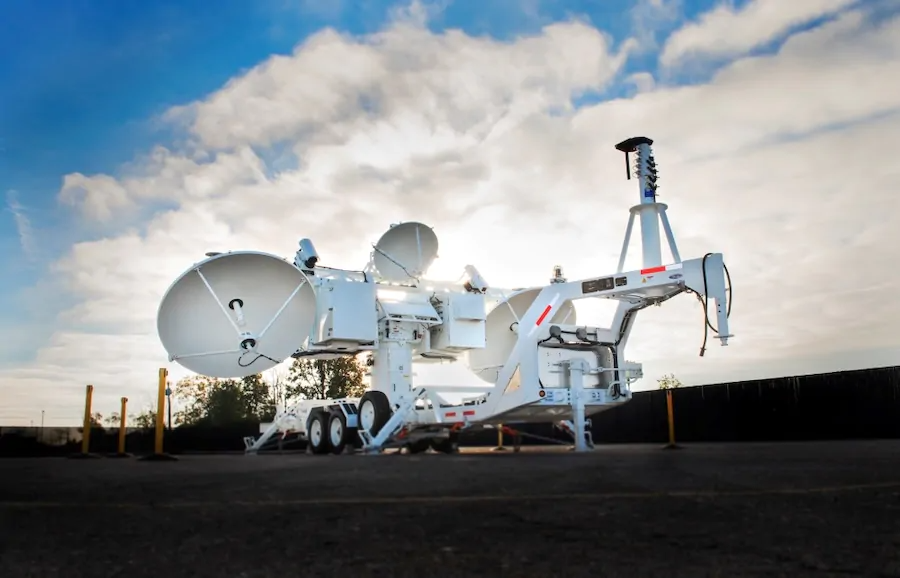
Northrop Grumman’s electronic warfare portfolio covers preparation, simulation, exploitation, deception, denial, and protection. The company has highlighted its Combat Electromagnetic Environment Simulator, or CEESIM, and Joint Threat Emitter as systems relevant to Japan’s future training and development requirements.
Simulation as industrial infrastructure
Electronic warfare production now extends well beyond individual hardware boxes. Modern EW equipment must be validated against complex emitter behaviour before installation on aircraft, ships, vehicles, or ground systems.
CEESIM is designed to generate multiple simultaneous emitter scenarios across static and dynamic platforms. The system allows dense threat environments to be replicated for radio-frequency performance testing, countermeasure validation, software refreshes, and mission-system development.
Systems such as the ALQ-257 Integrated Viper Electronic Warfare Suite, ALQ-251 Radio Frequency Countermeasures, and APR-39E(V)2 Digital Radar Warning Receiver show the manufacturing burden behind modern EW. Hardware must be rugged, certifiable, upgradeable, and compatible with rapid software changes while meeting military qualification standards for vibration, thermal stress, electromagnetic compatibility, and lifecycle support.
Training systems and production discipline
The Joint Threat Emitter adds another layer to the production base. Training emitters are not front-line weapons, but credible training depends on frequency accuracy, timing, emissions control, and reliability under repeatable conditions.
Electronic warfare resilience also depends on the link between threat intelligence, software updates, laboratory validation, flight or field trials, training, and sustainment. Each part of that loop requires equipment that can be produced consistently and maintained across long service lives.
Japan’s next electronic warfare step will be shaped by industrial integration, test infrastructure, and software-controlled hardware as much as by individual system performance. The ability to replicate, update, and validate threats quickly will determine how effectively new equipment can be brought into service.