IN Brief:
- Rafael will display precision-strike, targeting, air-defence, and counter-UAS systems at Farnborough.
- SPICE 250, ROCKS, and ICE BREAKER cover different ranges, launch platforms, warheads, and engagement profiles.
- Wider adoption depends on aircraft certification, seeker availability, software qualification, production capacity, and national workshare.
Rafael will present a broad portfolio of precision-strike and defensive systems at the Farnborough International Airshow, including SPICE 250, ROCKS, ICE BREAKER, LITENING 5, air-defence technology, and counter-UAS equipment.
Rather than forming a single missile family, the weapons cover several weight classes, engagement ranges, launch environments, and target sets. SPICE 250 is a 125kg-class guided weapon intended for carriage in larger numbers, while ROCKS provides a heavier stand-off option and ICE BREAKER offers a cruise-missile architecture for air, land, and maritime launch.
Across the portfolio, reduced dependence on continuous satellite navigation is a central design feature. Imaging-infrared seekers, electro-optical scene matching, inertial navigation, automatic target recognition, and mission-planning software are used to retain accuracy where GPS signals are degraded, denied, or deliberately manipulated.
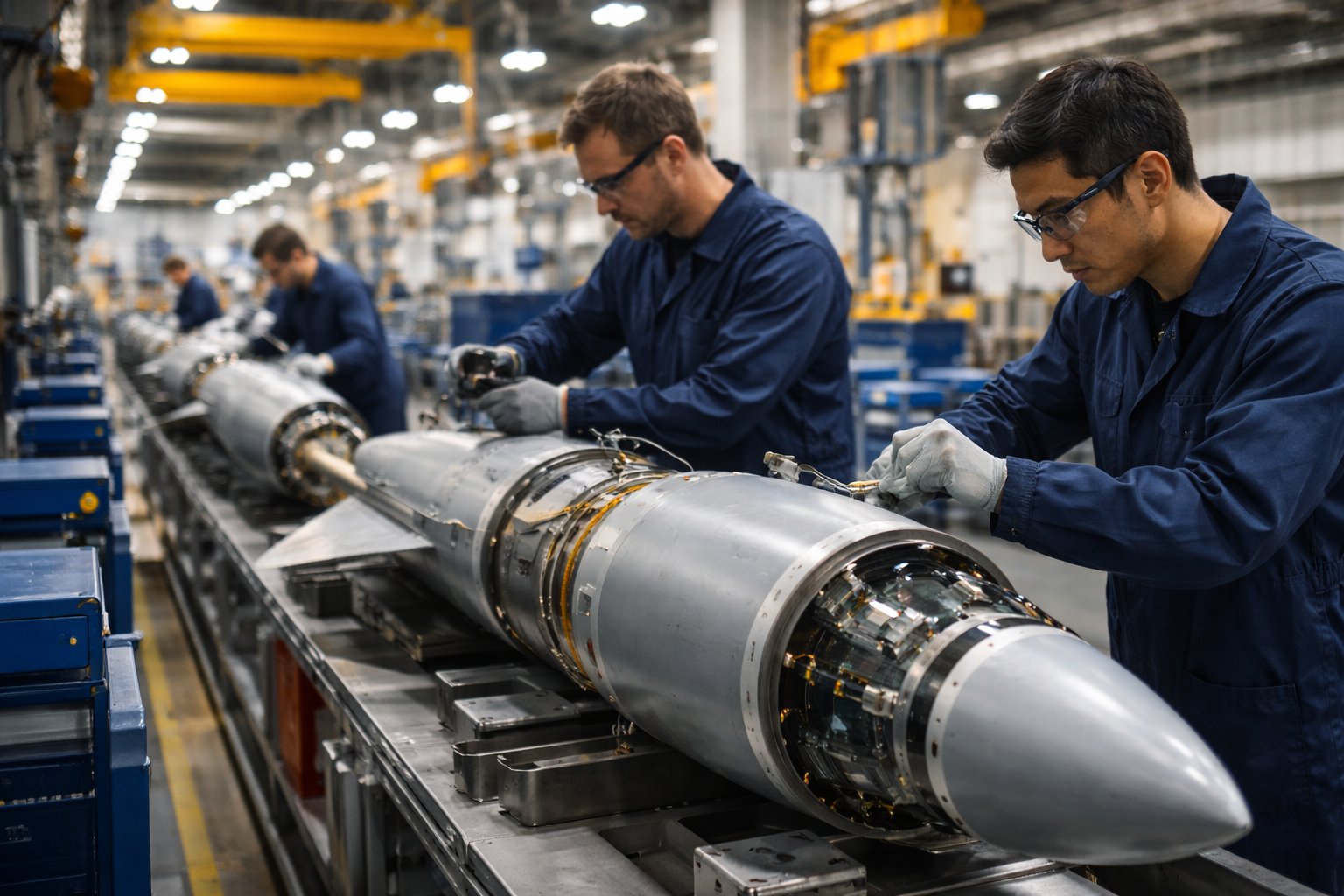
As guidance becomes more sophisticated, a growing share of the manufacturing burden moves into optics, detectors, processors, software, precision mechanisms, and calibration. Optical assemblies must be aligned accurately, seeker windows must tolerate thermal and aerodynamic loads, and target-recognition algorithms require extensive testing against varied terrain, lighting, weather, and countermeasures.
SPICE 250 combines a compact weapon body with a smart rack that allows several weapons to occupy one aircraft station. Greater carriage density can increase the number of targets addressed during a sortie, but the rack introduces its own electronics, power, communications, structural, and stores-management requirements.
Certification extends beyond proving that the weapon remains attached. Engineers must assess vibration, flutter, thermal behaviour, electromagnetic compatibility, emergency jettison, safe separation, and the effect of multiple release combinations across the aircraft’s flight envelope.
ROCKS brings a different production structure, combining long-range flight performance with alternative seeker and warhead configurations. Each option broadens customer choice while increasing the number of controlled configurations moving through procurement, assembly, software release, inspection, and support.
ICE BREAKER stretches the same design across several launch domains. Common internal architecture can reduce duplicated development, although aircraft, ships, and ground launchers impose different structural loads, communications interfaces, mission-planning procedures, and environmental requirements.
Integration becomes the market
At Farnborough, aircraft manufacturers, national delegations, weapons integrators, and industrial partners will examine more than published range and accuracy figures. Platform availability, certification schedules, sovereign mission data, production slots, local assembly, and long-term replenishment will carry equal weight.
Combat-aircraft integration schedules are already crowded with radar improvements, defensive-aids upgrades, communications, electronic warfare, software releases, and competing weapons. A technically mature missile can wait years for clearance when access to flight-test aircraft, mission computers, or stores-management software is limited.
LITENING 5 sits directly within that integration chain. A precision weapon depends on the aircraft finding, classifying, identifying, and updating its target, while the pod, mission computer, weapon, and command network exchange data through several controlled interfaces.
Production capacity presents a second constraint. Customers are seeking larger inventories and faster replenishment after years in which many missile programmes were sized for modest peacetime consumption. Motors, turbine engines, seekers, electronics, batteries, warheads, explosive fills, and final-test facilities must all expand without compromising quality.
Rafael’s cooperation with General Atomics on the Bullseye missile programme reflects the increasing importance of domestic content, scalable output, and controlled unit cost. Building weapons closer to the customer can shorten logistics chains and unlock national funding, provided sensitive seeker, software, and propulsion technologies can be divided into workable production packages.
European customers are pursuing similar outcomes through local assembly, licensed component manufacture, maintenance rights, and greater access to technical data. Sovereignty increasingly includes the capacity to repair, replenish, and modify a weapon during disruption, rather than merely the authority to employ it.
GPS-denied performance complicates those arrangements because scene libraries, target models, seeker-processing software, cryptography, and electronic-countermeasure data may be more closely controlled than the airframe or warhead. Industrial workshare must therefore separate physical manufacture from access to mission data and software authority.
Seeker production may prove particularly significant. Imaging sensors, cooled detectors, processors, lenses, actuators, and specialist materials serve several missile and surveillance programmes, leaving output vulnerable to small numbers of suppliers and long qualification cycles.
Designing for multiple launch platforms can improve overall volume, because common subsystems are spread across air, land, and maritime customers. It can also create a demanding configuration-management environment in which national software, warhead, datalink, and interface variations gradually erode commonality.
The strongest industrial proposition will combine a credible weapon with production depth, certified platform pathways, dependable replenishment, and a support model that gives the customer useful autonomy. Without those elements, an exhibition portfolio can remain technically attractive while failing to progress beyond limited integration studies.
Rafael’s Farnborough presence reflects a missile market in which guidance and range are only part of the purchasing decision. Aircraft access, software control, seeker capacity, local workshare, and the ability to replace expended stocks increasingly determine which systems become enduring programmes.