IN Brief:
- Raytheon completed multiple guided firings using a soldier-portable command launch assembly.
- The missile combines an optical seeker with a Northrop Grumman motor and is intended to exceed Stinger’s range.
- Shoulder-launched and vehicle-mounted employment will require common production without compromising either configuration.
Raytheon has completed multiple guided firings of its Next Generation Short Range Interceptor, advancing one of the designs competing to replace the US Army’s Stinger missile.
Launched through a soldier-portable command launch assembly, the missiles achieved direct hits against simulated aerial threats. The trials exercised the interceptor, launcher, precision optical seeker, guidance equipment, and solid rocket motor as a complete system.
Northrop Grumman supplies a highly loaded grain motor intended to improve performance within the restricted dimensions of a man-portable missile. Raytheon is seeking greater range than Stinger while retaining compatibility with shoulder launch and vehicle-mounted short-range air-defence systems.
Company-funded tests have run alongside two Army incremental demonstrations. Raytheon remains in competition with Lockheed Martin’s QuadStar, with a later selection expected to determine which design moves towards full-scale integration and production.
Replacing Stinger has become an industrial priority after transfers, consumption, and renewed global demand placed pressure on existing stocks. Portions of the original supply chain relied on components, tooling, and processes developed decades ago.
Expanding Stinger output has required manufacturers to recover equipment, redesign unavailable parts, and requalify processes. NGSRI allows the Army to adopt current electronics and manufacturing methods rather than continuing to reconstruct an ageing bill of materials.
The new interceptor must nevertheless fit within strict physical limits while delivering longer range, improved target detection, resistance to countermeasures, and compatibility with mounted launchers.
Performance is compressed into a narrow airframe
A short-range guided missile places several production disciplines inside a small diameter. Its seeker combines optical components, detectors, processors, and stabilisation precise enough to find and track targets against cluttered backgrounds.
The motor must generate greater impulse without making the missile too heavy for a soldier. Highly loaded propellant grains improve performance, but require close control during mixing, casting, curing, machining, and inspection.
Small internal defects can alter burn behaviour or compromise the motor structure. Non-destructive inspection and destructive lot testing consequently become constraints on both output and cost.
Guidance electronics must survive acceleration, vibration, storage, and extreme temperatures before operating within seconds of launch. Batteries, fuzes, actuators, and wiring need comparable longevity.
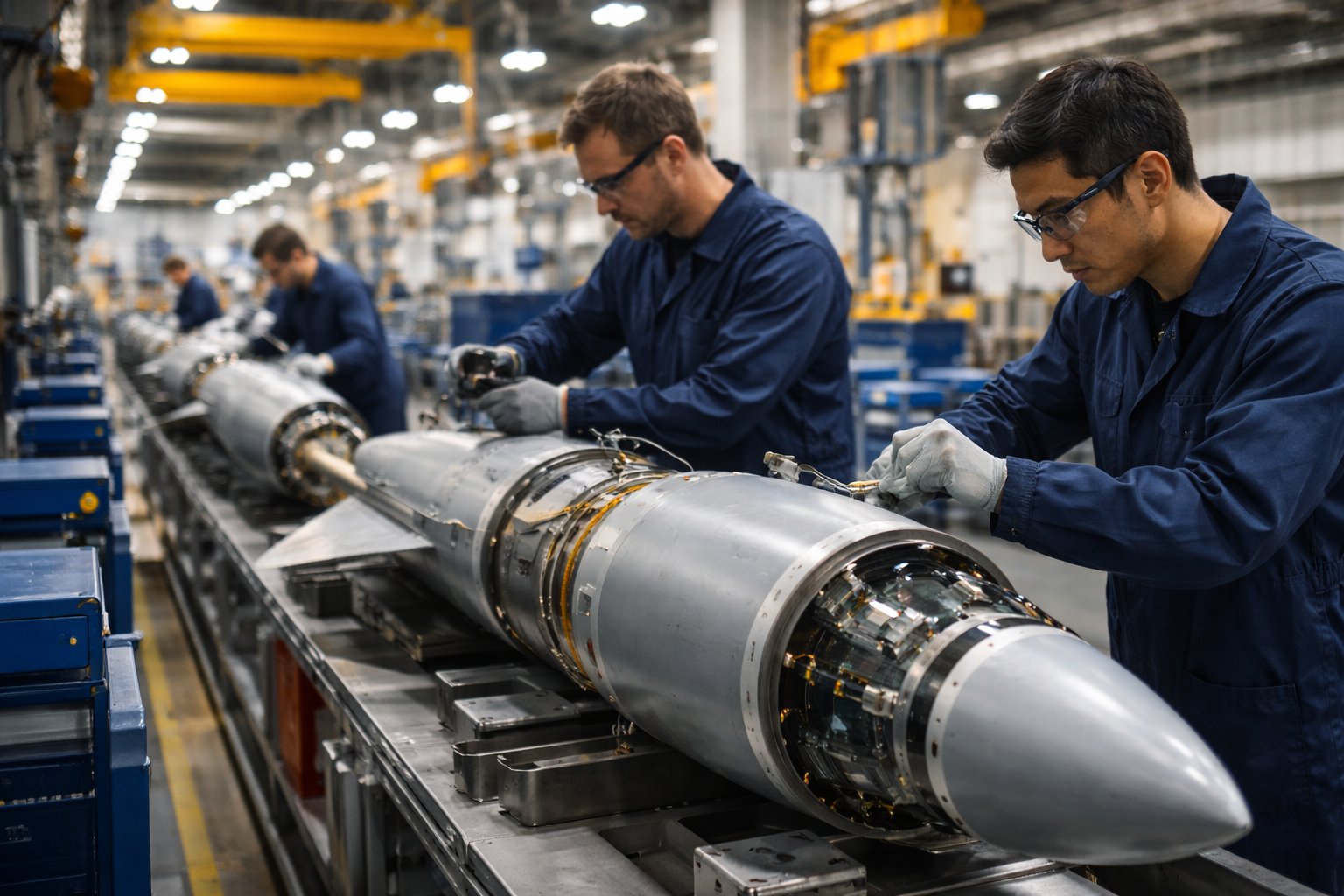
Raytheon has incorporated modular design and automated manufacturing into its production approach. Automation can improve consistency in electronic assembly, component handling, and inspection, while energetic-material processing continues to require specialist controls.
The line must also accommodate software changes without proliferating configurations. Helicopters, conventional aircraft, cruise missiles, and unmanned systems present different signatures and flight behaviours.
Seeker algorithms may therefore change during the weapon’s life even when its physical configuration remains stable. Representative data, controlled software releases, and regression testing will become recurring parts of production support.
One missile must serve two operating models
Shoulder-launched and vehicle-mounted use broadens the production base but increases qualification demands.
A man-portable missile needs manageable weight, acceptable backblast, simple controls, and rapid target acquisition. Soldiers may carry and operate the weapon in difficult terrain with limited maintenance support.
Vehicle-mounted systems can provide external radar cueing, electrical power, networked fire control, and larger ready-to-fire loads. The launcher may direct the missile towards a target before its onboard seeker has acquired it.
A common interceptor can reduce inventory and support complexity, provided the mounted interfaces do not add unnecessary weight or cost to the portable round.
The Army’s M-SHORAD Increment 3 programme could create a substantial vehicle-based requirement. Mechanical launchers, fire-control software, target handover, and reload systems will need to mature on a schedule aligned with missile production.
Broader missile demand is already reshaping investment across the sector, as outlined in the second-quarter review of capacity and procurement. NGSRI will compete for many of the same precision optics, energetic materials, electronic components, and test resources required by other programmes.
The eventual selection will assess producibility and supplier resilience alongside interception performance. Unit cost, delivery rate, maintenance, training, and component availability will influence how many rounds the Army can buy and keep ready.
Multiple guided hits reduce technical risk around the seeker, launcher, and motor, although volume production will expose different weaknesses. A single-source detector, propellant ingredient, or electronic component can constrain the line regardless of overall design maturity.
Long-term orders would support automation, second sourcing, and workforce investment. Uncertain annual quantities could recreate the stop-start conditions that complicated Stinger replenishment.
The next interceptor is expected to outperform Stinger, but its production system must also be more durable. Better range and guidance provide limited benefit when manufacturing cannot replenish stocks during sustained demand.
Raytheon’s firing campaign has advanced the technical design. The remaining contest will determine whether performance, portability, vehicle integration, and industrial resilience can be maintained within one affordable missile.