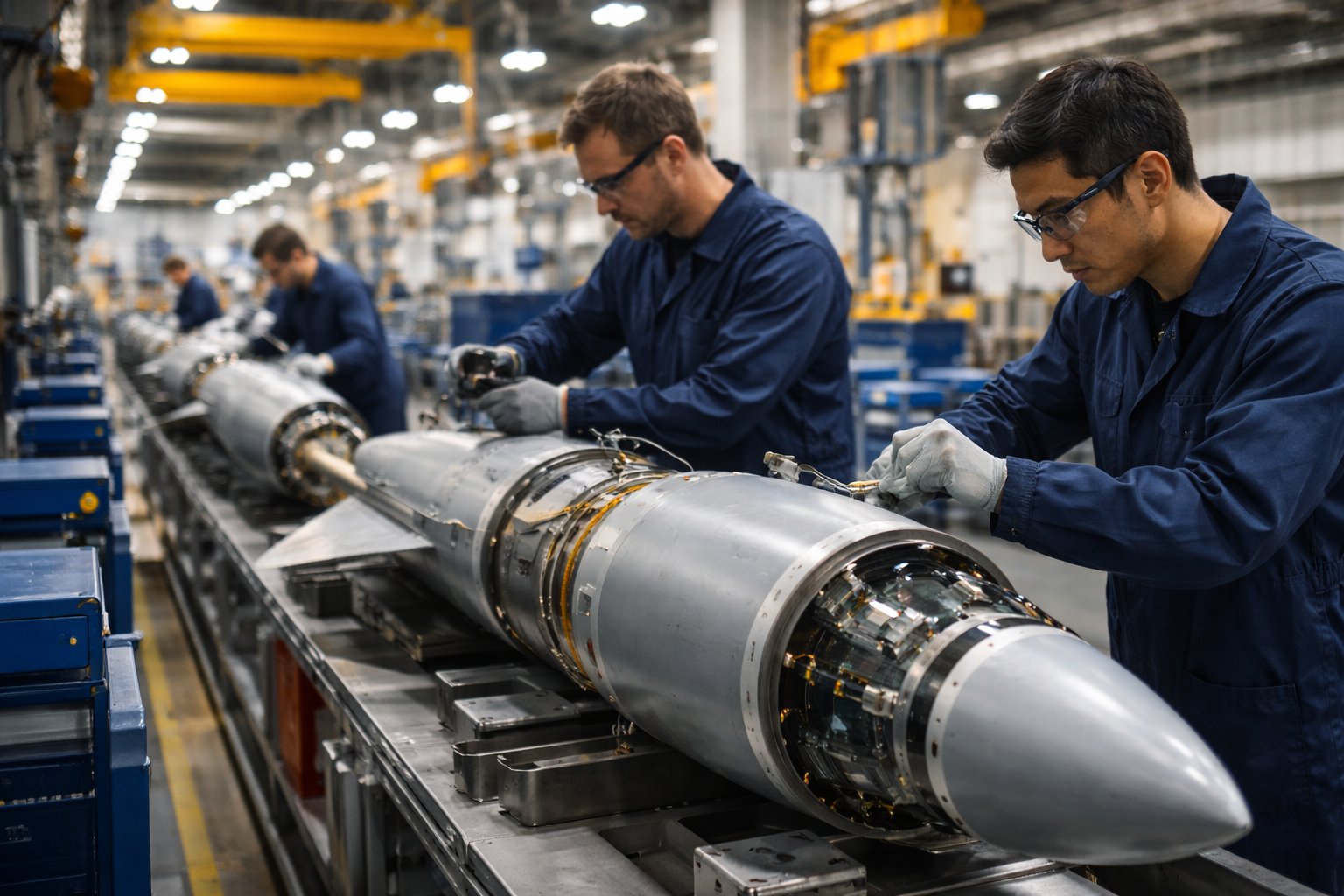
IN Brief:
- Sypris Electronics has received a follow-on award for advanced electronic power-supply modules used in a classified missile avionics suite.
- Deliveries are scheduled to begin in early 2027, extending an established manufacturing role on the unidentified programme.
- Financial terms, production quantities, the prime customer, and the missile system remain undisclosed.
Sypris Electronics has secured a follow-on contract to provide advanced electronic power-supply modules for a classified missile programme, extending its manufacturing role within the weapon’s avionics suite. Deliveries under the new award are scheduled to begin in early 2027, although financial terms, quantities, the customer, and the missile system have not been disclosed.
The award continues an established programme relationship rather than introducing Sypris at prototype stage. The company describes the contract as an extension of long-standing support for the system’s avionics, placing high-reliability electronics manufacturing at the centre of the requirement.
Power-supply modules receive less attention than seekers, processors, guidance systems, or propulsion, but every electronic function in a missile depends on correctly conditioned and reliable electrical power. The modules have to remain functional after storage, transport, and handling, tolerate the vibration and acceleration associated with the weapon, and operate within demanding thermal and electromagnetic conditions.
Those requirements create a manufacturing problem that is more involved than assembling a conventional circuit board. Component traceability, soldering and assembly processes, inspection, environmental testing, configuration control, documentation, and supplier quality all contribute to delivering hardware for an application in which failure costs are exceptionally high.
The September 2026 action follows an earlier Sypris award announced in September 2025 for advanced electronic power-supply modules within a classified missile avionics programme. That previous contract called for production to begin in 2026. The new release instead specifies deliveries starting in early 2027 and describes the latest action as extending production scope, establishing a fresh contractual step rather than a recycled announcement of last year’s work.
Continuity can provide a useful manufacturing advantage. Once a supplier has established tooling, controlled documentation, qualified operators, inspection methods, component sources, and test procedures around a specialised electronic assembly, follow-on work can avoid some of the disruption associated with transferring production to another facility or beginning the qualification chain again.
It does not eliminate supply risk. Defence-electronics manufacturers remain exposed to semiconductor availability, component obsolescence, lead times, supplier concentration, and changes in commercial production. A module can remain technically unchanged while one part within it becomes unavailable, forcing engineering work before a substitute can be introduced.
That issue becomes more significant as munitions production increases. Expanding final missile assembly requires corresponding output from propulsion, structures, seekers, control hardware, energetics, electronic modules, and other qualified suppliers. A bottleneck several tiers below the prime contractor can constrain the final production rate even where assembly capacity has already been increased.
Sypris occupies precisely that less visible part of the industrial base. Its electronics business provides engineering and manufacturing for high-reliability applications across defence, communications, and space rather than delivering a complete missile. Its value to the unidentified programme therefore lies in producing a qualified subsystem repeatedly to the required specification and schedule.
The company explicitly connects the new award with broader efforts to accelerate and expand US munitions production. That does not establish the scale of this particular contract, which remains undisclosed, but it places the follow-on manufacturing requirement within a defence market where suppliers are being asked to sustain higher output across programmes that can share common constraints in electronic components and skilled labour.
Configuration management will be central as the production run continues. Commercial electronic components may change or disappear over the life of a military programme, while replacing them can require design review, qualification, and additional system testing. Maintaining output therefore involves managing both manufacturing capacity and the technical baseline of the module.
The September announcement does not establish whether the latest action increases annual production, extends the programme duration, introduces a revised module, or combines several of those changes. Nor does it identify whether the missile is launched from an aircraft, ground system, or naval platform. Those details remain outside the public record and should remain outside the story.
What can be established is a production relationship continuing into another delivery cycle from early 2027. That makes the contract relevant for its industrial continuity rather than the operational characteristics of an unidentified weapon.
The useful measure will be whether Sypris can meet the new delivery requirement while preserving component availability, manufacturing yield, inspection performance, and configuration control. Large munitions programmes are often illustrated by final assembly lines; they remain dependent on specialist suppliers delivering comparatively anonymous electronics at exactly the same pace.