IN Brief:
- Taiwan is seeking to cancel a contract for 26 fixed-site counter-UAS systems after repeated test failures.
- The system combines passive RF sensing, 4D AESA radar, electro-optical tracking, command software, and directional jamming.
- The dispute highlights the gap between published subsystem specifications and acceptance of an integrated military capability.
Taiwan is moving to cancel a NT$987.81 million contract for 26 fixed-site counter-drone systems after the equipment failed prototype verification and two initial acceptance assessments.
Several of the systems had been expected to protect sensitive facilities and outlying islands positioned close to the Chinese mainland. Their repeated test failures have instead placed radar performance, jamming range, sensor integration, software stability, and military acceptance standards under examination.
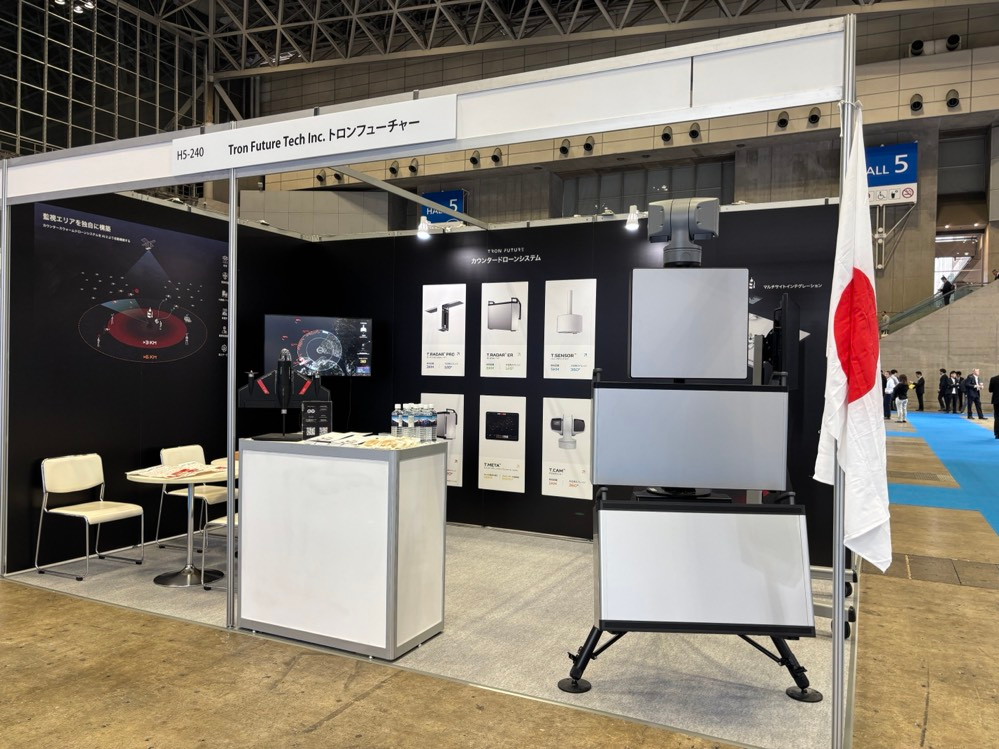
Taiwanese counter-UAS specialist Tron Future developed the equipment around a layered architecture combining passive radio-frequency detection, a four-dimensional active electronically scanned array radar, electro-optical tracking, command-and-control software, and an AESA jammer. The contract required the system to detect small, low-observable drones from at least six kilometres and disrupt them at four kilometres.
Those ranges become demanding when applied to small aircraft flying close to terrain, buildings, vegetation, or the sea. Civilian radio traffic, reflections, adverse weather, and electromagnetic interference can obscure targets or produce false tracks, while autonomous drones may provide no active command link for passive sensors to detect.
Tron Future’s T.Radar ER uses an S-band, software-defined AESA architecture with digital beamforming and track-while-scan functions. It is designed to detect targets with radar cross-sections as low as 0.01 square metres and provide position, speed, and signature data to the wider system.
Passive detection is supplied through the T.Sensor, which monitors remote-control links, video transmissions, navigation frequencies, and Remote ID signals. A T.Cam electro-optical unit provides visual confirmation, while the T.Jammer is intended to disrupt command, telemetry, video, and satellite-navigation bands.
Individually credible specifications do not automatically produce an accepted military capability. Radar tracks must be associated with the correct radio-frequency contacts, command software must fuse and classify those inputs, cameras must acquire the target, and the jammer must apply an appropriate effect before the aircraft reaches the protected area.
Latency accumulates throughout that sequence. A radar track that takes too long to stabilise may delay optical confirmation, while weak classification can create false alarms or direct the jammer towards the wrong sector. Directional interference loses value when tracking accuracy is poor, yet broad jamming can disrupt friendly communications, navigation, or civilian equipment.
From demonstration to acceptance
Counter-UAS procurement increasingly exposes the difference between controlled demonstrations and repeatable military acceptance. Suppliers can arrange trials around known targets, predictable flight paths, uncluttered spectrum, and experienced operators, whereas operational testing has to account for changing weather, interference, terrain, unfamiliar crews, and aircraft using several guidance methods.
Test design therefore forms part of the production system. Requirements need to define target size, speed, altitude, approach geometry, emissions behaviour, weather, clutter, acceptable false-alarm rates, and the period over which performance must be sustained. Pass-and-fail criteria must also separate subsystem faults from installation problems, software defects, and weaknesses in the original specification.
Fixed sites add further constraints. Radar sectors, terrain masking, antenna height, power supply, cooling, network resilience, and physical hardening all shape performance once the equipment leaves a test range. Coastal and urban installations can present very different electromagnetic and environmental conditions from those used during development.
Repeated acceptance failures also raise questions about the treatment of domestic suppliers during accelerated procurement. Taiwan has strong electronics, semiconductor, radar, and communications industries, but converting those capabilities into integrated military systems requires configuration control, environmental qualification, software assurance, documentation, and stable batch production.
Cancellation may prevent an underperforming configuration from entering service, although an abrupt return to imported equipment could discard technical knowledge accumulated through the programme. Where the gap remains recoverable, redesigned trials, phased acceptance, or replacement of specific subsystems may preserve more domestic capability than terminating the entire effort.
Similar pressures are emerging across the region. Japan’s interceptor-drone evaluations are placing candidate systems through proof-of-concept activity before larger acquisition decisions are made, allowing requirements and integration assumptions to be tested before production volumes are fixed.
Range figures alone will not decide which counter-UAS systems survive procurement. Defence customers increasingly require evidence covering detection probability, false-alarm performance, resistance to electronic attack, maintainability, software reliability, and successful operation against aircraft that navigate autonomously without an active control signal.
The Taiwanese dispute shows how quickly an urgent requirement can move from contract award to acceptance failure when subsystem performance is mistaken for integrated capability. Radar, jamming, optics, software, and command equipment must operate as one defensive chain, under conditions that seldom resemble a supplier demonstration.