IN Brief:
- Türkiye has brought the İHA-230 air-to-surface ballistic missile into service for combat drones.
- The weapon links UAV production, missile engineering, guidance resilience, software integration, and payload certification.
- The programme reflects a wider shift toward distributed precision fires carried by uncrewed aircraft.
Türkiye has brought the İHA-230 air-to-surface ballistic supersonic missile into service, extending the strike role of combat drones and adding another production layer to the country’s expanding unmanned systems sector.
The Roketsan missile is designed for launch from uncrewed aircraft including Bayraktar Akıncı, Aksungur, and Kızılelma-class platforms. With a stated range above 150km depending on release conditions, it gives UAVs a standoff precision-strike role more commonly associated with crewed combat aircraft or ground-launched rocket artillery. Türkiye’s defence-industrial model is increasingly built around that convergence, with drones, missiles, sensors, and mission software developed close enough together to support rapid integration.
The industrial task reaches well beyond missile assembly. An air-launched ballistic missile places unusual demands on the host aircraft, including carriage loads, release dynamics, vibration, software interfaces, flight-control effects, mission planning, safety certification, and targeting data management. A weapon that performs well in ground-based testing still has to behave consistently when released from an uncrewed aircraft at altitude, under changing aerodynamic conditions, and with the aircraft’s own performance limits in play.
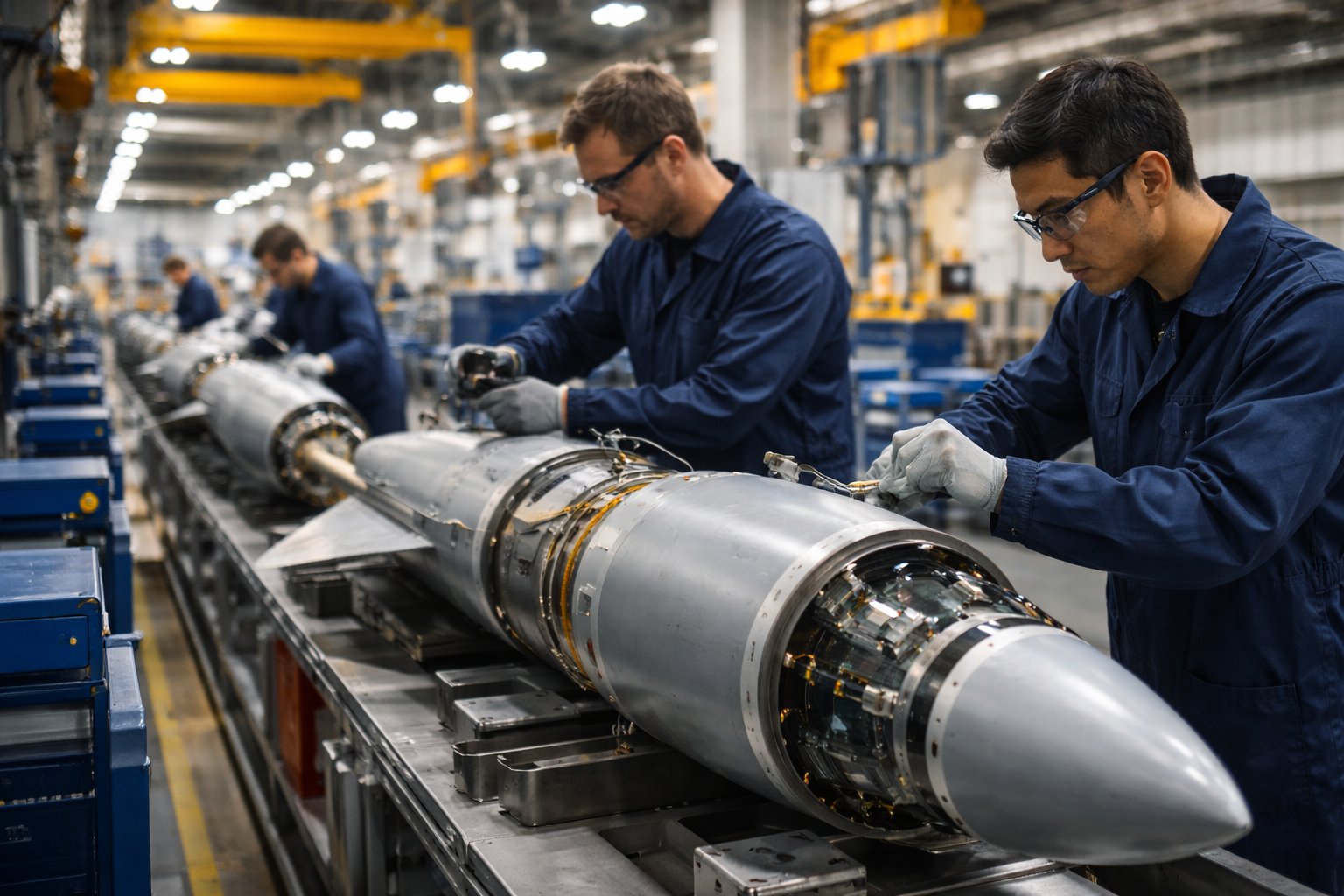
Roketsan’s İHA-230 builds on a wider guided weapons portfolio, but the UAV launch application creates a distinct production challenge. Air-launched weapons require repeatable manufacturing tolerances, safe carriage envelopes, reliable ignition after release, and predictable separation. Those requirements bring extensive qualification work across pylons, software, airframe structures, launcher mechanisms, and ground-support equipment.
Türkiye’s advantage lies in the proximity of its drone and missile sectors. Baykar, Turkish Aerospace, Roketsan, and other domestic suppliers operate within a defence-industrial ecosystem where aircraft, payloads, guidance systems, and control architectures can be developed with fewer external restrictions than multinational programmes often face. That does not remove the engineering difficulty, but it reduces integration friction and allows domestic customers to field combinations that would be harder to certify if major subsystems came from unrelated international suppliers.
The İHA-230 also changes the economics of precision fires. A UAV carrying a ballistic missile can threaten targets at significant range without the cost, risk, and infrastructure demands of a crewed fast-jet strike package. It does not replace fighter-delivered stand-off weapons, but it does add another layer to a distributed fires architecture. That creates demand for mission-planning tools, targeting pods, encrypted datalinks, weapons interfaces, and drone ground-control infrastructure.
Türkiye’s wider investment in airborne electronic and offensive systems adds context to the missile’s entry into service. The HAVA SOJ electronic-attack aircraft programme shows the same domestic push toward systems that can shape the battlespace, protect strike packages, and reduce reliance on imported mission platforms. İHA-230 applies that same logic to the uncrewed strike domain.
The Ukraine war has accelerated interest in distributed precision effects, uncrewed strike platforms, and lower-cost alternatives to traditional airpower. Türkiye’s model has drawn attention because it combines comparatively mature drone production with an increasingly capable missile and electronics base. Customers without large fleets of advanced combat aircraft may see armed UAVs with standoff weapons as a more accessible route to deterrent capability, provided sustainment and training can keep pace.
The supply chain behind the missile will be watched closely. Solid rocket motors, guidance units, anti-jam navigation, warheads, control actuators, composite structures, electronics packaging, and test equipment will determine whether the weapon can be produced at useful scale. The leap from entry into service to sustained operational availability depends on consistent manufacture, spares, diagnostics, training, and integration across multiple aircraft types.
There are operational limits. A UAV carrying a large missile may be more visible, less manoeuvrable, and more dependent on airspace access, communications, and survivability planning. Even so, precision strike is moving into distributed and uncrewed platforms, creating a more crowded industrial field in which drone manufacturers, missile houses, electronics suppliers, and software teams compete around the same future strike architecture.
The İHA-230’s entry into service shows how Türkiye is turning uncrewed aircraft into carriers for heavier effects. It also shows how drone and missile production lines are beginning to merge into a single offensive technology ecosystem, where platform, payload, guidance, and software are developed as connected elements rather than separate procurements.