
IN Brief:
- The US Air Force awarded KestrelX, A2G International and Fleet Adversary Support and Training positions under its CAF CAS contracting programme.
- The three IDIQ awards carry a reported $5.4 billion ceiling for adversary-air and close-air-support services through 8 October 2029.
- Only $3,000 of fiscal 2027 operations and maintenance funding was obligated at award; no aircraft production order was identified.
The US Air Force has awarded three companies indefinite-delivery/indefinite-quantity contracts under its Combat Air Force Contracted Air Support programme, a vehicle used to procure adversary-air and close-air-support services for training. The selected contractors are KestrelX, A2G International and Fleet Adversary Support and Training. The contract notice cites a $5.4 billion ceiling, while the Air Force initially obligated just $3,000. The work concerns training aircraft and support services, rather than procurement of newly manufactured combat aircraft.
The awards were made on 15 October and announced in the Department of War’s contract bulletin the following day. KestrelX, based in Driggs, Idaho, received contract FA4890-27-D-0003; Melbourne, Florida-based A2G International received FA4890-27-D-0002; and Fleet Adversary Support and Training of St Augustine, Florida, received FA4890-27-D-0001. The department recorded three offers for the competitive procurement. Performance is expected to run across the continental United States until 8 October 2029.
The indefinite-delivery/indefinite-quantity (IDIQ) vehicle sets a ceiling and terms for later orders without committing the Air Force to purchase that amount. Its $5.4 billion ceiling is not an award of that sum to each company, nor evidence that the service has committed an additional $5.4 billion beyond the programme’s existing authority. Obligations arise when funding is committed against particular orders. Only $3,000 of fiscal 2027 operations and maintenance funds was obligated on the three awards at signature; future funding depends on task orders.
Adversary-air services provide aircraft, crews and supporting personnel to replicate opposing forces or tactical problems during training. Contracted close air support gives ground controllers aircraft to direct against simulated targets, exercising communications, identification and coordination procedures. Contractors must provide the service under agreed operating and safety arrangements, while the government defines the actual training requirement. The announcement does not specify aircraft types, fleet sizes, flight hours or guaranteed sorties for any selected contractor.
Individual task orders would establish where and when particular flying services are needed, alongside the applicable technical and safety conditions. Aircraft availability, airworthiness, maintenance, qualified aircrew and range integration can govern whether that service is ready to be delivered. Training missions may require a particular flight profile or threat representation, which in turn affects aircraft selection, equipment fit and sortie preparation. The contract notice does not allocate aircraft configurations or training profiles to the three awardees.
KestrelX has separately developed aircraft-based threat replication concepts for drone and cruise-missile training. Separate US small-business research records describe earlier work on aircraft intended to reproduce selected aerial threat characteristics. KestrelX also markets aircraft for threat replication and military training. Those activities establish relevant company experience, but the CAF CAS notice does not order a named KestrelX platform or fund an aircraft manufacturing line.
A2G International operates in airborne services and integration, while Fleet Adversary Support and Training is named as a third awardee in the government contract notice. Each business has secured a contract position, while funded flying activity and allocation between companies remain subject to later orders. The department has not published the winning companies’ proposed aircraft complements, training rates or subcontract arrangements. The announcement does not establish new operating bases, additional personnel or equipment purchases by the awardees.
Contractor-provided adversary aircraft allow the Air Force to buy training sorties without maintaining an identical government-owned fleet for every simulated threat. Spending under these awards is consequently more closely tied to flight operations, maintenance and supporting technical services than to aircraft assembly. Any later equipment modification or fleet expansion would need its own supporting evidence rather than being inferred from the IDIQ ceiling. Suppliers still need reliable sustainment arrangements to keep equipment available, but the scale of that demand will depend on subsequent orders and utilisation rather than the ceiling alone.
The acquisition was administered by the Acquisition Management and Integration Center at Langley Air Force Base, Virginia. The Air Force had already selected other CAF CAS service providers in 2024; the October notice adds three awardees without explaining whether their stated ceiling is wholly shared with those earlier positions. Three offers were received in this competition, but the government has not disclosed how work will be divided among current and earlier awardees.
The immediate contractual outcome is access to future orders for defined training services. Funded task orders, contracted flying schedules and performance records will show which suppliers actually deliver training capacity. The 16 October bulletin contains no substantial task order or scheduled flight-hour allocation. The expected October 2029 completion date closes the announced performance period; it does not guarantee any individual company a minimum workload or a production programme.
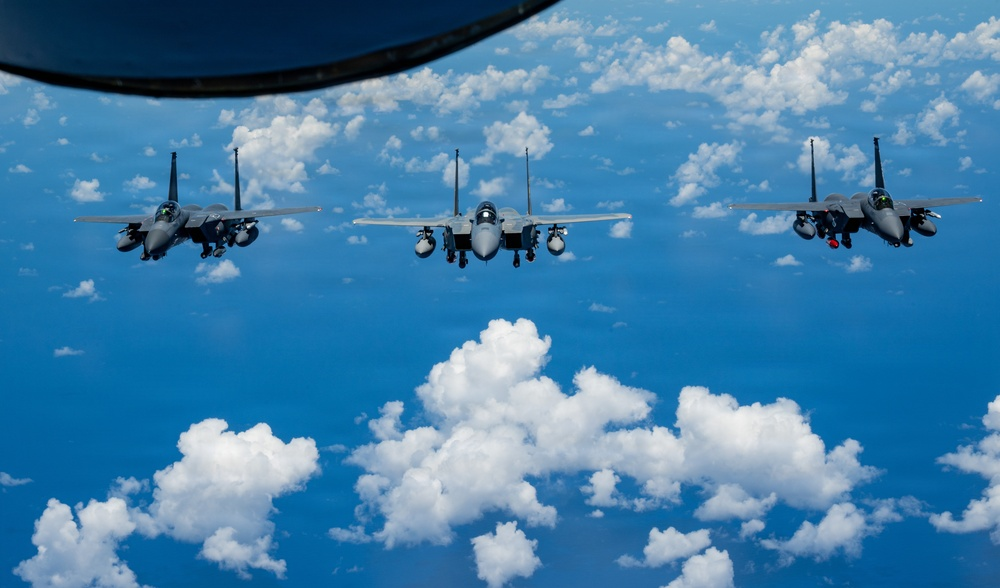
Archival photograph: U.S. Air Force (January 2025). Illustrates adversary-air training, not a newly awarded contractor aircraft.
