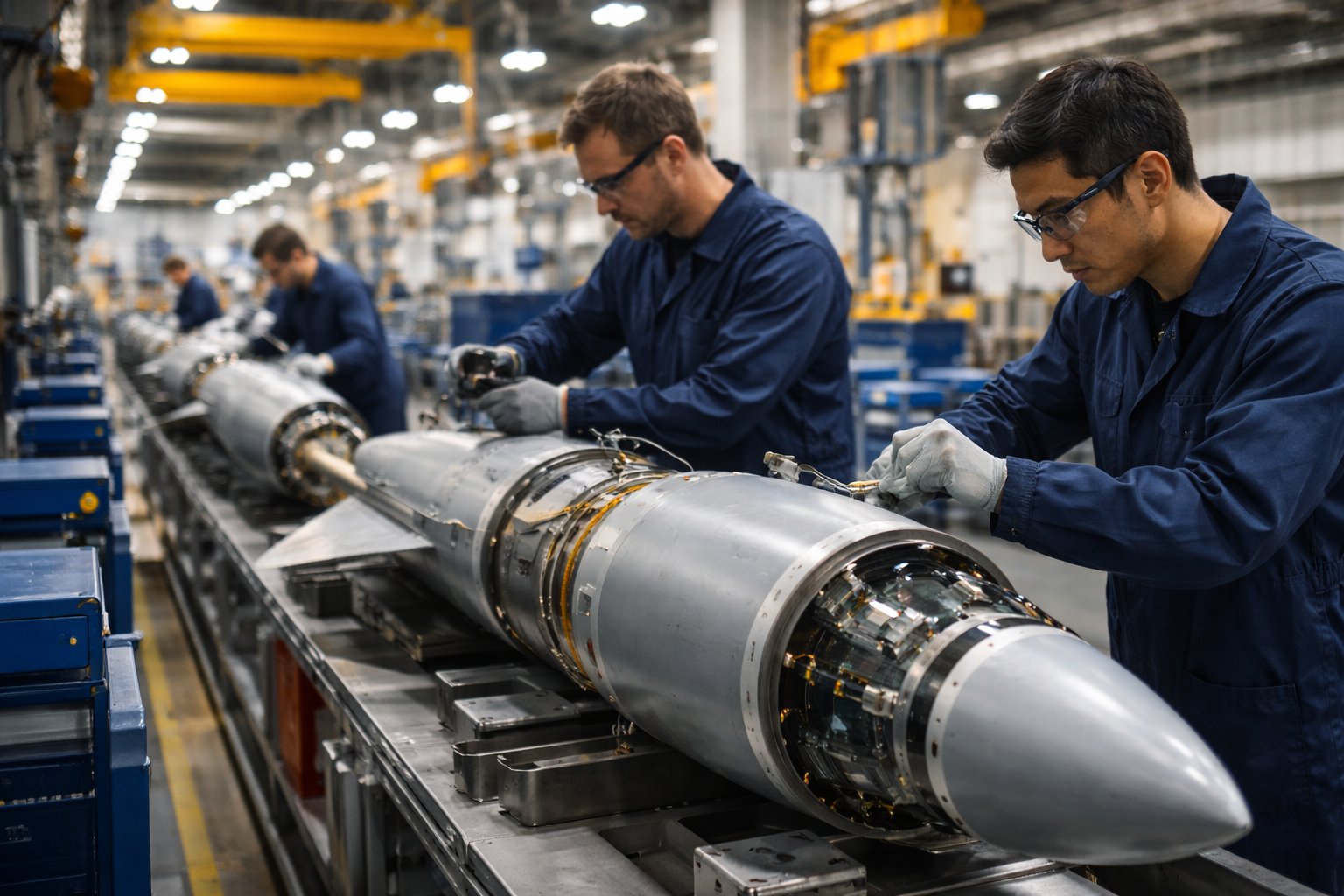
IN Brief:
- The US Air Force has designated the Next Generation Penetrator as GBU-76/B.
- The weapon is intended as a follow-on to the GBU-57/B Massive Ordnance Penetrator.
- Production planning covers design, manufacture, testing, aircraft integration, software, logistics, and sustainment.
The US Air Force has moved early planning for its Next Generation Penetrator into sharper focus, designating the future hard-target weapon as the GBU-76/B.
The weapon is intended as a follow-on to the GBU-57/B Massive Ordnance Penetrator, the 30,000 lb-class bunker-buster associated with deeply buried and hardened targets. Early acquisition activity covers system design, manufacturing, production, testing, delivery, logistics, aircraft integration, software support, storage, training, and sustainment.
A modern penetrator is much more than a heavy bomb casing. Structural strength, material properties, warhead design, fuze performance, guidance, navigation, aircraft carriage, release envelope, mission planning, and target effects all have to align. For deeply buried targets, small variations in impact angle, speed, guidance accuracy, fuze timing, or casing integrity can change weapon performance.
The planned GBU-76/B appears to be shaped by a different carriage and survivability logic from its predecessor. A lighter next-generation penetrator could widen platform options, potentially giving future aircraft more flexibility than the very large GBU-57/B allows. Integration work will therefore sit at the centre of the production task, covering weapon size, mass, centre of gravity, bay compatibility, release dynamics, software interfaces, and mission-planning data.
Navigation resilience is another major driver. Hard-target weapons may be used in environments where GPS is degraded, denied, or manipulated. Alternative navigation, hardened electronics, and robust guidance are core design requirements rather than add-ons. Producing those subsystems requires qualified electronics suppliers, secure software development, environmental testing, and confidence that components can survive vibration, shock, storage, and operational release conditions.
The programme sits within a broader US effort to strengthen complex weapons production. Leidos moves hypersonics toward production showed how advanced missile work is being pushed closer to manufacturing scale. The GBU-76/B is a different class of weapon, but it draws on the same industrial foundations: qualified energetic materials, precision machining, guidance electronics, modelling, test infrastructure, and specialist labour.
Hard-target defeat weapons bring a specific manufacturing challenge because production volumes may be lower than tactical missiles or artillery rounds, while engineering assurance remains exceptionally high. Suppliers must retain skills even when orders are episodic. That is difficult for companies balancing classified requirements, export controls, specialist materials, long qualification cycles, and competing demand from other weapons programmes.
Testing will be another constraint. Penetrator weapons require controlled trials, instrumentation, representative target structures, and analysis of underground effects. Those environments are expensive and scarce. Digital modelling can reduce the number of physical trials, but it cannot replace them entirely when validating new materials, fuze behaviour, casing performance, and navigation systems.
A credible hard-target weapon also needs a sustainment model that lasts long after production. Storage life, inspection regimes, aircraft software compatibility, upgrade pathways, technical documentation, and spares all shape operational readiness. A weapon that sits in inventory for years still requires surveillance, configuration control, and periodic assessment.
The supplier network will likely extend well beyond bomb-body production. Precision materials, warhead energetics, navigation components, mission-planning software, aircraft integration, ground-support equipment, transport fixtures, and test instrumentation all feed into the system. Companies with proven experience in classified weapons work and controlled supplier management will be central to any future production pathway.
The GBU-76/B also illustrates the difference between mass demand and strategic demand. Some weapons are not required in the quantities associated with artillery, air-defence interceptors, or tactical missiles, but their production chains remain strategically valuable. The capability depends on maintaining highly specialised design, test, and manufacturing capacity that cannot be recreated quickly once it has withered.
As planning advances, the key question for industry will be whether the US can modernise hard-target defeat without allowing cost, integration complexity, or supplier fragility to slow the weapon before it reaches operational aircraft. The GBU-76/B will test a specialised corner of the weapons base, where low volume and high consequence make production discipline especially unforgiving.