IN Brief:
- France’s DGA has ordered the Aliaca VTOL configuration for French Navy operations.
- The 25 kg-class mini-UAS combines VTOL launch with fixed-wing cruise endurance.
- Shipborne drone adoption is expanding to smaller platforms without catapults.
France’s Directorate General of Armament (DGA) has ordered a new version of the French Navy’s shipborne mini-drone system from Airbus Helicopters, specifying the vertical take-off and landing configuration of the Aliaca uncrewed aerial system. Airbus said the DGA has ordered a total of 34 Aliaca systems for the French Navy since 2022, and that deliveries of the VTOL version will begin in May 2026 following a qualification campaign, making the French Navy the first operator of this configuration.
“We are proud to be able to deliver the VTOL version of the Aliaca to the French Navy for the first time,” said Christophe Canguilhem, Aliaca programme director at Airbus Helicopters. “The French Navy has successfully operated the Aliaca from its ships and from land for several years. The SMDM, as it is named in the French Navy, has demonstrated its full potential in operation.” He added that the VTOL version will allow operation “with even more flexibility,” and said the amendment shows the solution is “mature and available” for customers worldwide.
The VTOL configuration is designed to remove the need for launch-and-recovery systems, reducing the logistical footprint and widening the set of ships that can carry and operate the system. Airbus said operators retain the same ground station already in service. For navies trying to push sensing further out from small hulls without re-engineering decks for catapults or arresting gear, that matters as much as the aircraft itself, because it reduces integration cost and shortens the path from procurement to operational deployment.
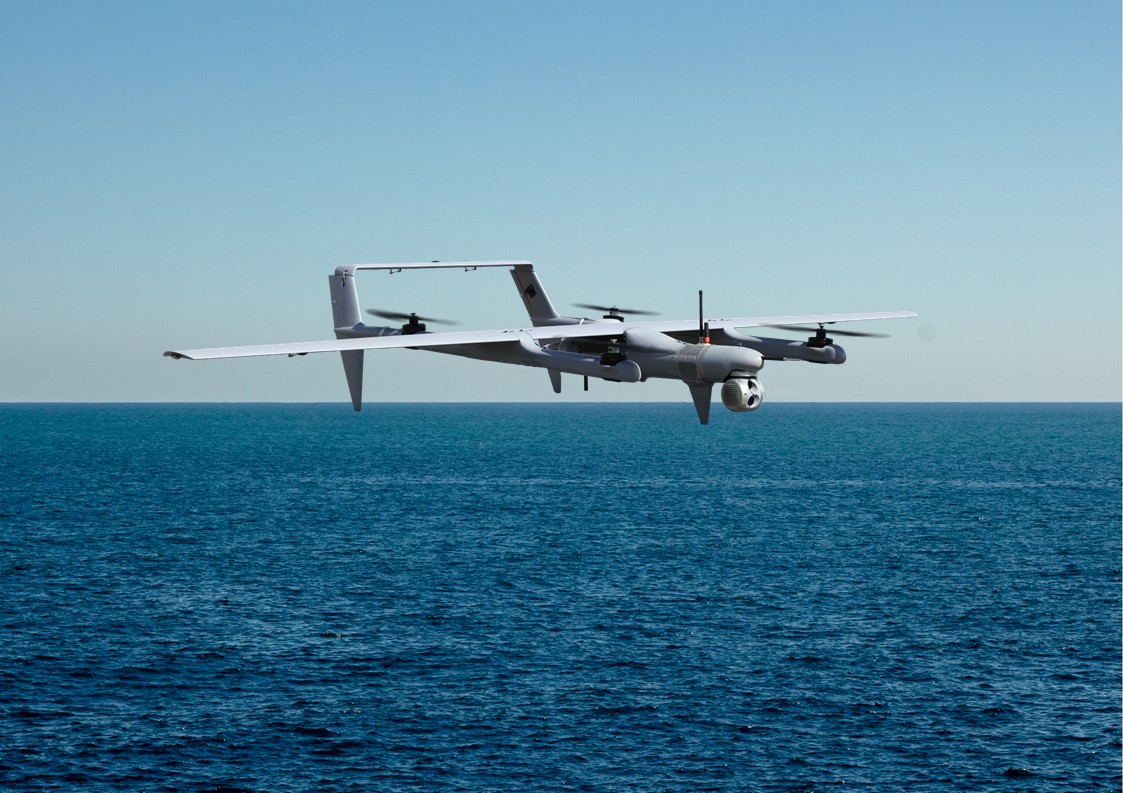
Airbus said the Aliaca VTOL was tested on land and at sea at the end of 2024 and throughout 2025, and was unveiled in April 2025 after being developed in less than a year from a version already in French Navy service. The company described the aircraft as a tactical mini-drone with four propellers enabling vertical take-off and landing, while retaining fixed-wing propulsion during the mission, with a maximum take-off weight of 25 kg, a wingspan of 3.5 m, and a length of 2.1 m. It has an endurance of two hours and a range of 50 km, and Airbus said the payload fit includes a camera, a gyro-stabilised electro-optical/infrared system, and an Automatic Identification System capable of identifying a ship within a radius of several hundred kilometres.
In service, the system is known as SMDM and has been operational since 2022, described by Airbus as the French Navy’s “remote binoculars.” It currently equips high-sea patrol vessels (PHM), overseas patrol vessels (POM), and surveillance frigates, and has also been used from the French coast for search and rescue missions in the English Channel since summer 2023. Airbus said the VTOL version is intended to equip other vessel types for missions including situational awareness, surveillance, search and rescue, and detection of suspicious behaviour, with longer-term plans to support coastal surveillance from land.
The DGA is expected to run early-2026 land and sea qualification trials before declaring the VTOL configuration operational, while the fixed-wing version remains in use and will be maintained for at least seven years.