IN Brief:
- A 181,055 m² Romanian facility will anchor Hanwha’s European land-systems output.
- Initial production focuses on K9 howitzers and K10 resupply vehicles, plus sustainment.
- Localisation targets will depend on Romanian sub-tier readiness and qualification pace.
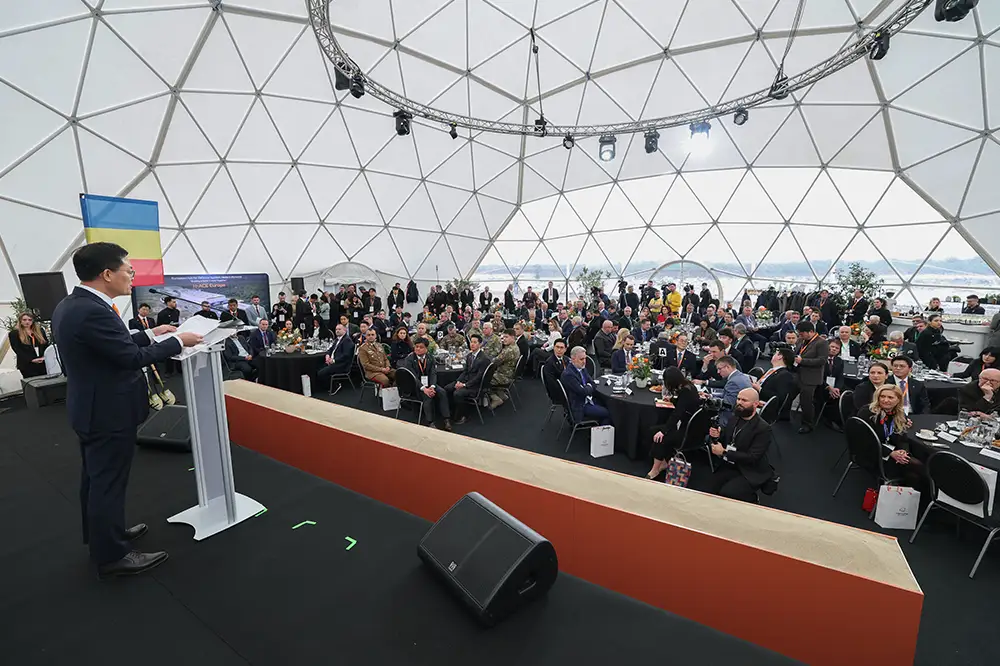
Hanwha Aerospace has broken ground on a new armoured-vehicle production facility in Petrești, Dâmbovița County, establishing its first land-defence manufacturing site in Europe.
The site, named the Hanwha Armoured Vehicle Centre of Excellence (H-ACE) Europe, is designed to support assembly, integration, testing, and lifecycle support for the K9 self-propelled howitzer and the K10 ammunition resupply vehicle. Hanwha has set a localisation target of up to 80% through Romanian industrial participation, alongside an expansion plan that could later encompass infantry fighting vehicles and unmanned ground systems.
“This will be Hanwha Aerospace’s first production facility in Europe and will grow into a core production site for European land systems,” said Jae-il Son, President and CEO, Hanwha Aerospace.
H-ACE Europe is planned at approximately 181,055 square metres and is set to include advanced assembly lines, performance and validation testing facilities, a 1,751-metre driving test track, and dedicated R&D laboratories intended to support the full lifecycle of land-systems development, production, and sustainment. Romania’s earlier K9 and K10 procurement provides the initial programme pull-through for the facility, with Hanwha also citing cooperation with more than 30 Romanian partners as the base layer for localisation.
Armoured vehicle localisation is rarely achieved by swapping one supplier list for another. The hard parts are structural fabrication and repeatable precision: welded hulls and subframes, machined interfaces, suspension and running gear components, and the steady supply of harnessing, connectors, and hydraulic assemblies that can survive shock, vibration, and harsh maintenance cycles.
The move also changes the production footprint required in-country. Even with kits and major subassemblies arriving from existing Hanwha lines, a local plant must be able to manage dimensional control, torque and assembly processes, functional checks, and configuration discipline across variants. That typically forces investment in fixtures, metrology, calibrated tooling, and trained inspection capacity early, because rework on armoured vehicles is slow, visible, and expensive.
The inclusion of a driving test track and validation facilities is a signal that the factory is being built for acceptance testing and sustainment as much as final assembly. For artillery systems, proving reliability is not a paperwork exercise: it comes from repeatable build quality, stable suppliers, and the ability to diagnose faults without stripping vehicles back to frames.
Throughput will depend on how quickly sub-tier suppliers can be qualified to defence standards and pulled into the plant’s production rhythm. If Hanwha moves beyond K9 and K10 into additional land systems, the next industrial constraint will be workforce depth — welders, machinists, test technicians, and quality engineers — rather than physical floor space.