IN Brief:
- IISS analysis indicates China launched more nuclear-sub tonnage than the US in 2021–25.
- Expansion at Bohai Shipbuilding’s Huludao site has increased throughput for SSBNs and SSGNs.
- Undersea competition is increasingly shaped by shipyard capacity and supplier depth.
An analysis by the International Institute for Strategic Studies (IISS) indicates China has surpassed the United States in nuclear-submarine production by both launch count and estimated displacement over the 2021–2025 period, reflecting a shift in the industrial balance underpinning undersea capability.
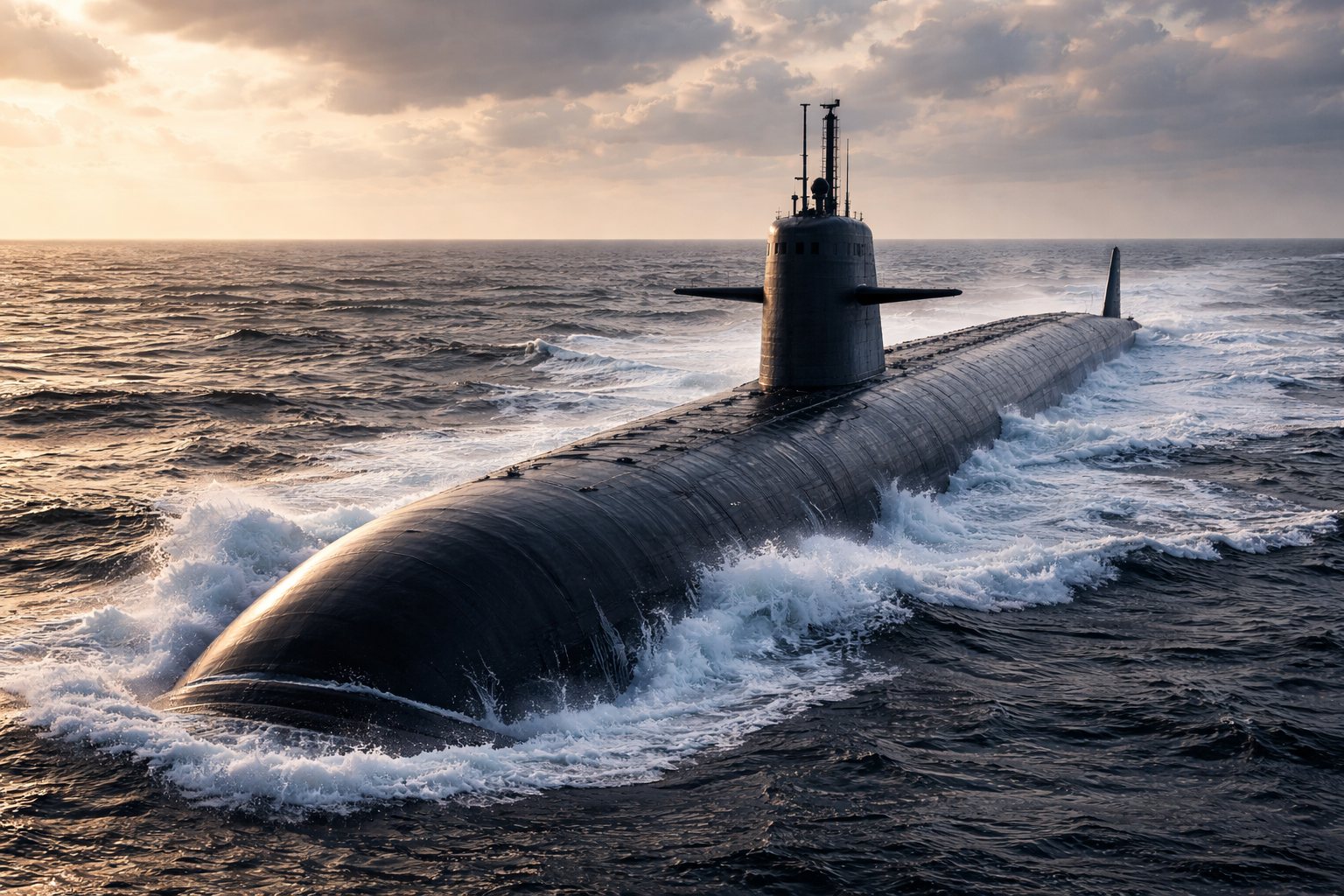
IISS research assessing commercially available satellite imagery estimates China launched 10 nuclear submarines with an estimated displacement of 79,000 tonnes between 2021 and 2025, compared with seven US boats totalling around 55,000 tonnes over the same period. The analysis links the higher output to an expansion at Bohai Shipbuilding Heavy Industry Co (BSHIC) in Huludao between 2019 and 2022, including a second submarine manufacturing hall and supporting facilities.
The same IISS assessment associates recent output with continued production of Type 094 ballistic-missile submarines, as well as nuclear-powered guided-missile submarines, pointing to a pattern of parallel construction rather than episodic, single-hull delivery. That matters because industrial rhythm is hard to fake: once a yard has stabilised its workforce, process flow, and supplier inputs for nuclear boat production, it can convert budget and policy intent into steel in the water with fewer delays.
Submarine production is a systems problem disguised as a shipbuilding problem. A second manufacturing hall does not just add covered space; it changes how modules are fabricated, moved, joined, and reworked, and it reduces the operational penalty of running multiple builds at different stages simultaneously.
Nuclear submarines also impose a supply chain discipline that is closer to civil nuclear than conventional naval construction. Steel quality assurance, specialist welding procedures, high-integrity pipework, and reactor-adjacent component traceability all require stable, audited supplier networks. Expanding physical infrastructure only delivers higher output if the upstream industrial base can match it.
At sustained production rates, workforce development becomes a limiting factor. Nuclear-qualified trades do not scale instantly, and neither do the inspection and test resources that validate each stage of build. That puts pressure on training pipelines, retention, and the industrial management systems that prevent rework from consuming schedule.
For navies watching the Indo-Pacific, the practical question is no longer only which submarines are quieter, faster, or better armed. It is also how quickly hulls can be produced, upgraded, and sustained over decades, and how resilient the underlying supply chain remains under geopolitical friction. Industrial capacity does not guarantee operational dominance, but it sets the boundary conditions for what is affordable, available, and replaceable.