IN Brief:
- A multi-year subcontract worth “several tens of millions of dollars” will expand small turbojet output in the US.
- PBS Aerospace is scaling production of compact engines intended for missile and unmanned applications.
- The award tightens transatlantic supply integration as propulsion becomes a pacing item for attritable systems.
PBS Aerospace has signed a multi-year subcontract agreement with Zone 5 Technologies, valued at “several tens of millions of dollars,” to support defence propulsion programmes. The work is set to run through PBS Aerospace’s US manufacturing operation in Roswell, Georgia, reinforcing a shift already underway in the market: small turbojets are no longer specialist hardware for a narrow set of targets, but a core industrial input for low-cost missiles, drone interceptors, and uncrewed aircraft.
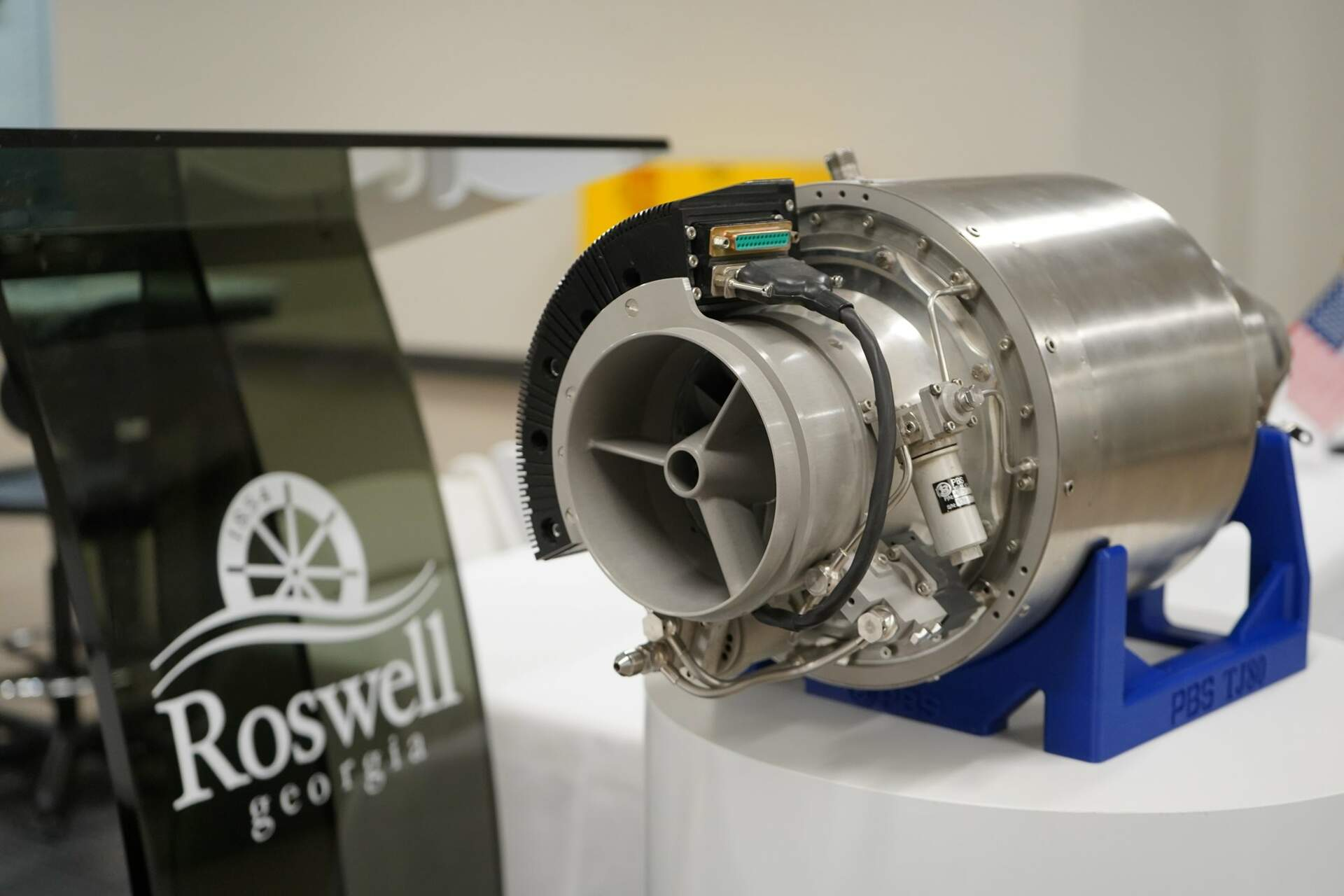
PBS Aerospace is the US subsidiary of PBS Group, and the subcontract lands after the company established its Roswell headquarters and manufacturing footprint with a stated $20m investment. PBS says the facility is operational and scaling, with production centred on compact turbojet families such as the PBS TJ40 (around 100 lbf thrust) and TJ80 (up to 200 lbf), designed for integration where size, weight, and repeatable performance dominate system trade-offs.
Erin Durham, CEO of PBS Aerospace, said: “Our Georgia facility is operational and scaling production to meet the demands of customers who require reliable, high-performance propulsion systems.” The award ties directly to Zone 5’s portfolio of digitally engineered, low-cost weapons and uncrewed systems, where propulsion availability is one of the few components that cannot be trivially substituted at the last minute.
The timing matters because demand signals are converging across mission sets. The same class of small turbojet can sit behind a loitering platform, a cruise-missile-like munition, or an interceptor — and each of those categories is being pulled toward higher production volumes than traditional acquisition cycles were built to handle. That, in turn, puts pressure on engine manufacturers to behave less like bespoke aerospace suppliers and more like high-discipline industrial producers, without dropping the quality floor that rotating machinery demands.
Scaling small turbojets without losing yield
A compact turbojet is still a turbojet: high-temperature materials, tight tolerances, and components that see extreme rotational speeds. The difficult work is not adding a second shift; it is keeping yield stable as throughput rises. That means investment in fixture design, automated measurement, and balancing processes, plus test-cell capacity to validate performance across batches rather than treating every engine as a stand-alone engineering artefact.
For defence customers, repeatability is often the real requirement. Thrust is one number; thrust consistency across a production run is what keeps range predictions honest and reduces integration rework on the vehicle side. The Roswell site’s value, if PBS can execute, is giving US programmes a domestic line with predictable test and acceptance routines, rather than relying on transatlantic shipment schedules for every engine.
Propulsion sits at the intersection of export controls, quality systems, and traceability. Even where core designs originate in Europe, US defence integration typically requires US-based documentation practices, material pedigree retention, and configuration control that survives programme churn. For manufacturers, the long-term challenge is keeping parts flow stable for cast and machined hot-section components while avoiding single-source fragility.
The subcontract is another indicator that propulsion is becoming a pacing item for attritable systems at scale. As more programmes chase “mass with acceptable performance,” the winners will be the suppliers that can industrialise — and prove it under audit.