IN Brief:
- The European Defence Agency has commissioned a 48-month, €1.1 million M2UAS activity around a multi-mission, fixed-wing UAS concept.
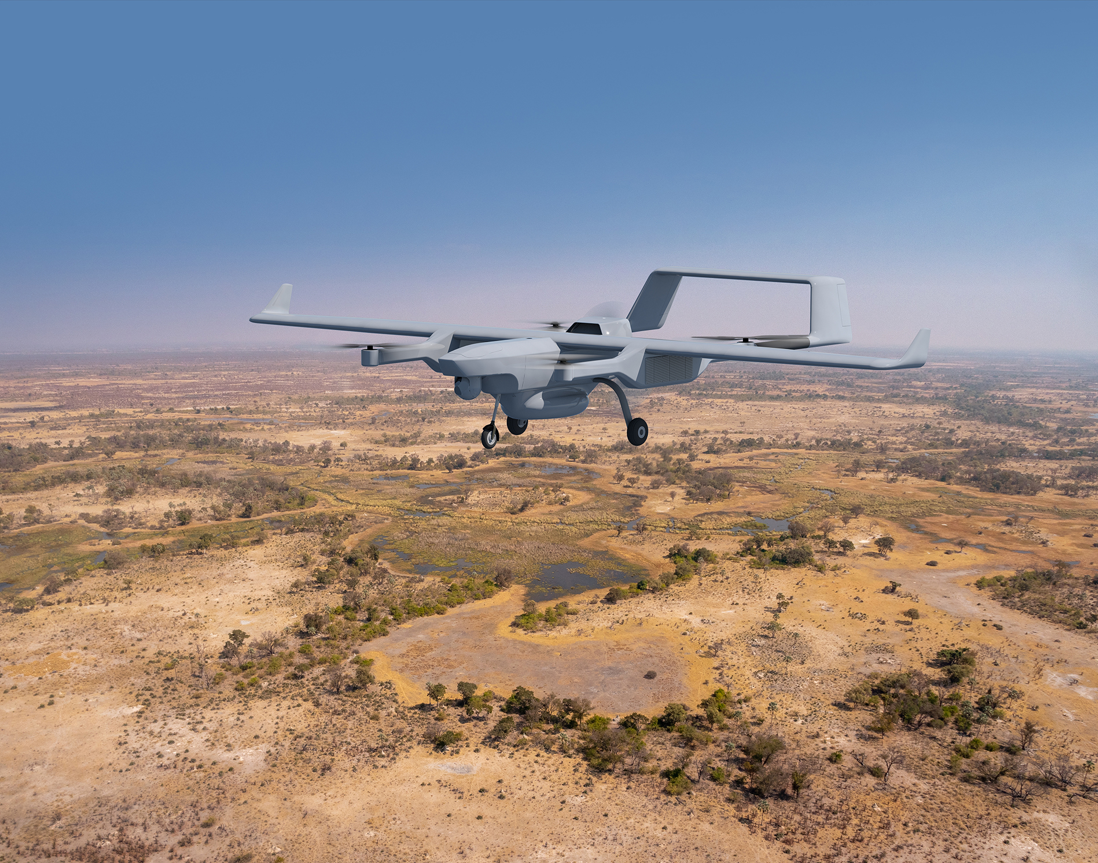
- Airbus Helicopters’ Survey Copter will build on the 120 kg Capa-X platform, targeting modular payloads and hybrid operating modes.
- The work is geared toward architectures that can span ISR, electronic warfare, and future “effects” roles within European procurement constraints.
Airbus Helicopters, via its Survey Copter subsidiary, has been selected by the European Defence Agency for the Multi Mission Unmanned Aircraft System (M2UAS) project, a 48-month activity with a total budget of approximately €1.1 million. The programme is framed as a study-and-development effort, aimed at maturing a hybrid uncrewed aircraft concept that can be configured for multiple operational missions through changes to payloads and air vehicle set-up.
The work sits as an extension of Airbus’s Capa-X uncrewed aerial system, a 120 kg-class platform quoted with a 100 km data link range, up to 10 hours of endurance, and payload capacity up to 20 kg. The baseline proposition is modularity: the same core air vehicle is intended to accept different sensor and mission packages, while also accommodating differing operational and regulatory constraints across military and governmental users.
Christophe Canguilhem, Director of the Capa-X programme at Airbus Helicopters, said: “We would like to thank the EDA for the trust it has placed in us. This selection is a major recognition of our expertise in tactical drone systems and reflects our commitment to supporting the development of innovative European defence capabilities.” He added: “The characteristics of the Capa-X system make it particularly well suited to the M2UAS project, while offering a scalable operational solution that can be adapted to the needs of the armed forces.”
The first phase of M2UAS is planned to run for 12 months, focused on analysing current and future operational needs, assessing technological challenges, and identifying development paths. The mission set under discussion spans surveillance and reconnaissance, electronic warfare, aerial effects deployment, and automated in-flight refuelling concepts — a spread that drives systems engineering complexity well beyond “fit a camera and fly”.
Modularity drives a different production model
A configurable aircraft presents a manufacturing challenge unlike most other product features. Modular payload bays, swappable wing sets, and alternative launch-and-recovery modes push a build strategy toward common cores with controlled variability — which, in turn, demands tight configuration management, repeatable harnessing, and validated mechanical interfaces that survive frequent re-role cycles.
For European programmes, the industrial reality is often low-to-mid volume output, with a heavy share of cost sitting in integration, qualification, and documentation. If the platform is expected to host electronic warfare payloads alongside ISR sensors, suppliers are pulled into EMI/EMC discipline, thermal management constraints, and power budgeting that can ripple into airframe tooling and the selection of onboard compute and datalink hardware.
Capa-X’s architecture is pitched around flexibility, including the ability to operate from confined areas as well as runway-style launches, depending on configuration. That hybrid operating intent tends to multiply test effort: propulsion modules, control laws, and flight safety cases have to hold across multiple build standards, not one “golden” configuration.
The production implication is that the factory becomes as much about controlled assembly and acceptance testing as it is about airframe build. Repeatable calibration of navigation, comms, and payload integration — plus maintainability designed into line-replaceable units — is what allows a multi-mission system to scale beyond a demonstrator into something procurement teams can actually sustain.