IN Brief:
- Hanwha Defence Australia has completed the first Australian-made AS9 Huntsman vehicles at H-ACE in Victoria.
- The milestone advances LAND 8116 and confirms that South Korean armoured vehicle production methods are being transferred into an Australian factory setting.
- The bigger industrial significance lies in the supply chain, training, testing infrastructure, and site expansion now gathering around Geelong.
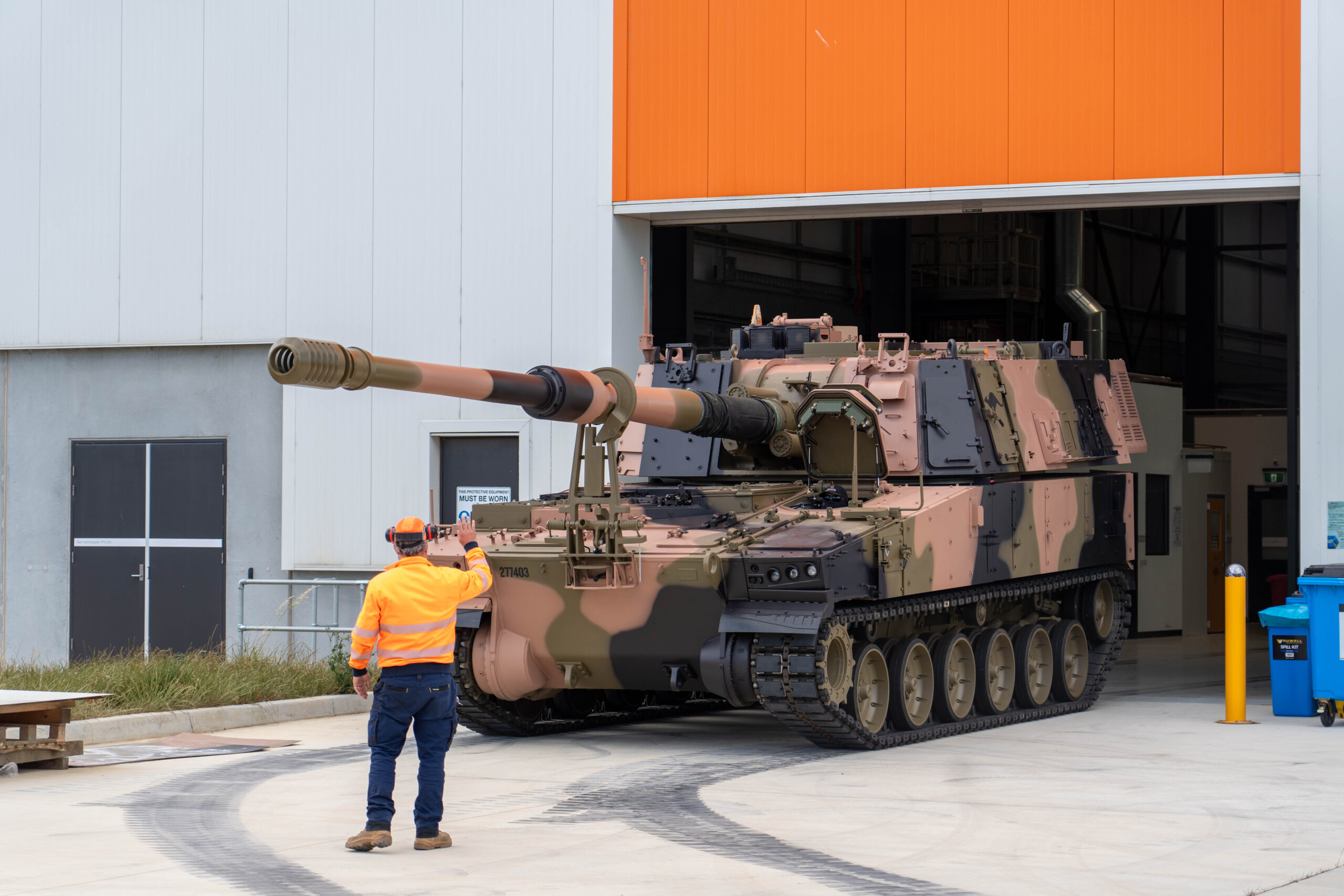
Hanwha Defence Australia’s completion of the first Australian-made AS9 Huntsman self-propelled howitzers at its Hanwha Armoured Vehicle Centre of Excellence in Geelong is a practical milestone for Australia’s land systems industry, not merely a ceremonial one. The rollout follows the arrival last year of an initial batch comprising two AS9s and one AS10 built in South Korea, and marks the point at which the programme’s local manufacturing effort moves from set-up into repeatable output.
Under LAND 8116 Phase 1, Hanwha is due to deliver 30 AS9 self-propelled howitzers and 15 AS10 armoured ammunition resupply vehicles to the Australian Army. The Geelong site is central to that effort. Stage one of H-ACE, a 32,000-square-metre facility opened in August 2024 under an accelerated build schedule, is focused on the Huntsman family. Stage two, which began in March 2025, is intended to expand the site for production of 129 Redback infantry fighting vehicles under LAND 400 Phase 3.
That is what makes the latest rollout significant. Australia is not simply receiving another imported variant with a local paint finish and some final integration work. It is building a broader production base around the vehicle line, with test facilities, workforce development, supply-chain participation, and sustainment infrastructure all forming part of the same industrial proposition. Hanwha says soldiers are already working through the H-ACE training wing as operator and maintainer preparation continues, while earlier vehicles have been through firing trials, verification work, and training activity over the past year.
Sovereign manufacturing in land systems rarely begins with a clean-sheet domestic design. More often, it begins with technology transfer made routine — welding, structures, turret work, drivetrain installation, digital integration, inspection, test, and rework repeated until the line becomes dependable. That is the more useful lens through which to view the AS9 milestone.
Hanwha has already stated that hull and turret production is taking place at Elphinstone in northern Tasmania, while line work continues at H-ACE in Victoria. That split matters. It means the industrial footprint is already extending beyond a single final-assembly site and into a more distributed manufacturing model, which is usually a healthier sign for long-term resilience.
The supplier base tells the same story. Hanwha has named Australian partners including Elphinstone, Kongsberg Defence Australia, CBG Systems, Penguin Composites, HIFraser, Bisalloy Steel, Safran Electronics and Defense Australasia, Sigma Bravo, and Thales Australia, among others. That is the less glamorous side of localisation, but it is the part that tends to endure. A domestic line becomes meaningful when local businesses are embedded in structures, subsystems, finishing, validation, and sustainment — not just invited to stand near the vehicle for launch photography.
Pressure from integration
Rolling out the first locally built vehicles is a necessary threshold, but it is not the difficult part concluded. Tracked artillery platforms place real demands on production quality, systems integration, and supportability. The platform itself is only one part of the challenge. Digital vehicle architecture, fire-control compatibility, ammunition resupply, maintainability, and electromagnetic performance all have to behave properly once the vehicle leaves the line and starts soldiering rather than demonstrating.
That is why H-ACE’s supporting infrastructure matters so much. The site includes a 1,200-metre test track, deep-water test facility, incline test area, production halls, and workshops, while stage two adds further industrial capability in the form of a second production line, an enclosed firing tunnel, and a major EMI/EMC chamber. Hanwha and Rohde & Schwarz have already described that electromagnetic compatibility capability as one of the largest of its kind in the southern hemisphere, which is a useful indication of how serious the site intends to be about systems assurance.
Geelong is therefore becoming something more substantial than a one-programme assembly point. It is shaping into an armoured vehicle manufacturing and validation hub that links South Korean design heritage with Australian production, training, and sustainment capacity. The first Australian-made AS9s matter because they show that transition is now happening on the factory floor.