IN Brief:
- AMRICC says it has moved from commissioning into commercial delivery, with 150 projects completed and 22 new companies engaged.
- The Staffordshire centre is positioning itself as a pilot-scale route for advanced ceramics and ceramic matrix composites across defence and other high-spec sectors.
- The harder test now is whether early project momentum converts into repeat manufacturing work, qualified processes, and a stronger domestic skills base.
The AMRICC Centre has reported a sharp increase in commercial activity as it moves out of commissioning and into full delivery, marking a more consequential phase for one of the UK’s newer advanced materials assets. The Staffordshire facility said it had completed 150 projects and attracted 22 new companies, with work spanning sectors including defence, aerospace, energy, nuclear, and ceramic matrix composites.
Advanced ceramics rarely fail for lack of technical promise. They fail when companies try to move from a successful sample to a repeatable, qualified manufacturing process and discover that scale-up is slower, dirtier, and more expensive than the prototype suggested. AMRICC can close part of that gap by giving manufacturers access to pilot-scale equipment, process development support, and an industrial setting rather than a purely academic one.
The centre, launched in February 2024, is the physical outcome of the Midlands Industrial Ceramics Group programme backed through UK Research and Innovation’s Strength in Places Fund. Hosted and managed by Lucideon, it has been built around a large suite of processing and characterisation equipment intended to help companies move new materials and production methods closer to market.
Ceramic matrix composites, high-temperature ceramics, and specialist engineered materials all sit in the awkward territory between materials science and production engineering. They are attractive because they can tolerate heat, wear, corrosion, and mechanical stress in ways conventional materials often cannot. They are difficult because processing them at industrially relevant scale is seldom straightforward.
Pilot-scale processing is where programmes stall
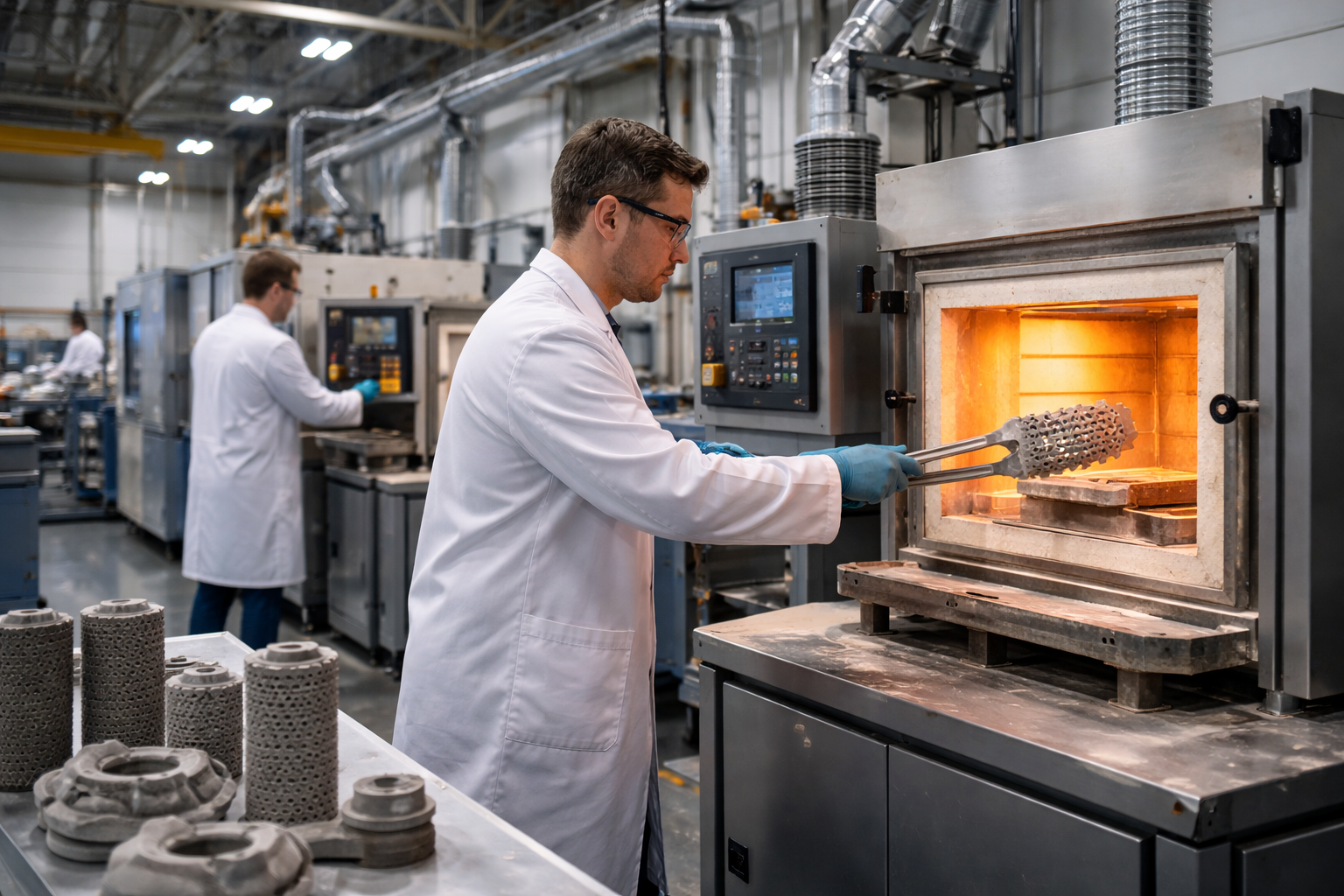
Powder formulation, mixing, forming, sintering, hot pressing, machining, and non-destructive inspection all have to be controlled tightly if a material is going to move from lab result to usable component. A promising part on a test bench is one thing. A part made repeatedly, with predictable yield and acceptable scrap rates, is quite another.
That is why facilities such as AMRICC are useful when they work properly. They give manufacturers somewhere to trial process windows, stress materials under realistic conditions, and produce enough evidence to support the next investment decision. For defence suppliers, that can shorten the route between early development and low-rate production, especially where customers want proof of performance before committing to a broader production run.
The centre’s defence relevance sits in exactly those applications where materials are expected to keep performing after metals begin to struggle. High-temperature processing, ceramic composites, and advanced materials testing all have obvious crossover into aerospace structures, propulsion-adjacent environments, thermal protection, and other harsh-duty components where failure margins are narrow and qualification takes time.
AMRICC has already linked into ceramic matrix composite work with the National Composites Centre, and the wider Lucideon network has also used the facility in materials work tied to component supply research for the US Navy’s nuclear-powered fleet. That does not turn the site into a defence plant in its own right, but it does show the sort of industrial problems it is being asked to support — difficult materials, demanding environments, and customers that need evidence as much as ambition.
The next question is less about equipment than about continuity. What matters now is whether AMRICC can turn early project flow into repeat custom, long-term process knowledge, and a workforce that understands advanced ceramics as a manufacturing discipline rather than a niche research specialism.
Alongside the commercial projects, the centre has been developing training activity through the AMRICC Academy and degree-level apprenticeship routes aimed at the materials pipeline. Defence manufacturers know the pattern well enough: you can buy equipment faster than you can build process engineers, technicians, and operators who know how to run it consistently.
AMRICC’s stronger commercial performance does not solve the UK’s advanced materials problem on its own, but it does suggest that a useful piece of infrastructure is starting to behave like industrial capacity rather than a one-off development project. For defence manufacturing, that is the point at which the story becomes worth watching.