IN Brief:
- The UK Ministry of Defence says four maintenance, repair, and overhaul facilities are operating in Ukraine, with a fifth planned.
- The sites repair CVR-T vehicles, Husky support vehicles, L119 light guns, former Soviet-era equipment, and all AS-90 artillery systems donated by the UK.
- The shift points to a more embedded industrial model, where British companies, Ukrainian labour, spares management, and local manufacturing capability are pushed closer to the battlefield.
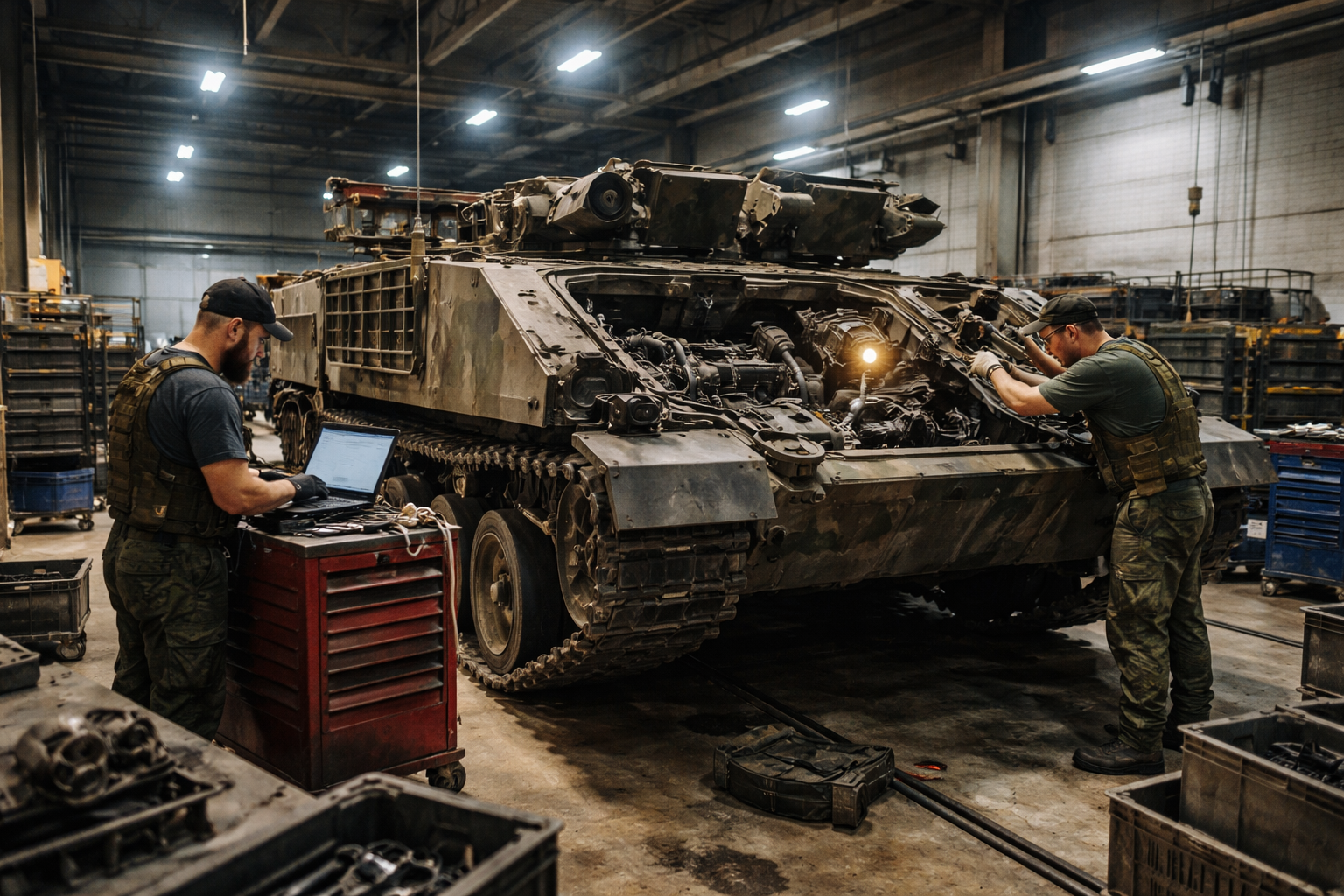
The UK Ministry of Defence has now publicly confirmed that four maintenance, repair, and overhaul facilities are operating inside Ukraine, with a fifth planned. The sites are run under MoD contracts by UK companies using British and Ukrainian workforces, and the ministry says they are repairing CVR-T armoured vehicles, Husky support vehicles, L119 light guns, former Soviet-era equipment, and all AS-90 artillery systems donated by the UK. Through collaboration with Swedish partners, the same support structure is also able to cover Archer artillery systems.
That is a significant step in operational transparency, but it is also a clearer statement of industrial intent. Western support to Ukraine began with urgent transfer, refurbishment, and back-end sustainment from outside the country. What London is now describing is something more embedded: contractor-run repair capacity inside Ukraine, closer to the point of use, with local labour, local turnaround pressure, and growing ties to domestic production.
Luke Pollard, Minister for Defence Readiness and Industry, said: “From the factory floor to the frontline, the UK is standing with Ukraine. Our pioneering facilities are helping keep Ukraine’s defiant Armed Forces in the fight against Putin’s brutal attacks, and British firms are boosting long term industrial production in Ukraine and partnering with Ukrainian companies to benefit both our nations.”
The ministry’s statement also linked the MRO network to a wider industrial push. Pollard’s visit coincided with the seventh UK-led trade mission to Ukraine, involving more than 80 delegates and 55 companies, including 35 British businesses, while the UK also flagged a move toward a permanent presence to support industry in country. This is no longer a narrow sustainment story. It is a supply-chain story, a partnering story, and eventually a localisation story.
Babcock is one of the clearest examples of how that model has been assembled. Since 2023, the company has been public about contracts to support Ukrainian land assets, manage spares, train Ukrainian personnel, and extend repair capacity. In 2024 it announced an in-country engineering facility with Ukraine Defence Industries, and in 2025 it added a proof-of-concept contract with QinetiQ to create digital drawings and CAD files so parts could be manufactured in country using methods including 3D printing. Piece by piece, the sustainment chain has been moving east.
Industrialising battle damage repair
Repairing armoured vehicles and artillery in a war zone is not equivalent to routine peacetime depot work. Damage is less predictable, turnaround expectations are harsher, and fleets are more mixed. AS-90 support alone brings a heavy engineering burden around structures, automotive systems, recoil components, power distribution, hydraulics, and controls, while older tracked vehicles and legacy gun systems can be even more difficult because spares quality and configuration history are rarely tidy.
That is why forward MRO capacity has strategic value. Every day cut from a repair loop matters, but the deeper industrial point is that battle damage repair has become its own production discipline. It draws on welding, machining, harness repair, diagnostics, calibration, inspection, and increasingly digital documentation. The companies that can do that under war conditions are no longer just support providers. They are part of the weapons output equation.
Babcock’s earlier Ukraine work illustrates the direction of travel. Its support announcements have repeatedly stressed not only repair and overhaul, but supply-chain management and training so Ukrainian forces can conduct more work themselves. That is how contractor support starts to harden into sovereign capability.
The harder part is not opening a facility. It is keeping it fed. A forward repair site lives or dies on spares forecasting, transport reliability, technical data, and the ability to make intelligent substitution decisions when original components are unavailable. The moment mixed fleets and urgent battlefield returns collide, MRO becomes an exercise in industrial judgement.
The 3D-printing and reverse-engineering strand of the UK-backed effort is important for that reason. It does not replace full-scale manufacturing, and nobody sensible should pretend otherwise, but it can close gaps around low-volume parts, obsolete items, housings, brackets, and temporary restorations. In war, that kind of flexibility is not a side project. It is throughput.
The UK’s disclosure is therefore about more than some facilities. It shows how land systems support is being reorganised around proximity, partner labour, digital manufacturing, and contractor-managed repair depth. Exporting kit is one thing. Building a repair industry around it is where the longer war economy begins.