IN Brief:
- EOS has secured U.S. remote weapon system contracts and a follow-on Slinger order for Northrop Grumman’s Agnostic Gun Truck.
- Deliveries are due during 2026, with manufacturing tied to Huntsville for one contract and Australian production for other Slinger work.
- The company is also advancing discussions on a conditional 100kW laser contract in South Korea, highlighting a market that now spans cannon and directed-energy solutions.
EOS has added to its U.S. counter-drone workload with new remote weapon system contracts, including work for the U.S. Army and a follow-on Slinger order for Northrop Grumman’s Agnostic Gun Truck. At the same time, the company says discussions have continued around a conditional South Korean deal for a 100kW high-energy laser weapon, giving the market a useful snapshot of how counter-drone demand is dividing across more than one technical path.
The immediate U.S. business is concrete enough. EOS says the Army-related work will be delivered from Huntsville, Alabama, with deliveries expected during 2026, while the Northrop Grumman order extends an existing collaboration around mobile counter-drone applications. Those are still modest sums by major-programme standards, but they carry more weight than the topline suggests because they sit inside a fast-moving segment where follow-on production can scale quickly once a concept proves useful.
There is also a portfolio lesson. EOS is not treating gun-based and laser-based defeat mechanisms as competing bets. It is treating them as adjacent product lines for customers trying to build layered protection against increasingly cheap and numerous aerial threats.
Counter-drone manufacturing is becoming a volume business
That shift changes the industrial equation. Remote weapon stations for counter-drone work must now be built as reliable production items, not demonstration pieces. That means stabilised mounts, sensor integration, ammunition handling, vehicle interfaces, and production rates that can support both urgent deliveries and longer campaign demand.
The same is true of systems such as Slinger, which sit at the intersection of optics, fire control, remote operation, and platform integration. Once an OEM secures repeat orders, the pressure moves quickly from proving the concept to reducing lead times and protecting margins.
Directed energy adds another supply-chain layer
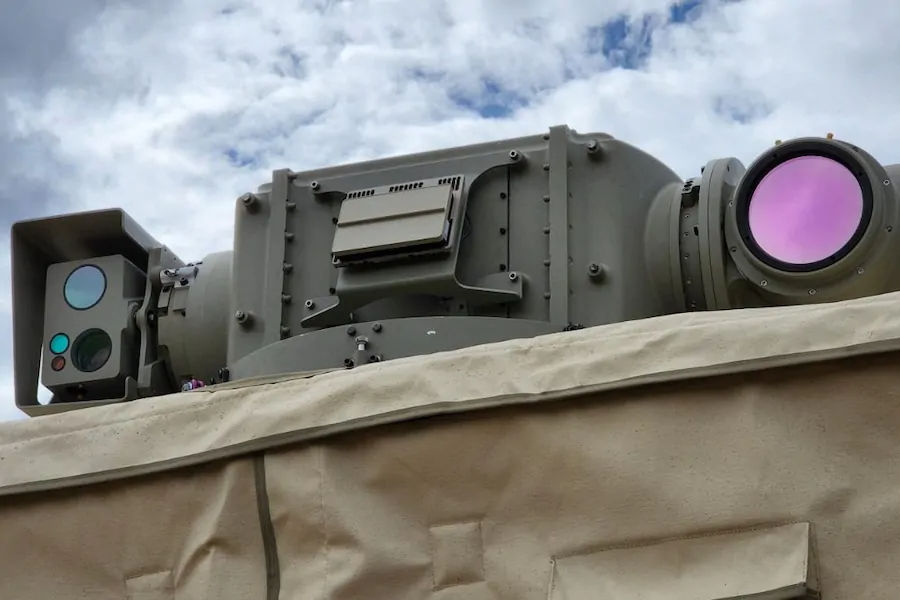
The South Korean laser discussions widen the picture. High-energy laser systems demand a different industrial stack, one centred on power management, thermal control, beam quality, ruggedisation, and integration into a usable mobile or fixed-site package.
The result is a counter-drone market that is no longer singular. It is becoming a family of manufacturing problems, with cannons, missiles, and directed energy all competing for industrial attention at once.