IN Brief:
- France is working on an interim tank as Leclerc approaches end of life around 2040 and MGCS slips by about a decade.
- The concept under discussion points to a likely KNDS platform paired with a French turret.
- Any bridge programme would put pressure on chassis choice, integration workshare, qualification timelines, and future support planning.
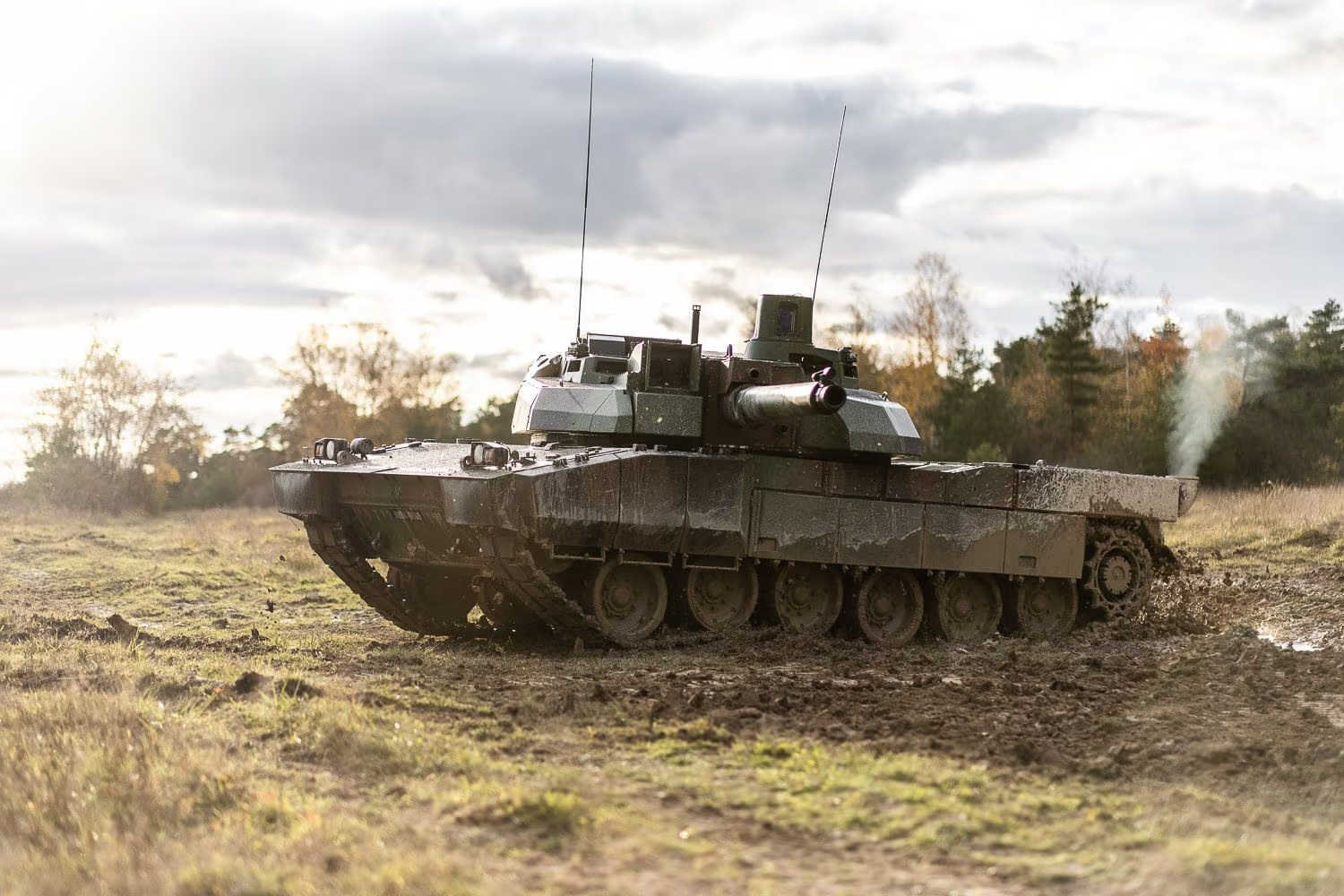
France has opened work on an interim tank programme intended to bridge the gap between the Leclerc’s end of life and the delayed Main Ground Combat System, bringing forward a land-systems decision that had been sitting behind the wider debate on the updated military programming law. Catherine Vautrin said France needs an intermediate tank as the Leclerc reaches the end of its service life around 2040 and MGCS slips by roughly ten years.
The broad outline already says a great deal about where Paris is trying to hold the line. The platform under study would likely come from KNDS, with the final balance between the French and German industrial pillars still unsettled, while the turret would be French. That points to a programme designed to preserve sovereign control over firepower, mission architecture, and part of the integration burden, while avoiding a full break with the longer MGCS path.
France is not starting from zero. Leclerc modernisation is already under way, and KNDS France remains central to the country’s heavy-land industrial base through vehicle production, turret work, ammunition, and lifecycle support. But a bridge tank is not simply a life-extension exercise under another name. Once definition work begins in earnest, it will force choices on chassis origin, powertrain commonality, turret layout, optronics, protection packages, digital backbone, and ammunition compatibility under a timetable that is likely to be tighter than a clean-sheet programme would normally allow.
Industrial implications
Any interim tank would open near-term work across the French land-systems base, particularly around turret integration, vetronics, observation systems, survivability kits, trials activity, and support planning. If a German-origin KNDS chassis is chosen with a French turret and French mission architecture, the programme will need a clear workshare model around final assembly, qualification responsibility, and through-life support. If a more France-led route emerges, the pressure falls more heavily on domestic integration capacity and supplier readiness.
Production and programme pressures
The risk for Paris is building a bridge fleet that solves the timing problem but fragments the long-term heavy-armour roadmap. The opportunity is to use the programme as a disciplined industrial stepping stone. If the vehicle carries forward new-generation connectivity, modular electronics, and upgrade room in protection and lethality, France can preserve heavy-platform skills while keeping the eventual transition to MGCS coherent. If it drifts into a stop-gap specification, the cost will reappear later in duplicated support lines, retrofit work, and another awkward transition window.