IN Brief:
- China has shown the Type 100 / ZTZ-100 main battle tank in field training.
- The platform combines an unmanned turret, active protection, sensor fusion, and networked targeting.
- Its production model brings armour manufacturing closer to electronics, autonomy, and data-led survivability.
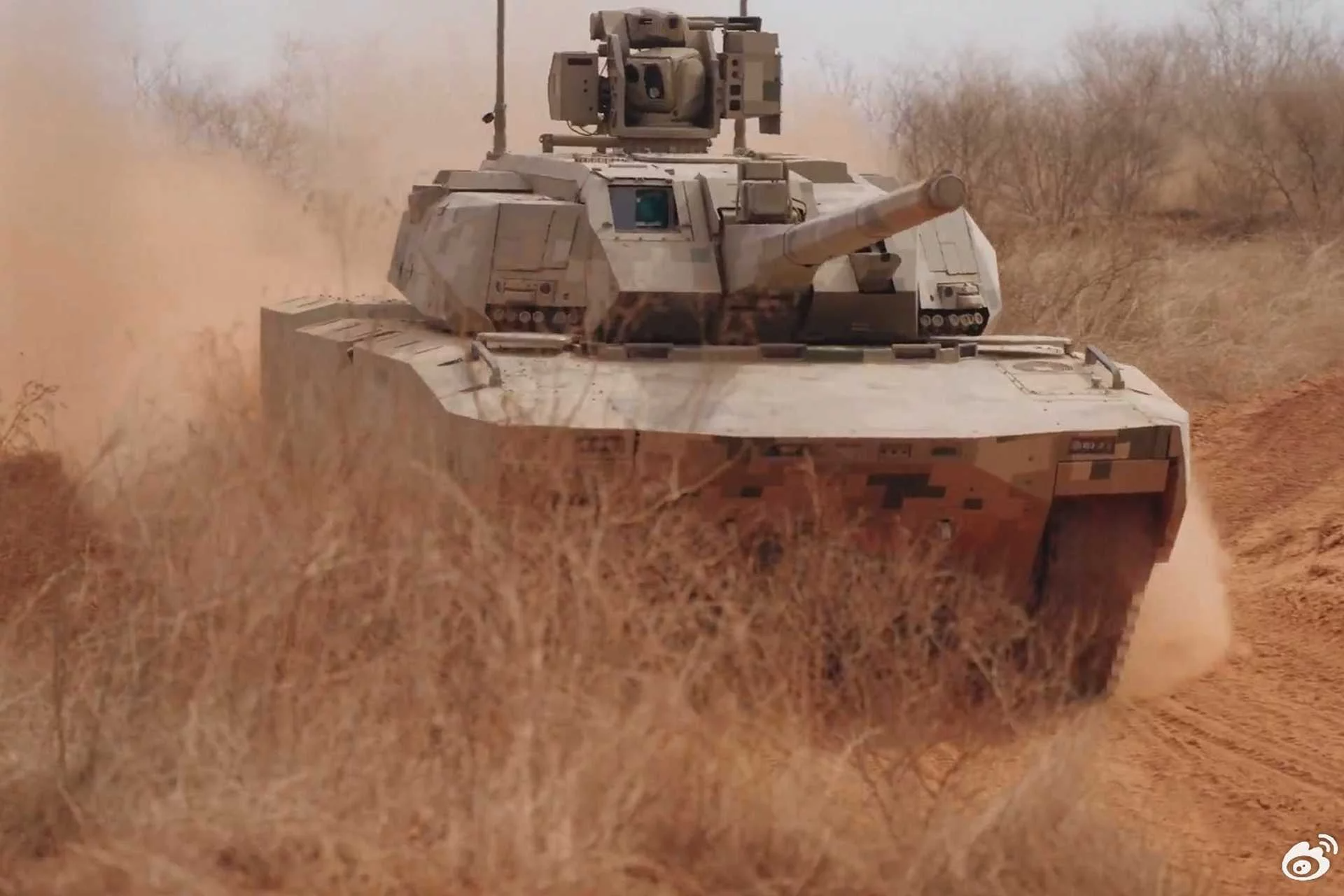
China has shown its Type 100 main battle tank in field training, giving the People’s Liberation Army Ground Force a visibly more modern armoured platform built around automation, protection, and battlefield connectivity.
The vehicle, also referred to as the ZTZ-100, moves away from the conventional model of heavy armour as the principal route to survivability. Its configuration places the crew in the hull and uses an unmanned turret, reducing crew exposure while shifting more of the vehicle’s combat function into sensors, fire-control electronics, actuators, and protected computing.
The tank is understood to use an autoloading main armament, advanced electro-optical systems, active protection, and digital links to other battlefield assets. Those features reflect the direction of modern land warfare, where armoured vehicles are expected to detect, share, process, and act on data while surviving drones, top-attack weapons, loitering munitions, and precision fires.
Its appearance comes as several major armies reassess the future of main battle tanks after Ukraine demonstrated both their continuing value and their vulnerability to cheap aerial threats. China’s answer appears to be a heavier reliance on integration rather than mass alone.
Production and integration demands
An unmanned turret creates a different manufacturing challenge from a traditional crewed system. Turret drive, ammunition handling, fire control, thermal imaging, panoramic sights, crew displays, and vehicle networks all have to operate as a single controlled architecture.
The hull and turret remain major metalworking products, but the programme’s performance depends increasingly on electronic packaging, software assurance, cable routing, sensor alignment, power management, and electromagnetic hardening. A vehicle may meet its mechanical requirements and still fail as a combat system if those elements are not manufactured and tested consistently.
The active protection layer adds another demanding production stream. Sensors, launchers, countermeasures, and control software have to react in fractions of a second while operating around friendly troops, vehicle structures, and nearby platforms. That requires testing across radar, optics, computing, energetics, and vehicle safety.
China’s Type 100 shows how future armoured vehicle production is becoming a systems-integration contest. Steel, armour, and mobility remain fundamental, but the differentiator is the ability to turn a tank into a protected sensor node with reliable automation and maintainable electronics under battlefield conditions.