IN Brief:
- VAMPIRE was evaluated by US and allied forces during Exercise Balikatan 2026 in the Philippines.
- The system combines detection, identification, and defeat functions around a modular counter-UAS architecture.
- Exercise use strengthens the case for high-volume production, standardised vehicle integration, and lower-cost kinetic effectors.
L3Harris’ VAMPIRE counter-unmanned system has been evaluated during Exercise Balikatan 2026, giving the company’s modular counter-drone architecture another Indo-Pacific reference point as allied forces build layered air defence around bases, islands, littoral infrastructure, and dispersed forces.
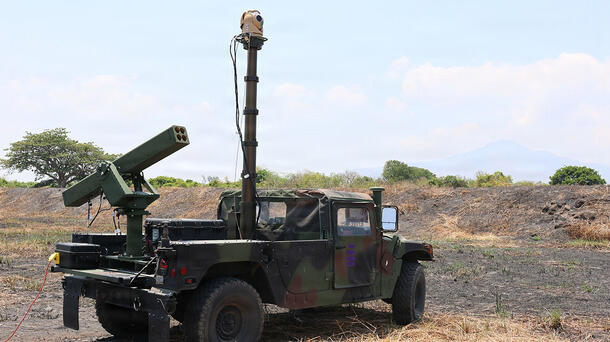
The system was used by US and allied forces in simulated engagements during the annual US–Philippines exercise. VAMPIRE is designed as a portable, vehicle-agnostic palletised kit able to launch APKWS or other laser-guided munitions from a host vehicle. In practice, it occupies the space between heavier air-defence batteries and lighter counter-drone tools, offering a mobile kinetic option against small unmanned threats.
The Indo-Pacific places unusual demands on mobile air defence. Bases, radar sites, logistics nodes, island outposts, ports, and expeditionary airfields all require protection against reconnaissance drones, loitering systems, and lower-cost attack aircraft. Large missile batteries cannot cover every site, while traditional short-range air defence systems are too scarce, expensive, or cumbersome for every location that now needs a hard-kill option.
VAMPIRE’s appeal sits in its modular design. A vehicle-mounted kit can be integrated across different tactical platforms, moved between operating locations, and adapted to user needs without turning every installation into a bespoke engineering effort. That still leaves a substantial integration burden: power supply, targeting sensors, launcher interfaces, software, datalinks, environmental protection, cabling, operator controls, and safety logic all have to be managed consistently.
That consistency is now central to counter-UAS production. L3Harris’ high-volume VAMPIRE line in Huntsville, covered in L3Harris opens VAMPIRE high-volume production line, was built around flexible assembly, testing, and installation for vehicle-mounted and containerised configurations. The Balikatan evaluation adds the operational counterpart: a system built for repeatable factory output is being exercised in the distributed allied environment likely to drive future demand.
The use of laser-guided 70mm rockets remains a defining part of the economics. Premium interceptors are too expensive for routine use against low-cost drones, but electronic attack alone cannot handle every threat, particularly where drones are autonomous, hardened, or operating in complex electromagnetic conditions. A rocket-based kinetic layer gives commanders another option, provided the guidance, fuze, warhead effect, and engagement sequence are suitable for small aerial targets.
Production pressure then shifts into munitions supply. A launcher has limited value without sufficient guided rockets, training rounds, sensors, spares, and support equipment. APKWS-type weapons sit in a more scalable industrial space than high-end surface-to-air missiles, but they still depend on rocket motors, guidance kits, warhead sections, test equipment, and quality assurance. Counter-UAS is becoming a magazine-depth problem as much as a sensor problem.
Exercise use also tests allied familiarity. Multinational events expose whether crews can learn the equipment quickly, whether it fits into local command structures, whether deployed personnel can maintain it, and whether it works alongside sensors and weapons from other suppliers. Those details shape procurement because a counter-UAS system that needs a narrow support ecosystem is less useful than one that can be absorbed into allied operating patterns.
The market is moving quickly. NATO members, the United States, South Korea, Japan, Australia, and Ukraine-facing procurement channels are all pressing industry to deliver counter-drone capability faster than traditional air-defence cycles allow. That has opened space for companies able to package sensors, launchers, software, and lower-cost effectors into systems that can be bought, installed, trained, and repaired without years of custom engineering.
VAMPIRE sits in a useful industrial position. It has combat exposure, a dedicated production line, modular vehicle integration, and a munition type that addresses the cost side of the drone-defence equation. Sustaining output, reducing installation friction, and proving supportability across different allied vehicle fleets, climates, and command networks will determine how far that position extends.
The Indo-Pacific will keep pulling counter-UAS systems in this direction. Distributed forces need affordable defence against observation and attack from above, and the production winners will be those able to turn modular systems into repeatable programmes rather than customised installations.