IN Brief:
- HII has showcased autonomous maritime systems at Combined Naval Event 2026 in Farnborough.
- The company highlighted REMUS UUVs, ROMULUS USVs, Odyssey autonomy software, and live, virtual, constructive training capability.
- The industrial focus is moving toward scalable production, torpedo-tube launch and recovery, UK sustainment, and allied fleet integration.
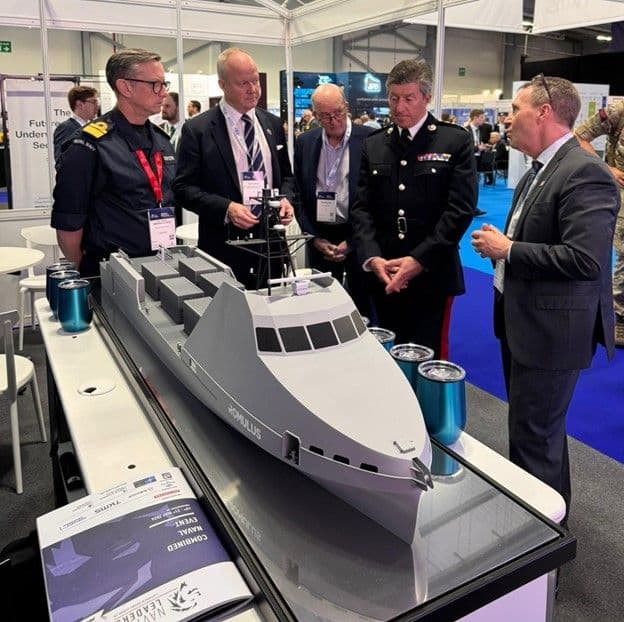
HII has used Combined Naval Event 2026 in Farnborough to present its maritime autonomy portfolio, including REMUS unmanned underwater vehicles, ROMULUS unmanned surface vessels, and the Odyssey Autonomous Control System software suite.
The systems were presented alongside HII’s live, virtual, constructive training work, linking uncrewed platforms with naval readiness, mission rehearsal, and crewed-uncrewed teaming. The event gives HII a UK and allied platform for a portfolio now spanning undersea vehicles, surface autonomy, control software, submarine launch-and-recovery work, and scaled production.
REMUS remains the most established part of the offer. The UUV family has been in service for 25 years, with more than 750 systems delivered to over 30 countries, including 14 NATO members. That installed base carries weight in a market where navies are no longer buying only promising prototypes. They also need operational history, support arrangements, spares availability, training pathways, and evidence of reliability in demanding maritime environments.
HII is also moving the ROMULUS USV family towards broader production. Multiple ROMULUS 151 vessels are under construction, supported by manufacturing initiatives intended to accelerate delivery of autonomous surface capability to allied fleets. The shift reflects a wider naval procurement pattern: uncrewed surface vessels are moving from experimental assets toward distributed platforms for sensing, mine warfare, maritime security, electronic payloads, decoys, and future contested-water roles.
The UK setting adds weight because HII has expanded its Portchester facility as a regional hub for allied naval customers, sustainment operations, training, and future autonomous-system deployment. Local support is decisive in maritime autonomy. Saltwater systems need maintenance, software updates, payload changes, pressure-hull inspection, corrosion control, battery management, and operator training. A distant factory can build the platform, but regional sustainment capacity determines whether fleets remain available.
HII also highlighted torpedo-tube launch and recovery work for REMUS vehicles, including a Defense Innovation Unit contract and successful operations involving a REMUS 600 UUV from USS Delaware. Launching and recovering UUVs from submarines could extend ISR, seabed awareness, mine reconnaissance, and risk reduction without exposing a crewed vessel. It also imposes demanding engineering requirements around vehicle dimensions, launch mechanics, recovery reliability, hydrodynamics, communications, autonomy, pressure tolerance, and submarine safety certification.
Production challenges differ across REMUS and ROMULUS. UUVs place emphasis on pressure vessels, batteries, propulsion, navigation, acoustic communications, payload integration, and software reliability below the surface. USVs place more pressure on hull production, propulsion, autonomy, collision avoidance, datalinks, payload modularity, survivability, and launch-and-recovery arrangements from crewed vessels or shore bases. Odyssey software then has to simplify control, support mission behaviours, and reduce operator workload across those different vehicles.
UK maritime autonomy is also developing through domestic suppliers. The production step examined in SubSea Craft moves MARS USV into production reflected the same movement away from one-off demonstration and toward repeatable product lines, modular payloads, and operational support. HII is working at a different scale, but the market logic is converging.
Operational pressure is pushing navies towards that model. The Black Sea has shown the disruptive potential of uncrewed surface attack craft. The Red Sea has reinforced the need for persistent sensing and distributed protection. The North Atlantic and Indo-Pacific are driving renewed attention to undersea surveillance, seabed infrastructure awareness, and mine countermeasures. Uncrewed systems can extend reach, reduce risk to crews, and fill gaps where traditional platforms are too few or too expensive to use continuously.
The transition remains difficult. Prototype autonomy can perform well in controlled events, but naval procurement demands repeatability, certification, cybersecurity, training, spares, documentation, and long-term upgrade management. Saltwater exposes weak engineering quickly. Corrosion, vibration, shock, biofouling, pressure, temperature variation, and communications limits can undermine designs that appear mature on land.
Software is becoming a defining production asset. Odyssey’s role in controlling unmanned systems and supporting coordinated operations reflects a broader move toward autonomy stacks as long-term defence products. Software must be configurable, secure, testable, and updateable without fragmenting the fleet. That discipline is closer to mission-system engineering than a simple software release cycle.
HII’s CNE 2026 activity shows how major naval suppliers are assembling complete autonomy ecosystems around vehicles, software, training, launch and recovery, regional sustainment, and allied customer support. The companies able to supply those elements together, while keeping architectures open enough for payload and mission evolution, will shape the next phase of naval autonomy procurement.