IN Brief:
- Oshkosh Defense and Forterra have secured two US Marine Corps delivery orders worth $92m for ROGUE-Fires Block 2.
- The award advances production of JLTV-based semi-autonomous vehicles for distributed expeditionary fires.
- Block 2 adds autonomy and weapon-integration pressure to an already demanding tactical vehicle manufacturing model.
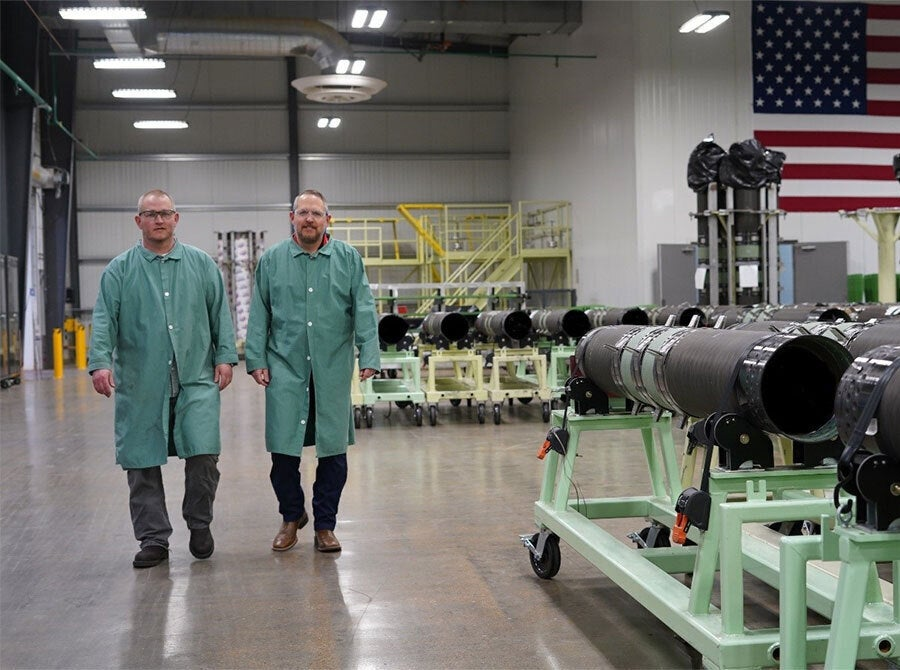
Oshkosh Defense and Forterra have secured two US Marine Corps delivery orders worth $92m for ROGUE-Fires Block 2 production, moving semi-autonomous expeditionary fires deeper into the manufacturing pipeline.
ROGUE-Fires, the Remotely Operated Ground Unit for Expeditionary Fires, is built on the Oshkosh Joint Light Tactical Vehicle family and integrates Forterra’s autonomy technology. The Block 2 award brings enhanced autonomous mission capability and expanded weapon-system integration to a platform designed for distributed long-range precision fires. Forterra has described the award as the US military’s first large-scale production contract for ground vehicle autonomy.
Ground autonomy is often demonstrated in trials, but production contracts force the technology into a different environment. Autonomy hardware and software must be installed repeatedly, tested consistently, maintained in the field, and integrated with military communications, power systems, safety controls, and weapons. The result has to be a vehicle that can operate in contested environments without turning every mission into a bespoke engineering exercise.
ROGUE-Fires reflects the Marine Corps’ broader move toward distributed operations. Smaller, harder-to-target units operating across island chains, littorals, and contested maritime regions need mobile launchers that can deploy, hide, reposition, and connect to targeting networks. Autonomy reduces crew exposure and gives commanders more flexible ways to employ fires assets without tying every launcher to a full onboard team.
The JLTV base gives Oshkosh an established production foundation. The vehicle family already brings mobility, protection, transportability, and sustainment infrastructure. The ROGUE-Fires task is to add autonomy, remote operation, weapon interfaces, and mission electronics without undermining reliability or supportability. That is a systems-integration problem as much as a vehicle manufacturing problem.
Forterra’s AutoDrive adds the software-defined layer. Military ground autonomy must cope with degraded GPS, dust, poor roads, obstacles, electromagnetic interference, and tactical uncertainty. It also needs predictable behaviour around friendly forces and weapons. Fielding such systems at scale requires sensor calibration, software validation, safety-case development, rugged computing, and update mechanisms that do not compromise certification.
The long-range fires pressure is already visible across allied land forces. PrSM combat debut tests long-range fires model examined the missile side of the equation, while HIMARS drill sharpens Pacific fires model showed the operational demand for deployable launcher networks in the Pacific. ROGUE-Fires belongs to the same family, but with a stronger autonomy and vehicle-integration burden. The missile is only one part of the system; launcher mobility, targeting links, reload logistics, and survivability determine whether distributed fires can work under pressure.
Supplier pressure will reach several layers. Autonomy kits require sensors, processors, rugged networks, drive-by-wire interfaces, power management, software tools, and test infrastructure. Weapon integration adds launch systems, fire-control interfaces, safety interlocks, environmental qualification, and transport constraints. A vehicle designed to fire precision weapons also has to survive storage, shipping, off-road movement, and repeated launch effects.
Block 2 marks a shift from prototype logic to production discipline. Demonstrators can tolerate manual workarounds, specialist engineers, and carefully controlled trials. Fielded systems cannot. The Marine Corps will need vehicles that maintainers can support, operators can trust, and commanders can integrate into a wider fires architecture. Manufacturing quality and software governance become operational capability.
Allied militaries will watch the programme closely. Ground autonomy, unmanned launchers, robotic logistics, and distributed missile systems are all being examined as forces try to increase combat mass without proportionally increasing personnel exposure. ROGUE-Fires gives Oshkosh and Forterra a strong reference point because it combines an existing vehicle base with a real fires mission and production funding.
The next test is configuration control. Weapon options, sensor updates, mission software, and communications requirements will evolve. If the platform can absorb those changes without repeated redesign, it could become a useful model for other autonomous military vehicle programmes. If every change drives major requalification, cost and integration burden will rise quickly.
The award puts autonomous fires into a more serious industrial phase. The US Marine Corps is not merely experimenting with driverless vehicles. It is buying a production pathway for mobile, semi-autonomous launchers tied to distributed operations. ROGUE-Fires is therefore one of the clearest current examples of ground autonomy leaving the test range and entering the defence manufacturing base.