IN Brief:
- Poland has placed major contracts with WB Group for GLADIUS fire units, FLYEYE reconnaissance UAVs, and WARMATE loitering munitions.
- Production will draw on WB Group’s domestic industrial base across airframes, electronics, command systems, launch equipment, and mission software.
- The orders strengthen Poland’s move towards networked reconnaissance-strike systems rather than standalone unmanned platforms.
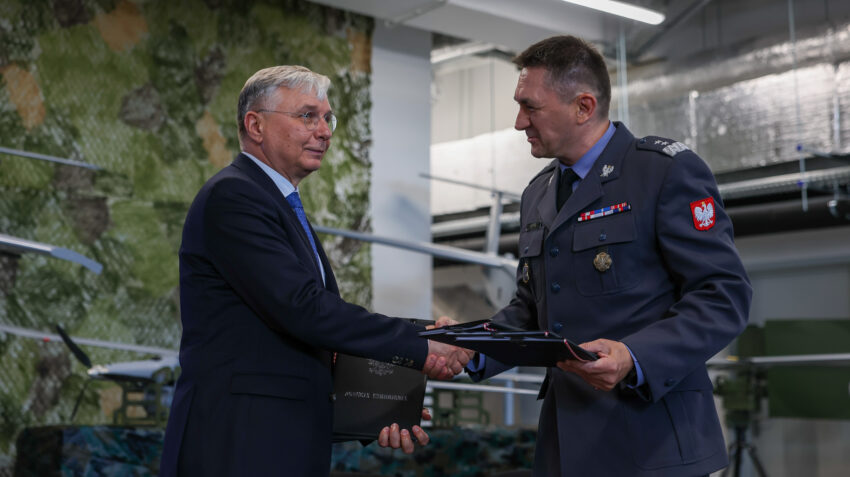
Poland has signed major contracts with WB Group for GLADIUS reconnaissance-strike systems, FLYEYE tactical UAVs, and WARMATE loitering munitions, giving its domestic unmanned systems industry a substantial production push.
The package includes 12 GLADIUS fire units, nearly 200 FLYEYE reconnaissance systems, and hundreds of WARMATE loitering munition systems. Funding is linked to the European Union’s SAFE instrument, placing the procurement within a broader effort to strengthen European defence production and shorten the route between operational demand and manufacturing output.
WB Group’s domestic production network is central to the order. The company’s facilities and subsidiaries support airframe production, electronics, command-and-control systems, launch equipment, payload integration, software, vehicle systems, and maintenance infrastructure. That mix is important because modern unmanned warfare is no longer built around isolated aircraft. It depends on networks of sensors, effectors, datalinks, operators, vehicles, and software.
GLADIUS is the most complex element. The battery-level system integrates reconnaissance aircraft, loitering munitions, command vehicles, ammunition vehicles, launch systems, and support equipment. It is built around the same logic that has reshaped artillery and drone warfare in Ukraine: find targets quickly, process information rapidly, and connect reconnaissance to strike assets before the target moves.
Poland’s recent push on artillery, including the production demands described in Poland’s Krab and 155 mm orders deepen artillery production race, sits naturally beside the WB Group contracts. Tube artillery, loitering munitions, tactical UAVs, and command systems increasingly operate inside the same kill chain. The industrial base has to supply barrels, shells, drones, datalinks, software, optics, warheads, batteries, and vehicles in parallel.
FLYEYE gives the package a recoverable reconnaissance layer. Tactical UAVs need rugged airframes, dependable sensors, secure communications, field-replaceable components, and ground-control systems that can survive real operational use. Their value is shaped as much by endurance, launch and recovery reliability, operator training, and maintenance rhythm as by headline performance figures.
WARMATE pushes WB Group into a different production model. Loitering munitions behave partly like aircraft and partly like ammunition. They need airframe reliability, guidance, warheads, propulsion, and communications, but they also have to be affordable enough to procure and expend at scale. That combination places pressure on design teams to simplify assembly, reduce cost, and keep supply chains resilient without degrading operational performance.
The contracts also give Poland more control over configuration and upgrade cadence. Imported unmanned systems can be useful, but domestic production allows faster feedback from operators to engineers, particularly when systems encounter jamming, weather, battery performance issues, or changes in battlefield tactics. Software-defined systems need that cycle to be short. A UAV or loitering munition that cannot be modified quickly risks falling behind the threat environment.
Electronic warfare will shape the value of the programme. Reconnaissance drones and loitering munitions rely on navigation, datalinks, sensors, and onboard computing, all of which can be attacked. Production therefore has to account for anti-jam antennas, alternative navigation options, hardened communications, and software updates. The airframe is only one part of survivability.
Poland’s decision also reflects a shift in European procurement culture. Many countries want unmanned systems quickly, but speed without domestic industrial depth can create dependence on foreign supply chains and slow upgrade routes. By placing large orders with a national manufacturer, Warsaw is trying to create both operational capacity and production sovereignty.
For WB Group, the work will test repeatability. Scaling loitering munitions and tactical UAVs requires component availability, quality assurance, warhead integration controls, trained labour, and stable electronics supply. Commercial drone markets, export controls, and wider demand for sensors and chips can all create pressure on the production line. Large orders help justify investment, but they also expose weaknesses if suppliers cannot keep pace.
The programme gives Poland a clearer position in Europe’s unmanned systems market. It is building an ecosystem around reconnaissance, strike, and command integration rather than treating drones as disposable accessories. As European armies absorb lessons from Ukraine, that integrated production model is likely to become the benchmark.