IN Brief:
- Jackal has completed a flight test validating key flight systems.
- The missile demonstrated automated turbojet start, autopilot-controlled flight, navigation, propulsion, and high-speed manoeuvring.
- The programme reflects growing demand for precision strike systems that can be produced and deployed at greater scale.
Northrop Grumman’s Jackal precision strike missile has completed a key flight test, validating core airframe, propulsion, navigation, and autopilot functions as the system moves further through development.
The test included automated turbojet engine start, autopilot-controlled flight, autonomous waypoint navigation, propulsion performance, and flexible high-speed manoeuvring. Jackal is being developed as a next-generation precision strike missile that can be integrated with mobile launch concepts and used in contested environments where fast, responsive effects are required.
The missile’s stated performance profile includes speeds above 300mph, a range of up to 100km from surface launch, and up to 125km from air launch. It is also being presented as compatible with light tactical vehicle integration, including launch canister configurations for rapid-fire missions. That places it between short-range loitering effects, heavier cruise missiles, and larger long-range fires.
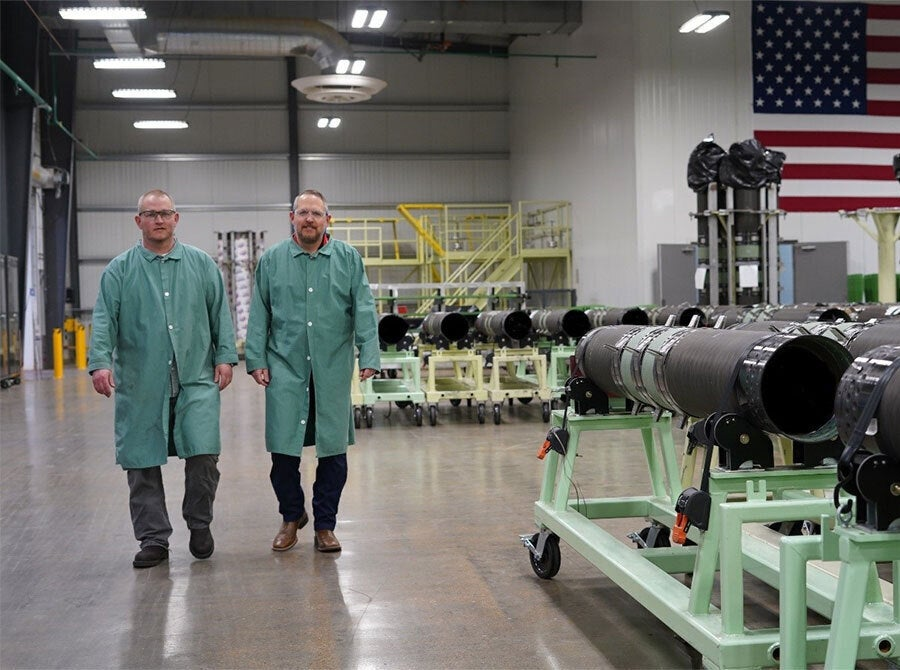
A successful flight event is only one stage in a much harder industrial progression. Precision strike missiles compress propulsion, guidance, control surfaces, flight software, warhead integration, launch systems, canisters, test equipment, and storage requirements into a compact package. Each subsystem has to withstand handling, transport, launch loads, vibration, temperature variation, and the aerodynamic stresses of flight.
The missile market is moving in two directions at once. Customers want advanced guidance, autonomy, electronic resilience, and precision, while also demanding larger inventories and faster replenishment. Those requirements pull against each other. More sophisticated missiles tend to rely on more expensive components, longer test cycles, tighter quality assurance, and specialist suppliers. Larger inventories require simplified production, predictable cost, and fewer bottlenecks.
Jackal sits inside a wider industrial push toward affordable precision strike. The US and its allies are examining containerised missiles, lower-cost cruise missiles, loitering munitions, modular launchers, and mobile effects that can be produced in higher numbers than traditional exquisite weapons. The inventory pressure behind that shift is visible in Pentagon moves on containerised missile mass, while the move from advanced weapon design toward production has also shaped Leidos moves hypersonics toward production.
Jackal occupies a different strike category from hypersonic systems, but it faces the same manufacturing hurdle. A missile flight test can show that a design works; production must prove that the hundredth or thousandth article behaves like the qualified configuration. That requires supplier stability, tooling control, acceptance testing, software version management, propulsion consistency, and clear inspection routines.
Mobile launch integration adds another layer. A weapon designed for light tactical vehicles must fit into existing force structures without creating an excessive support burden. Canisters, launch electronics, power supply, reload processes, vehicle interfaces, crew training, storage safety, and field maintenance all become part of the industrial package. A missile that performs well but is difficult to handle, store, or reload will struggle to scale.
Demand for dispersed strike is rising across several theatres. Ukraine has accelerated attention on precision inventory depth, while Pacific planning has pushed militaries toward mobile launchers, island basing, maritime targeting, and rapid relocation. NATO’s eastern flank adds another requirement for systems that can strike, move, and survive against counter-battery, drone, and electronic-warfare threats.
Northrop’s test moves Jackal further along that path. The next phase will be shaped by whether performance can be maintained while the system becomes manufacturable at useful scale. In the precision-strike market, a missile’s operational value increasingly depends on the production line behind it — and on whether that line can deliver enough weapons, quickly enough, to support sustained use.