IN Brief:
- Palladyne AI and IAI are partnering on US production and marketing of Harpy, Harop, and Mini Harpy systems.
- The arrangement gives Palladyne a domestic manufacturing and integration role tied to Israeli loitering-munition designs.
- The move reflects growing US demand for lower-cost, air-defence-suppression and long-range precision-strike systems.
Palladyne AI and Israel Aerospace Industries have formed a partnership to manufacture, integrate, market, and sell IAI loitering munitions for US defence customers, giving three established Israeli systems a potential domestic production route into the American market.
The arrangement covers IAI’s Harpy, Harop, and Mini Harpy systems. Palladyne is expected to adapt the weapons for US requirements and establish domestic manufacturing and integration capability, while IAI provides engineering support, key subsystems, and intellectual property. The partnership targets demand for systems able to suppress and destroy enemy air defences and conduct long-range precision attack.
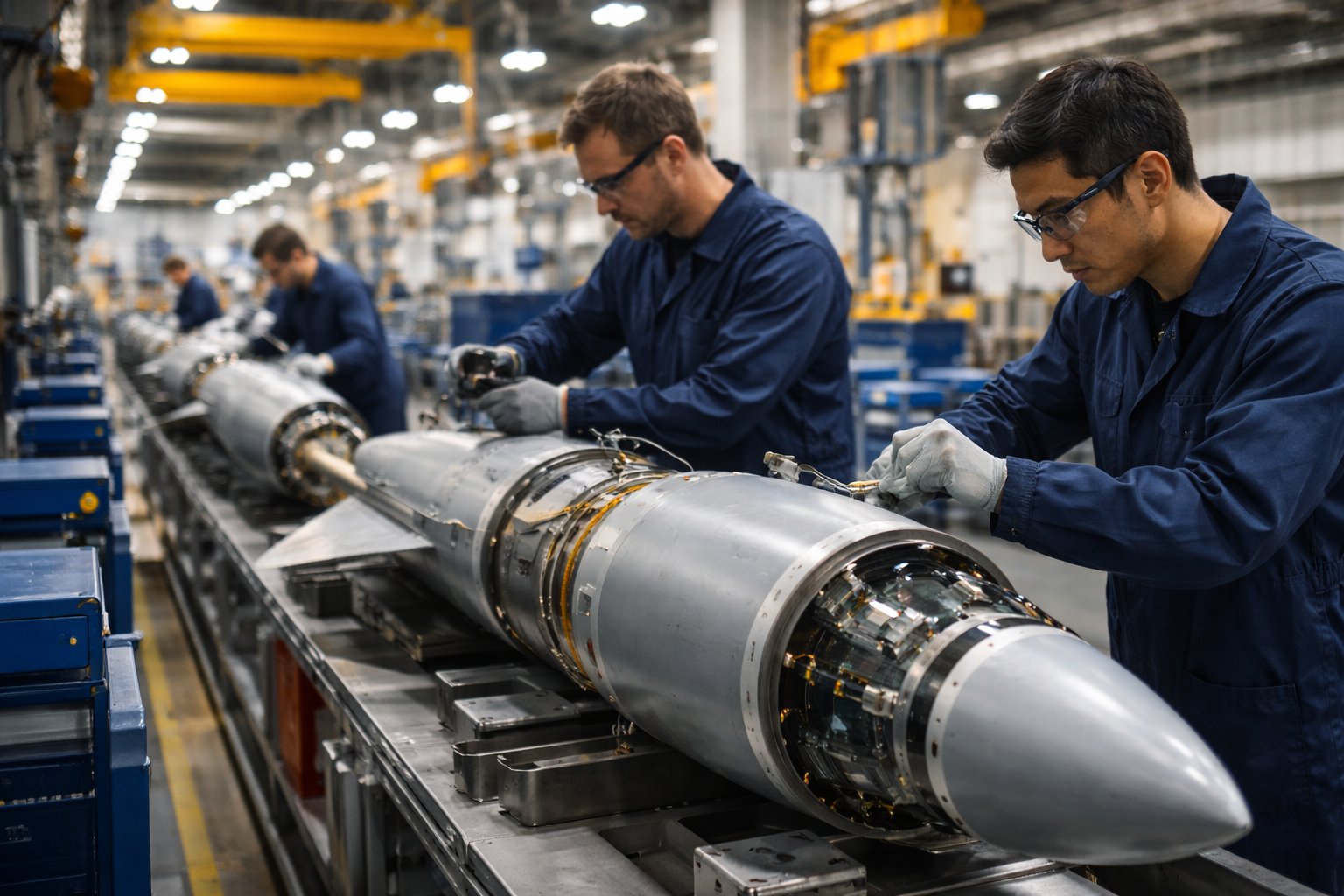
Loitering munitions sit between drones and missiles, which gives them a distinctive production profile. Airframes, seekers, datalinks, autopilots, warheads, launch canisters, ground-control equipment, mission software, propulsion or battery systems, and test procedures all have to be produced reliably enough for operational stocks. They must be affordable enough to buy in numbers, while still sophisticated enough to survive and strike in contested environments.
IAI’s Harpy family has long been associated with suppression and destruction of enemy air defences, with systems designed to loiter, detect emitters or targets, and attack without exposing manned aircraft. Harop and Mini Harpy extend that concept into more flexible reconnaissance-strike roles. Domestic production would align those designs with US demand for weapons that provide precision, range, persistence, and inventory depth.
Palladyne’s autonomy work adds another dimension. Loitering munitions are increasingly judged by their ability to operate in groups, share data, manage mission changes, resist jamming, and remain effective when communications are degraded. Software, autonomy, target-recognition logic, and mission-management tools are becoming part of the weapon’s core value rather than an enhancement added after the airframe is built.
The same market pressure appears in lower-cost strike development and drone procurement. Northrop’s Jackal test advances lower-cost precision strike showed how US industry is looking for more affordable strike options, while Ukrainian drone order shows scale of FPV production model demonstrated the volume that militaries now expect from unmanned systems. The Palladyne-IAI partnership sits between those poles: more complex than improvised FPV drones, but potentially more scalable and flexible than traditional cruise missiles.
Domestic production will be central to US customer interest. Imported designs can meet urgent capability gaps, but American defence buyers increasingly want local assembly, supply-chain visibility, cybersecurity assurance, export-control clarity, and production lines that can expand in crisis. That is especially true for munitions expected to be consumed in quantity during high-end conflict.
Building a US production route for loitering munitions will involve far more than final assembly. The line would need controlled manufacture of electronics and seekers, warhead integration, energetic-material handling, launcher production, test equipment, flight-test access, quality assurance, secure software management, and configuration control. If US-specific autonomy functions are added, validation and safety assurance will become major workstreams.
The air-defence-suppression mission adds further technical pressure. Weapons designed to find and attack radar systems must function in a hostile electromagnetic environment, deal with decoys, avoid fratricide, and preserve enough autonomy to act when datalinks are degraded or denied. That demands high-quality seekers, signal-processing software, mission planning, target discrimination, and rules-of-engagement controls.
US Army interest in longer-range precision munitions has created a contested market for systems that extend tactical reach without the cost of high-end missiles. Loitering munitions appeal because they can search, wait, and strike, giving commanders more flexibility than direct-fire weapons or ballistic trajectories. The production test is whether that flexibility can be delivered at volume, cost, and reliability.
Adapting proven foreign designs into US manufacture can shorten development cycles, but it brings its own engineering and commercial work. Intellectual property, export controls, component substitution, testing evidence, US safety standards, software security, and customer-specific requirements all have to be resolved before a domestic line becomes credible.
The opportunity for Palladyne and IAI is clear. The US market is seeking weapons that combine range, autonomy, precision, and scale. The harder task will be proving that the domestic production model can deliver those systems at the tempo required for modern conflict. Loitering munitions have moved beyond niche experimentation; they are now part of the wider strike-production debate, where manufacturing capacity will count as heavily as performance.