IN Brief:
- Marshall Aerospace has completed a 6-DOF flight dynamics and control model for Horizon Aircraft’s Cavorite X7.
- The work supports safety-critical control-system development and certification planning.
- Hybrid-electric VTOL programmes create demand for modelling, test, certification, and special-mission engineering capability.
Marshall Aerospace has completed a flight dynamics and control model for Horizon Aircraft’s Cavorite X7, supporting development and certification work on the hybrid-electric vertical take-off and landing aircraft.
The model gives Horizon a six-degrees-of-freedom simulation tool to understand how the X7’s aerodynamic, propulsion, and mass characteristics influence flight behaviour. It will support development of the aircraft’s safety-critical control system, allowing engineers to predict and optimise responses to control inputs across the flight envelope.
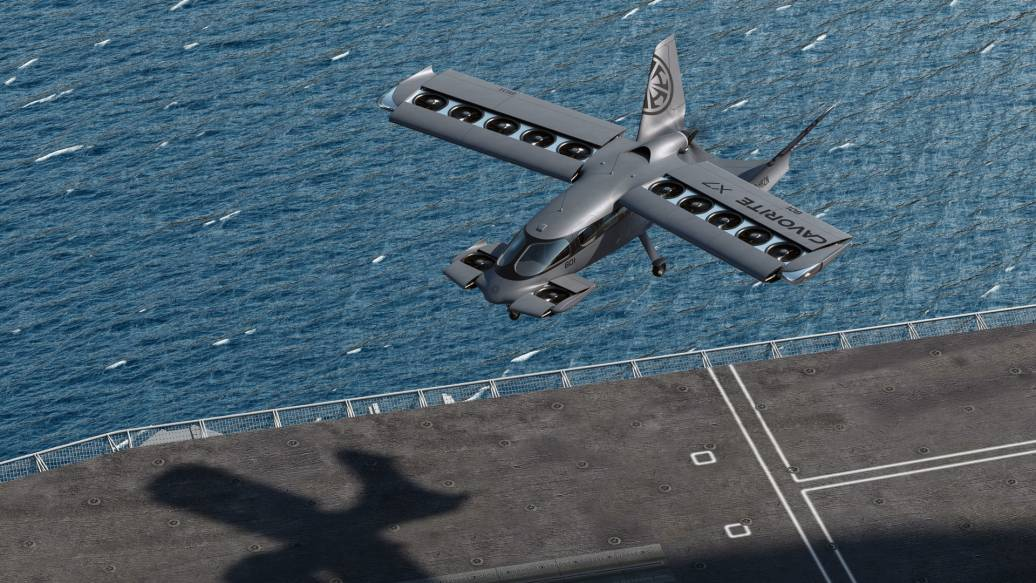
The Cavorite X7 is a hybrid-electric VTOL aircraft with a patented fan-in-wing design and a power system intended to support longer range and higher speed than many purely battery-electric concepts. Its dual-use potential extends beyond advanced air mobility, with possible applications in logistics, special missions, medical evacuation, surveillance, and government support roles.
Marshall’s work draws on its background in aerospace engineering, platform modification, special-mission conversions, test beds, stability, control, and applied aircraft dynamics. The programme places UK engineering capability inside a development route where modelling and certification evidence are just as important as the physical aircraft.
A modern VTOL aircraft is not simply an airframe with distributed propulsion. Its production path depends on flight-control software, propulsion management, aerodynamic modelling, structural loads, sensor redundancy, thermal management, hybrid power systems, certification evidence, and repeatable test procedures. A credible control model informs design changes, test planning, safety cases, and certification submissions before expensive flight-test hours are committed.
Hybrid-electric VTOL aircraft face particularly complex transition problems. The aircraft must move between vertical and forward flight while managing power availability, thrust distribution, wing behaviour, lift-fan performance, mass properties, and failure cases. Weak modelling pushes uncertainty into physical testing, where it becomes slower, more expensive, and harder to correct. Strong modelling allows engineers to narrow risk before hardware changes or flight-test points are locked in.
A similar shift is visible in Airbus’ work to build uncrewed capability from the H145 helicopter family, where autonomy, cargo handling, sensors, and safety assurance are being layered onto an established airframe and support base.
The supply-chain requirement is broad. Hybrid VTOL programmes need structural suppliers, propulsion specialists, battery and generator expertise, avionics, software, simulation environments, sensor suites, test instrumentation, and maintainability planning. Defence or special-mission variants add secure communications, mission payloads, ruggedisation, survivability considerations, and support documentation.
Experienced engineering partners can play a strong role in that market. Many advanced-air-mobility developers have ambitious concepts but need support turning those concepts into certifiable, supportable products. Established aerospace businesses can contribute safety-critical modelling, certification preparation, flight-test planning, and integration expertise without owning the entire aircraft programme.
The Cavorite X7 still faces the familiar barriers around certification, funding, production readiness, customer confidence, infrastructure, and support economics. Military and government customers will also test the aircraft against reliability, deployed maintenance, mission-system integration, operation in degraded environments, and through-life cost. A flight dynamics model does not settle those issues, although it does move the programme toward evidence-led engineering rather than concept-stage assertion.
Digital models, flight-control laws, simulation, software validation, and certification evidence are becoming production enablers in their own right. Marshall’s work on the Cavorite X7 places UK engineering expertise in that development layer, where proven modification and test capability can help new aircraft types move from prototype ambition toward credible manufacturing programmes.