IN Brief:
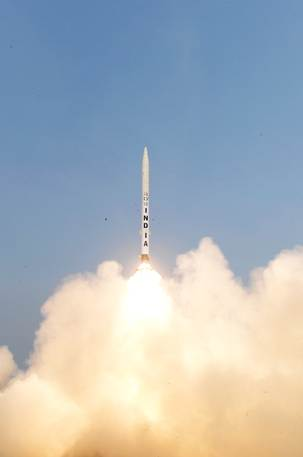
- India has completed a maiden flight-test of the Naval Anti-Ship Missile-Medium Range.
- The programme strengthens India’s domestic maritime strike and missile-integration pathway.
- Production maturity will depend on propulsion, seeker, warhead, launcher, and naval targeting supply chains.
India has carried out the maiden flight-test of its Naval Anti-Ship Missile-Medium Range, advancing a domestic maritime strike programme that sits squarely inside the country’s wider push for sovereign missile production.
The NASM-MR programme gives India a medium-range anti-ship weapon intended to sit between short-range naval strike options and heavier stand-off systems. For the Indian Navy, the capability adds flexibility in littoral and blue-water scenarios, where surface vessels, coastal positions, and mobile launch sites increasingly need to hold hostile ships at risk without relying only on imported munitions or larger strike systems.
Behind the launch is a broader industrial effort across propulsion, missile-body manufacture, guidance, navigation, terminal homing, warhead engineering, launch interfaces, telemetry, and environmental qualification. Anti-ship weapons place heavy demands on consistency because the operating environment is highly variable: sea clutter, moving targets, electronic countermeasures, low-level flight, maritime weather, and salt-laden storage conditions all influence performance.
India’s naval modernisation is increasingly being built around the same idea: domestic control of the electronic, guidance, and strike layers that define modern maritime power. The country has already been strengthening naval resilience through new GNSS jamming procurement, and NASM-MR adds the offensive counterpart to that defensive and electronic-warfare direction.
The next stage will be less visible than the test launch, but more decisive for industry. A flight-test proves that a configuration can work under defined conditions; a production missile has to perform repeatedly across batches, storage cycles, handling events, transport routes, launcher interfaces, and operational launch environments. That requires qualified suppliers, disciplined process control, and test infrastructure able to expose small inconsistencies before they become fleet-level problems.
Anti-ship missile manufacture also creates pressure across the materials and electronics base. Seeker assemblies must be protected from shock and vibration, control surfaces must remain precise across thermal ranges, propulsion systems must deliver predictable energy output, and warheads must meet lethality and safety requirements without creating handling problems for the navy. Where imported systems can hide those complexities inside a foreign supply chain, domestic programmes force every layer into national industrial view.
That is precisely why NASM-MR has wider relevance for India’s defence economy. A mature anti-ship missile line supports not only the navy’s order book but also suppliers in composites, machining, explosives, electronic packaging, inertial navigation, RF components, software assurance, and launcher integration. Once those capabilities stabilise, they can support adjacent air-launched, ship-launched, and ground-launched weapons.
The maritime strike market is becoming more demanding worldwide. Navies are no longer planning around a small number of exquisite engagements; they are preparing for longer campaigns in which missiles, decoys, drones, electronic attack, and distributed sensors are consumed quickly. A weapon that cannot be built and replenished in credible quantities offers limited deterrence, even when its individual performance is strong.
For India, the industrial objective is therefore not only to produce a capable missile but to deepen the ecosystem around it. The country’s public-sector laboratories, private manufacturers, propulsion suppliers, electronics houses, and naval integration teams will need to converge around a production model that can support qualification, inventory growth, and future upgrade work.
NASM-MR’s flight-test gives that effort a visible milestone. The programme’s real value will be determined by how quickly India can move from a successful launch to repeatable manufacture, platform integration, and stockpile depth across a maritime environment where naval strike capacity is again becoming a manufacturing race.