IN Brief:
- Milrem Robotics is showcasing robotic counter-UAS and combat systems at Eurosatory.
- The display includes THeMIS, HAVOC, ARCOS, weapon stations, and tethered UAV integration.
- The systems reflect growing demand for unmanned land platforms that extend defensive coverage.
Milrem Robotics is showcasing robotic counter-UAS and combat systems at Eurosatory, placing unmanned ground platforms inside a layered defensive model for NATO’s eastern flank.
The company’s display is built around its Robotised Eastern Flank Deterrence Initiative and includes several configurations of the THeMIS unmanned ground vehicle, the HAVOC 8×8 robotic combat vehicle, and the ARCOS command-and-control suite. The package is designed to show how unmanned platforms, sensors, weapons, and control software can work as a coordinated defensive layer rather than as isolated robotic vehicles.
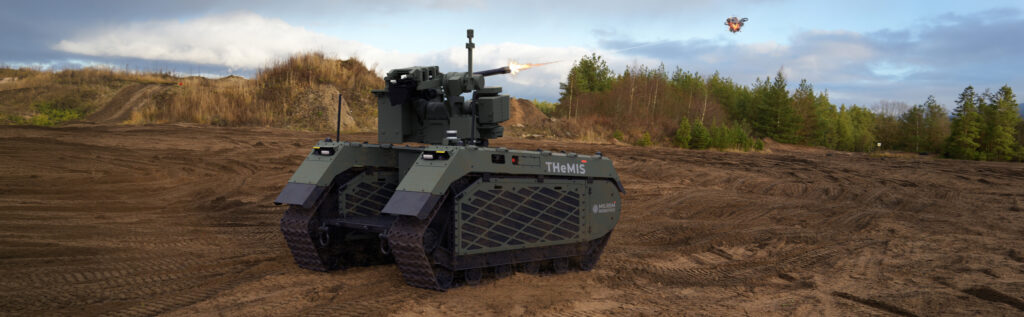
THeMIS appears in multiple roles, including weaponised configurations and counter-UAS variants. One configuration integrates the EOS R400 Slinger remote weapon station, using a 30x113mm cannon and specialised ammunition to engage hostile drones at ranges beyond 1,000m. Other integrations include Ukrainian and partner payloads, reflecting how quickly battlefield demand is pulling robotics into mixed operational roles.
HAVOC adds a heavier robotic combat option, using an 8×8 hybrid-electric platform intended to carry larger payloads and operate in more demanding missions. With options for cannon armament, proximity-fused ammunition, short-range air-defence missiles, and electronic-warfare equipment, the platform points toward a land domain in which unmanned systems carry both sensors and effectors.
Autonomy has already moved from experimental promise toward test-and-scale work, with facilities such as the Swindon military drone centre reflecting the need for repeatable trials, qualification, and production evidence. Milrem’s Eurosatory package brings that requirement into the land systems domain, where unmanned platforms must handle terrain, recoil, communications, power, payloads, and safety rules.
For manufacturers, unmanned ground systems are becoming integration platforms. Mobility is only one layer. A useful robotic vehicle needs secure datalinks, autonomy software, power management, payload interfaces, remote weapon control, sensor fusion, operator tools, cybersecurity, safety functions, and field maintainability. Each new payload creates fresh qualification work.
Counter-UAS provides a strong use case because it places personnel at high risk. Ground forces need persistent coverage against drones without exposing soldiers to every forward sensor mast, weapon station, or observation point. A robotic platform can carry heavier sensors than a dismounted team, reposition under remote control, and absorb risk in areas threatened by artillery, mines, drones, or direct fire.
The engineering remains difficult. A robotic C-UAS vehicle must manage power-hungry sensors and stabilised weapons while maintaining mobility, communications, and target-tracking accuracy. Recoil from cannon systems affects vehicle stability and sensor alignment. Electronic-warfare environments can degrade control links or navigation. Maintenance has to be practical in field conditions rather than dependent on specialist factory teams.
ARCOS may become as important as the vehicles themselves. Militaries cannot scale robotics if every platform requires constant individual control. Fleet management, tasking, supervision, route planning, sensor fusion, and integration with battle-management systems will determine whether unmanned ground systems can operate in meaningful numbers. Software architecture becomes the production backbone.
The modular nature of THeMIS is a commercial strength, allowing Milrem to integrate different weapons, sensors, and mission kits. That flexibility also brings configuration-control pressure. If every customer requires a unique mix of radios, weapons, sensors, software, and national interfaces, production can fragment quickly. The successful industrial model will allow adaptation without creating an unsustainable catalogue of bespoke variants.
Hybrid-electric systems such as HAVOC add their own manufacturing demands. Batteries, generators, drivetrains, power electronics, thermal management, and high-voltage safety all need military-grade robustness. Silent watch, onboard power, and exportable energy for payloads are valuable, but they bring sustainment and training burdens that armies must plan for.
For NATO’s eastern flank, robotic systems offer a way to extend surveillance, increase distributed firepower, and reduce exposure in defensive positions. They can support forward sensing, counter-drone cover, perimeter defence, and high-risk reconnaissance, while allowing manned forces to remain further from the first point of contact.
Milrem’s display shows land robotics moving into a production and integration phase. The market will no longer be judged by novelty alone. Customers will look for payload maturity, software reliability, maintainable designs, secure communications, and industrial capacity able to deliver more than a handful of demonstration vehicles.