IN Brief:
- AM General and Marshall Land Systems have signed an MoU covering authorised HUMVEE service support.
- Marshall’s role supports the IRONCLAD Team’s bid for the UK Light Mobility Vehicle programme.
- Domestic service capacity, diagnostics, spares, and configuration control are becoming central to light tactical vehicle procurement.
AM General and Marshall Land Systems have signed a memorandum of understanding to certify Marshall as an authorised HUMVEE service provider, adding a UK sustainment layer to the IRONCLAD Team’s bid for the Ministry of Defence’s Light Mobility Vehicle programme.
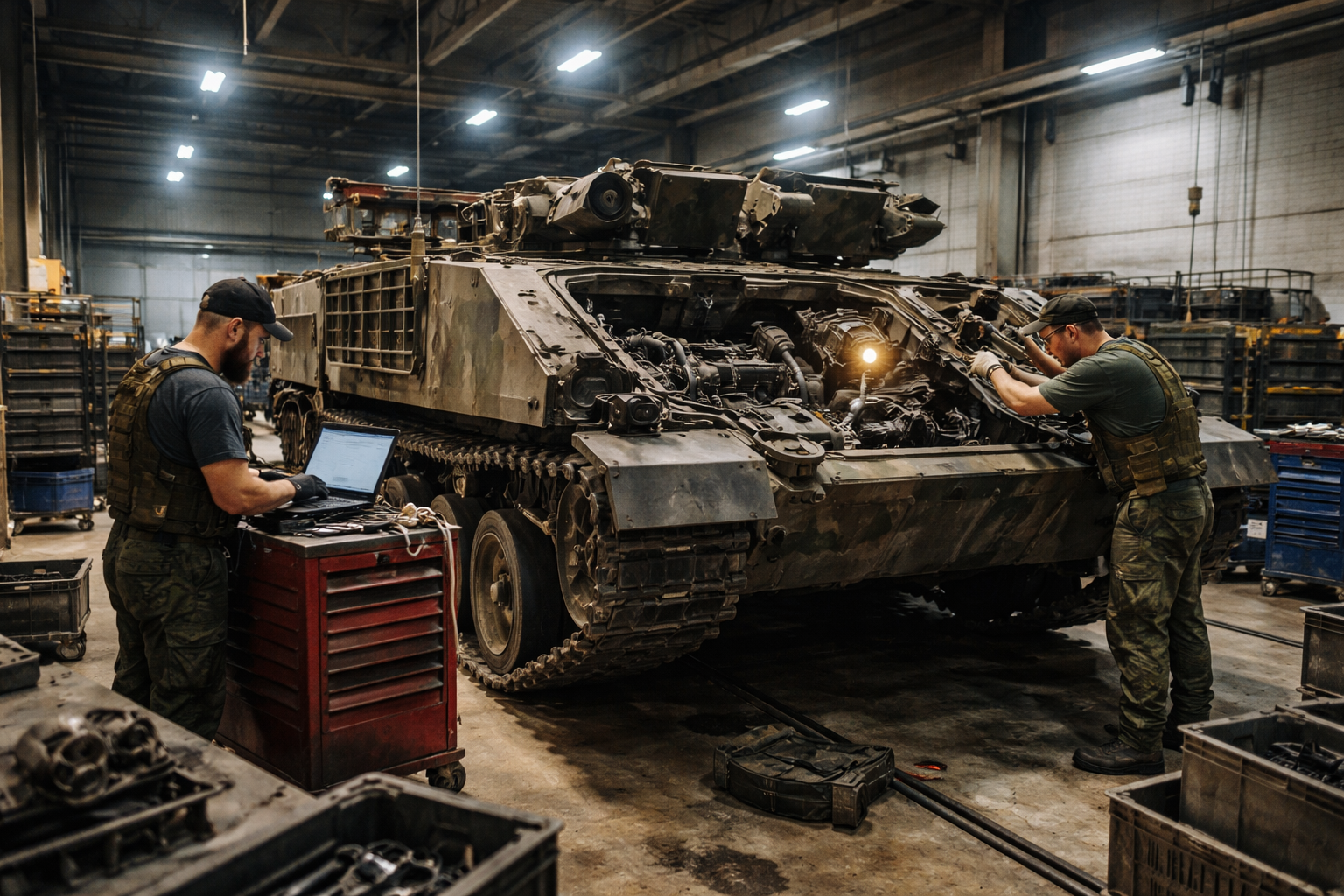
The agreement builds on the companies’ existing partnership around the UK requirement and gives Marshall a defined role in HUMVEE lifecycle support. That work is expected to include troubleshooting, diagnostics, parts service, maintenance support, and related technical activity for HUMVEE users in the UK and across European NATO markets.
Although the HUMVEE is a mature platform, its installed base makes support a substantial industrial activity. AM General has cited more than 350,000 HUMVEE vehicles deployed worldwide, including NATO and European users. Fleets of that scale generate continuing demand for spares, repair, overhaul, documentation, training, configuration updates, diagnostics, and technical assistance.
The UK Light Mobility Vehicle contest will not be decided on vehicle supply alone. Light tactical vehicles now carry radios, antennas, battle-management systems, electronic equipment, armour kits, role-specific storage, weapon mounts, medical equipment, and power systems. Each addition creates work around integration, electrical load, cable routing, mounts, certification, maintenance procedures, and future upgrade paths.
Marshall’s land-systems business gives the bid a local engineering and sustainment base. The company’s work spans deployable infrastructure, vehicle integration, support services, and specialist military equipment, with facilities in the UK, Canada, and the Netherlands. Its involvement allows the IRONCLAD Team to present the HUMVEE not simply as an imported platform, but as a vehicle family backed by regional maintenance and service capacity.
Light mobility procurement has become more complex as armies replace ageing fleets and prepare for dispersed operations. Vehicles that once carried troops and equipment now need to support command nodes, anti-tank teams, electronic warfare payloads, casualty evacuation roles, reconnaissance teams, and logistics activity. That diversity turns configuration control into a practical issue. A fleet can fragment quickly if variants, mounts, communications fits, and spares are not governed properly.
The UK’s wider land-equipment experience has also sharpened attention on testing, supportability, and acceptance discipline. Recent armoured vehicle programmes have shown the cost of discovering problems late, particularly where vibration, noise, reliability, safety, or integration risks are allowed to accumulate. A light vehicle is not comparable to a complex tracked platform, but the basic principle holds: support, documentation, and configuration management must be built into the programme rather than added after selection.
Through-life support also shapes fleet availability. A light tactical vehicle may be bought in useful numbers, but availability depends on technician training, parts distribution, repair turnaround, diagnostic tools, warranty processes, and technical authority. In deployed or high-readiness contexts, a minor electrical fault or unavailable suspension component can remove a vehicle from service as effectively as battle damage.
The HUMVEE’s maturity gives AM General a strong support history, but it also creates expectations. Customers will expect rapid access to spares, established maintenance procedures, and a clear upgrade route. Marshall’s role can strengthen that proposition in the UK by placing technical capacity closer to the customer and by supporting national integration needs.
For European NATO customers, the arrangement may also carry value beyond the UK requirement. Defence forces are rebuilding readiness, refreshing vehicle parks, and improving mobility across dispersed infrastructure. A regional HUMVEE support network can serve existing users while supporting new opportunities, especially where customers want proven vehicles backed by nearby maintenance and repair capacity.
Industrial participation remains a constant factor in UK procurement. A foreign-designed platform can still support domestic work if sustainment, integration, testing, training, and modification activity are placed locally. That creates skilled employment and preserves knowledge inside the UK support base, while avoiding some of the risk associated with launching an entirely new vehicle design.
The Marshall agreement brings the HUMVEE offer closer to the realities of long-term military vehicle ownership. A light mobility fleet has to be bought, adapted, driven hard, repaired repeatedly, upgraded, and kept available across years of use. In that environment, the support organisation is part of the capability.