IN Brief:
- Australia is prioritising domestic sustainment and upgrade capacity across key armoured and artillery platforms.
- Boxer, Redback, AS9 Huntsman, Bushmaster, and Hawkei fleets are now tied to wider industrial-readiness planning.
- The approach reflects a regional shift from platform acquisition to sovereign support, repair, and production depth.
Australia’s land systems strategy is moving deeper into domestic sustainment, repair, and upgrade capacity, with Boxer CRV, Redback IFV, AS9 Huntsman artillery, Bushmaster, and Hawkei fleets forming the practical test of industrial readiness.
The headline platforms are familiar, but the harder question is how Australia keeps them available, updated, and repairable across the Indo-Pacific. Boxer gives the Australian Army a modern combat reconnaissance vehicle. Redback will provide the next infantry fighting vehicle layer. AS9 Huntsman adds self-propelled artillery. Bushmaster and Hawkei remain central to protected mobility. Together, they create a support burden that cannot be solved by procurement alone.
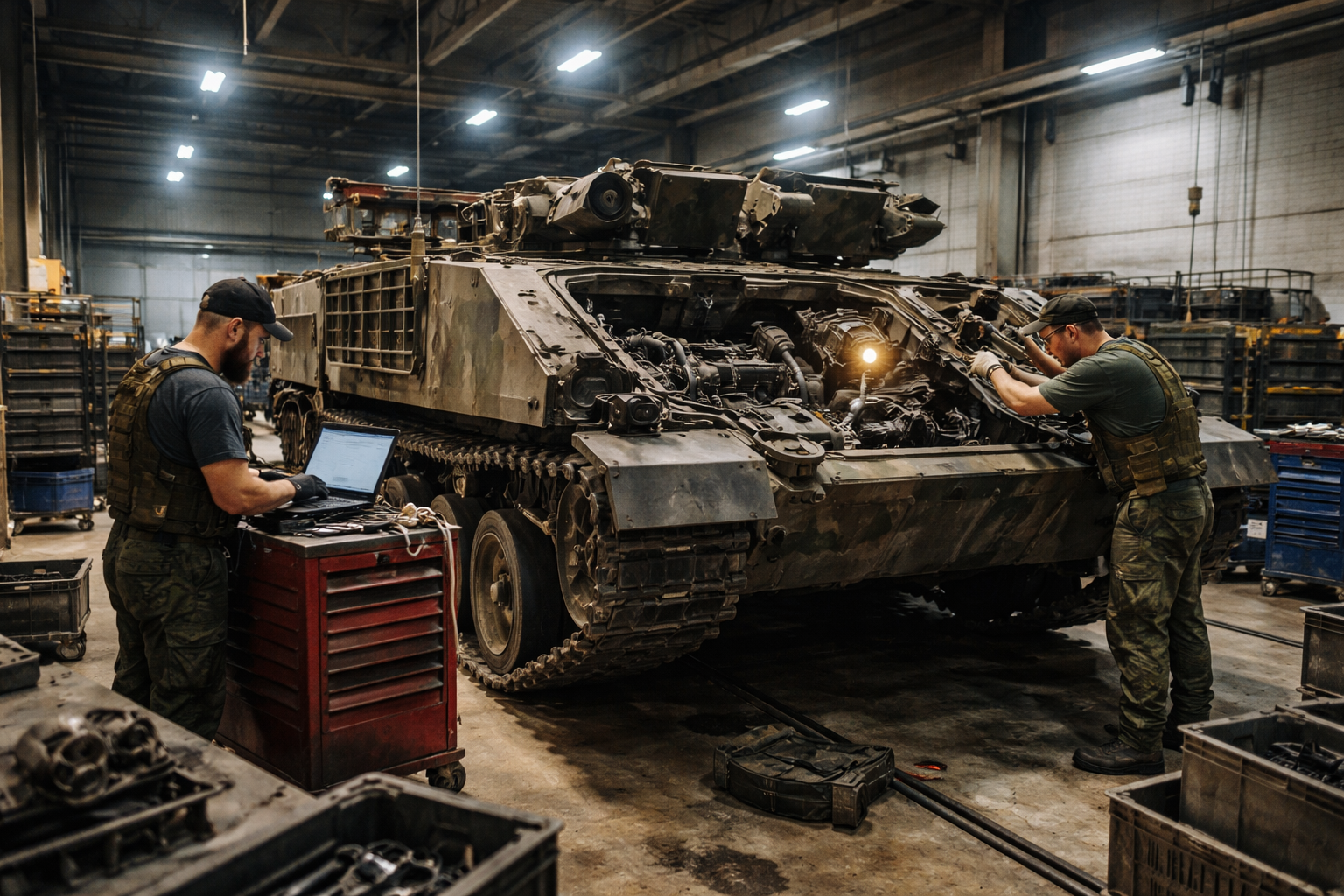
That burden now sits firmly inside manufacturing policy. Readiness depends on local stocks of spares, trained welders and machinists, digital technical data, depot capacity, electronics support, armour repair, turret maintenance, and the ability to incorporate upgrades without sending every difficult problem offshore. Australia’s geography sharpens those requirements. Long supply lines, dispersed operating areas, and coalition commitments make sovereign sustainment a practical requirement rather than a procurement slogan.
The Boxer programme has already given Australia a production and export foothold through Rheinmetall’s Redbank facility in Queensland. Export work linked to German Boxer requirements has shown that Australian facilities can contribute to a wider industrial network rather than only supporting domestic fleets. Redback brings a similar opportunity, with Hanwha Defence Australia contracted to deliver locally built infantry fighting vehicles and associated support.
Artillery creates another layer of industrial pressure. The AS9 Huntsman programme sits in a global market where ammunition demand, barrel life, fire-control upgrades, protection systems, and mobility support are all under strain. India’s possible K9 Vajra expansion shows how tracked self-propelled artillery is moving from selective procurement into a broader production-scale requirement across several regions.
Australia’s sustainment push reflects the post-Ukraine reality that land-platform readiness is now an industrial contest. Vehicles must be produced, repaired, modified, and returned to service faster than peacetime acquisition systems were designed to support. A fleet can look credible on paper and still struggle if spares, technicians, depot slots, or software support are missing. The manufacturing base is therefore becoming part of the force structure.
Several practical questions follow. Local suppliers need the ability to produce replacement parts under pressure, while primes and government customers need clear technical-data arrangements for urgent modifications. Electronics and software upgrades must be deliverable without long overseas release cycles, and the skilled workforce has to support simultaneous demand across armoured vehicles, naval construction, aerospace sustainment, and munitions. Each constraint shapes how quickly Australia can turn platforms into persistent combat power.
The supplier opportunity is broader than the prime-contractor layer. Domestic SMEs can become critical in machining, fabrication, harnessing, coatings, additive manufacturing, diagnostics, test equipment, and repair tooling. Defence industrial policy often focuses on marquee final assembly, yet long-term readiness is frequently determined by workshops that can produce or repair components at short notice and without excessive dependence on imported stock.
The wider Indo-Pacific setting demands a more resilient model. Land forces must prepare for distributed operations, littoral manoeuvre, infrastructure constraints, and long-range fires. Armoured vehicles and artillery need to be rugged enough for deployment across difficult terrain, but the industrial system behind them must be equally robust. A vehicle damaged in training, deployment, or crisis has to be recoverable through a support network that can function under pressure.
A similar logic is visible in the air domain, where Australia’s Williamtown air power precinct links F-35 sustainment to local industrial depth. The land domain is moving along the same path. Buying platforms is only the first phase; keeping them upgraded, repairable, and operational is where the long-term industrial contest begins.
The market is shifting towards lifecycle capability. Platform manufacturers that can anchor local production, transfer practical skills, and support domestic repair capacity will be better positioned than suppliers offering an imported vehicle with a support manual attached. For Australia, the factory floor is becoming part of deterrence.