IN Brief:
- L3Harris has been selected to manufacture 18 advanced missile-defence tracking satellites.
- Medium-field-of-view sensors are intended to provide data accurate enough for fire-control use.
- Production must combine constellation tempo with demanding optical calibration and environmental qualification.
L3Harris has received a US Space Force award worth up to $955 million to manufacture 18 advanced missile-defence tracking satellites, adding another substantial tranche to America’s proliferated orbital architecture.
The spacecraft will detect and follow ballistic missiles, manoeuvring hypersonic vehicles, and other advanced threats. Medium-field-of-view infrared payloads are intended to produce tracks accurate and timely enough to support fire-control activity rather than warning alone.
Manufacturing is due to begin immediately, with launch readiness planned by the end of 2028. L3Harris now has more than 70 missile-warning and tracking spacecraft on order, while five are already operating in orbit.
The award continues a shift away from a handful of large, bespoke defence satellites towards larger constellations of smaller spacecraft. Repeated buses, common payloads, shorter cycles, and batch launches allow capability to be expanded or replenished more regularly.
Series production in space remains considerably more demanding than ordinary industrial manufacture. Every spacecraft must survive launch vibration, vacuum, radiation, and severe thermal cycling while maintaining accurate sensor alignment and secure communications for years without physical access.
Infrared payloads carry much of that difficulty. Detecting a missile against the Earth, cloud, atmosphere, and background heat requires cooled detectors, precision optics, calibration, onboard processing, and algorithms capable of separating a target from clutter.
Generating fire-control-quality information raises the standard further. A general warning that an object exists differs from a continuous track accurate enough to inform an interceptor.
Sensor performance, timing, navigation, data fusion, communications latency, and ground processing all contribute to the final result. Weakness in any part of that chain can reduce the value of an otherwise capable payload.
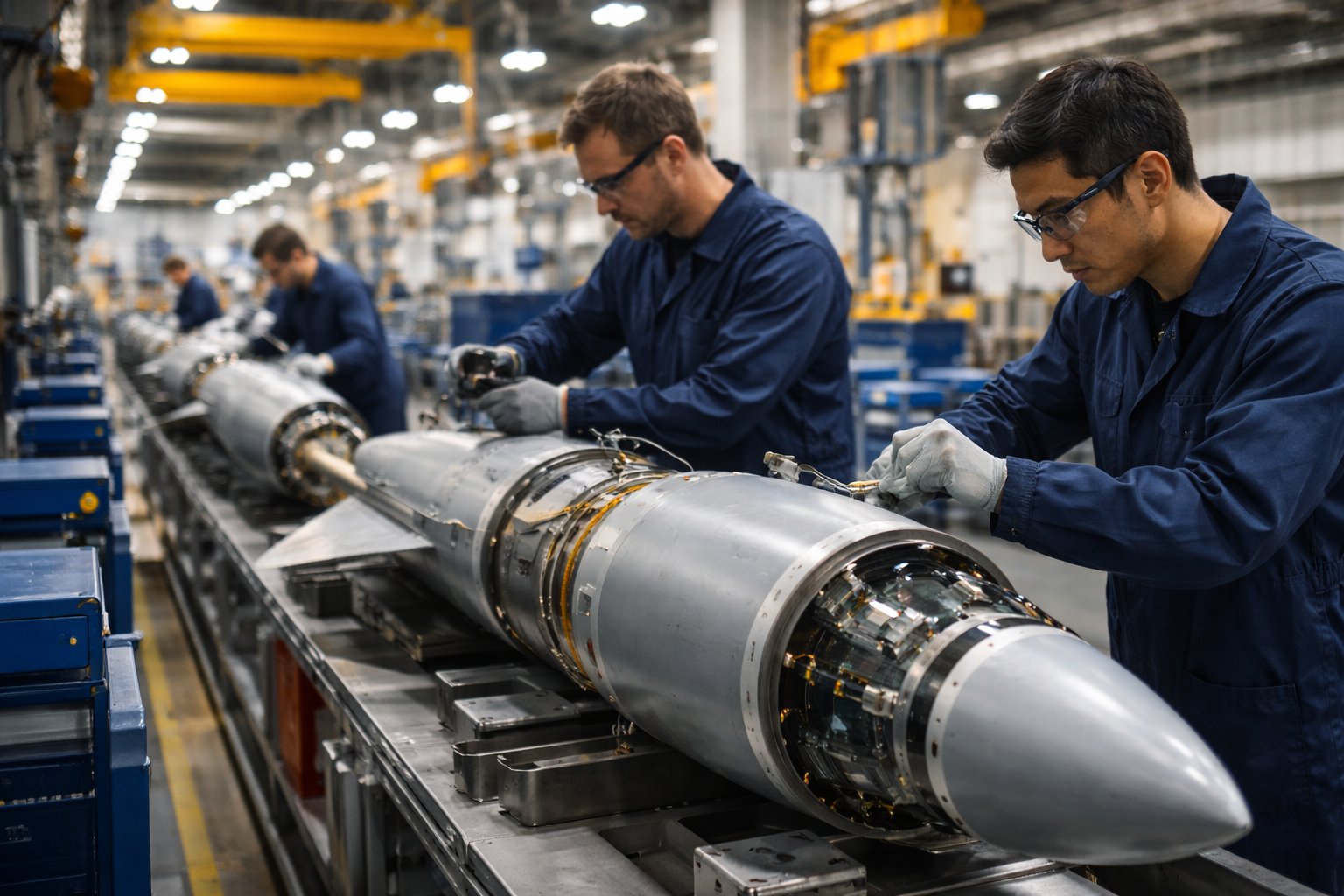
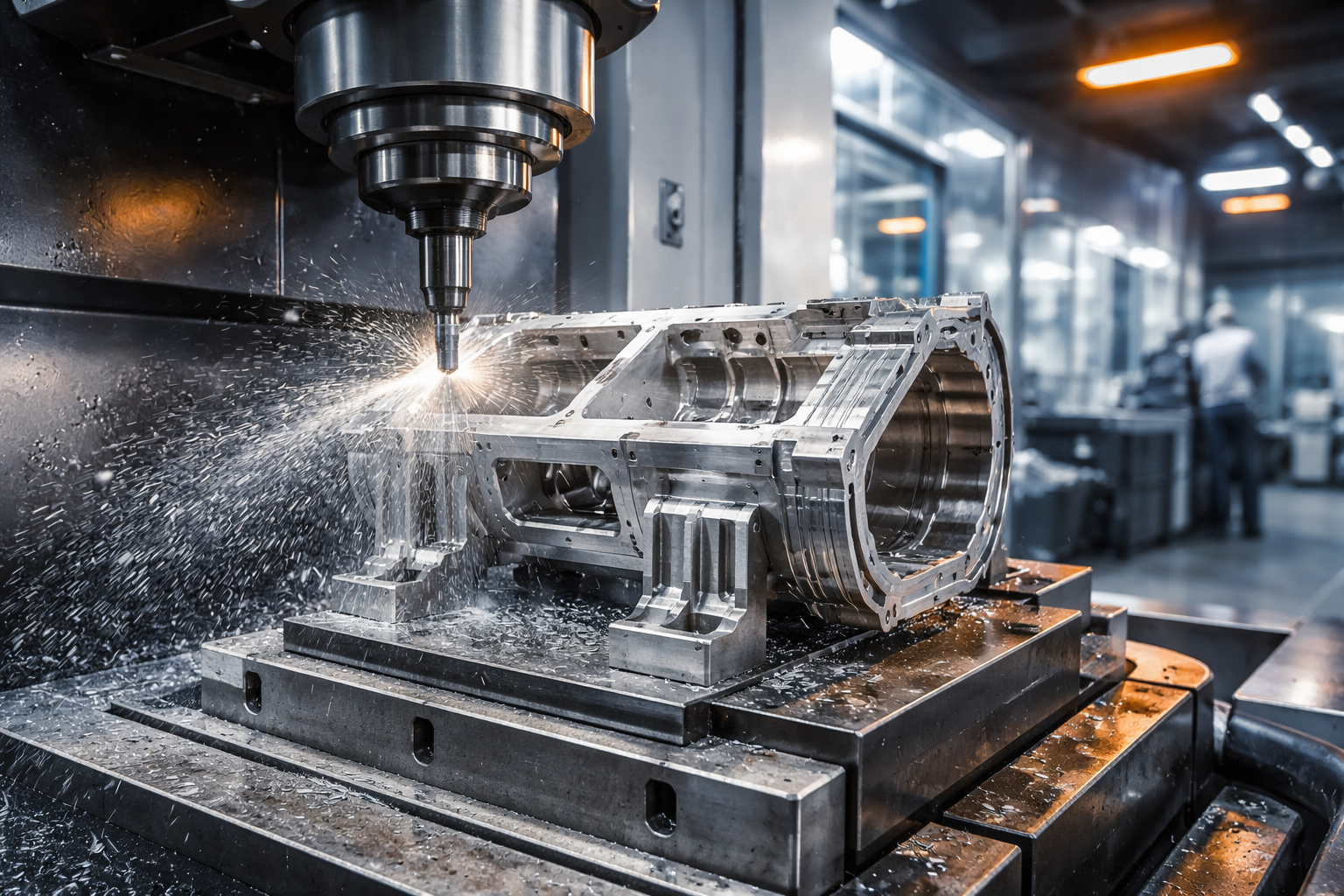
L3Harris has expanded manufacturing in Indiana and added integration capability in Florida, allowing spacecraft structures, electronics, payloads, and final testing to move through a more regular production flow.
Repetition can reduce cost and schedule risk when configuration remains stable. Defence customers frequently introduce new sensors, encryption, communications equipment, or resilience requirements between tranches, however, turning a nominal production line back into a sequence of customised projects.
Managing change will therefore be central. Improvements identified on earlier spacecraft need to enter later builds without disrupting tooling, supplier orders, software baselines, or qualification evidence.
The supplier base includes space-qualified detectors, radiation-tolerant processors, reaction wheels, star trackers, optical materials, propulsion components, antennas, power electronics, and thermal-control hardware.
Many of those products come from small specialist markets serving defence, intelligence, civil, and commercial customers simultaneously. A single late component can hold an otherwise complete satellite on the factory floor.
Test capacity can become equally restrictive. Thermal-vacuum chambers, vibration rigs, electromagnetic facilities, and optical-calibration equipment require substantial investment and can process only a limited number of spacecraft at once.
Increasing assembly speed without expanding test throughput simply moves the queue towards the end of production. Fixtures, automated scripts, common procedures, and parallel facilities will be required to maintain the 2028 schedule.
Workforce requirements are changing as satellite quantities rise. Programmes need production engineers, planners, technicians, quality specialists, and supply-chain managers alongside traditional spacecraft designers.
Assembly instructions must be detailed enough to support repeatability without weakening the judgement required for flight hardware. Excessive reliance on a small group of experienced engineers limits output and creates vulnerability when personnel leave.
Proliferated constellations gain resilience through numbers. Losing one spacecraft has less effect than the loss of one platform within a small architecture, while regular production enables technology refresh and replenishment.
Greater numbers create continuous demand elsewhere. Launch services, ground stations, network management, software, communications, and orbital operations must grow alongside the spacecraft factory.
Cybersecurity is embedded throughout the architecture. Flight software, cryptographic material, ground systems, manufacturing data, and command links need protection from development through launch and operation.
The 2028 readiness date compresses design completion, long-lead purchasing, assembly, test, and delivery across 18 spacecraft. Suppliers will need commitments before every element of the final configuration is settled.
L3Harris can draw on earlier tracking-satellite work, allowing lessons to move into tooling, test automation, software, and supply agreements. Capturing that knowledge institutionally will be more scalable than relying on the memory of individual engineers.
The broader acceleration of defence production has already brought digital integration, supplier resilience, and sovereign capacity into sharper focus across aerospace and missile programmes. Tracking constellations combine all three within schedules that resemble production campaigns rather than occasional spacecraft projects.
Orbital sensors also depend on integration with terrestrial command systems and interceptors. Accurate data must move quickly between services, networks, and weapons using compatible formats and trusted timing.
Manufacturing satellites without completing that data architecture would create observation rather than a functioning defensive chain. Hardware acceptance must therefore be matched by software, communications, and end-to-end testing.
The contract is both a spacecraft order and a test of production maturity. L3Harris must deliver 18 highly calibrated orbital sensors at constellation tempo while preserving the assurance expected of equipment supporting decisions within seconds of a missile launch.