IN Brief:
- AWI has recorded a 20% increase in orders for wire used in aerospace components.
- The company has invested £1.1 million in additional space, furnace capacity, and rolling equipment.
- More than 400 tonnes of DFARS-approved material support short lead times for specialist batches.
Alloy Wire International will use its seventh appearance at the Farnborough International Airshow to pursue further aerospace and defence work after recording a 20% increase in orders for specialist wire used in aircraft components.
The West Midlands manufacturer has added approximately £150,000 in aerospace orders during 2026. Its materials are used in springs, fire-detection wire, fasteners, sealing rings, fuel pipes, electrical instruments, engine assemblies, and other high-temperature components.
AWI will exhibit Nimonic 90, Waspaloy, Haynes 282, and Inconel 718 among a portfolio of 62 nickel, cobalt, and iron-based alloys. These grades are selected where heat, corrosion, fatigue, and long service lives rule out conventional wire products.
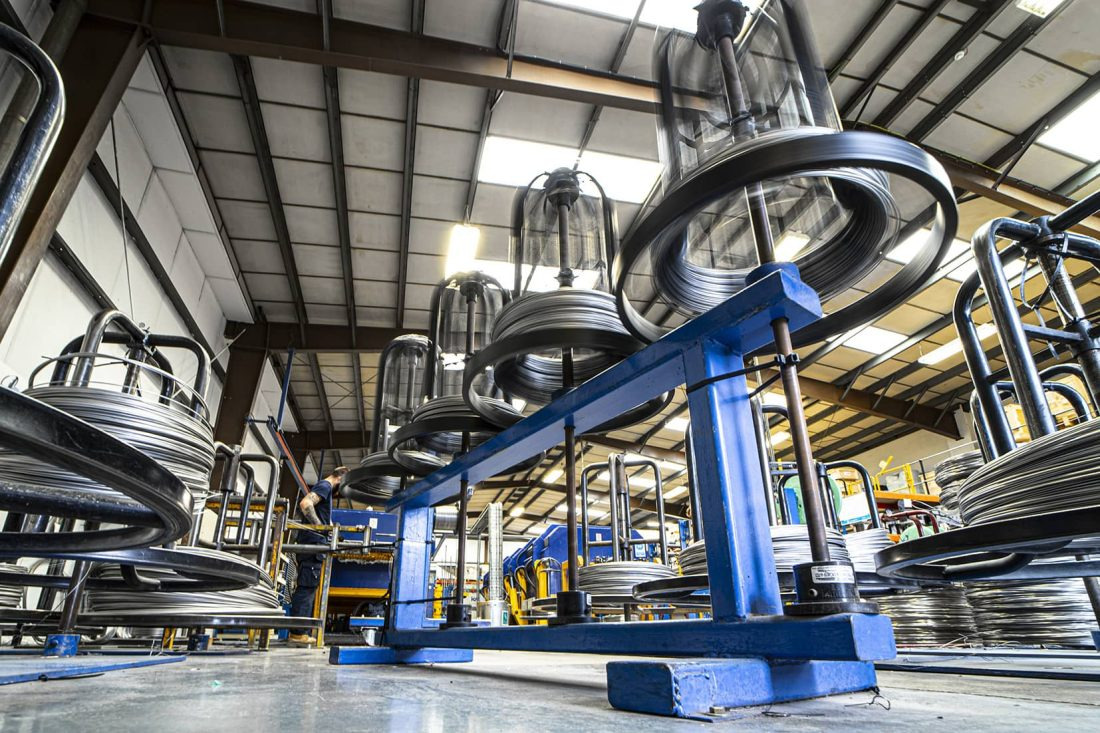
Customers across 75 countries can order wire from 0.025mm to 21mm diameter, covering development quantities, small batches, and medium-volume production. More than 400 tonnes of DFARS-approved material are held in stock to support a stated three-week lead time.
Although several contractual stages may separate AWI from an aircraft or engine prime, its wire enters components whose failure could stop an assembly, delay qualification, or ground an aircraft. The monetary value of the material can be small compared with the equipment relying upon it.
Production begins with controlled feedstock whose chemistry, melt history, mechanical properties, surface condition, and traceability must remain intact through repeated reductions and heat-treatment cycles.
High-performance nickel alloys resist deformation, which allows them to retain strength inside engines and other hot environments but increases tool wear and forming loads during manufacture.
Drawing and rolling processes must avoid cracking, unwanted work hardening, dimensional variation, and surface defects. Lubrication, die condition, reduction sequence, and operator experience all influence the result.
Heat treatment then controls grain structure, strength, ductility, and residual stress. Furnace uniformity, atmosphere, cycle time, and cooling have to remain within approved limits, making additional furnace capacity a quality investment as well as a volume increase.
AWI has invested £1.1 million in its manufacturing operation, adding another unit, new furnace capability, and rolling equipment. The extra capacity is intended to improve throughput while preserving flexibility across numerous alloys and dimensions.
Flexibility is valuable in aerospace, where development, maintenance, and low-rate programmes may require modest quantities to exact specifications. Large mills are often organised around longer runs, leaving specialist businesses to serve urgent or unusual requirements.
Holding substantial approved stock reduces exposure to mill lead times, although it ties up capital and increases forecasting risk. Exotic alloy inventory is expensive, and material held in the wrong grade, diameter, or condition may remain unused.
Raw-material prices can also move sharply. Nickel, cobalt, chromium, and molybdenum respond to energy costs, mining conditions, geopolitical risk, and demand from several industrial sectors.
Defence work adds procurement controls. DFARS compliance requires eligible material sources and complete documentation, while export customers may impose separate national rules covering origin, processing, and custody.
Paul Chatterley, sales executive at Alloy Wire International, said the Farnborough event places the company alongside engineers, buyers, and decision-makers from civil and military programmes.
“We have seen a £150,000 increase in orders so far in 2026 and believe there is further opportunities to extend this, with an increase in defence spending both at home and overseas,” he said.
Airshow discussions rarely convert directly into production. Customers may require sample material, test results, process audits, first-article inspection, and approval by several tiers before a new supplier enters an established bill of materials.
Once qualified, continuity becomes valuable because changing material source can require renewed testing or customer approval. Reliable delivery and documentation can support long relationships, while a certification error can affect components worth many times the original wire order.
Aerospace growth is exposing the dependence of major production targets on lower-tier material specialists. Prime contractors can increase intended aircraft or missile output only when forgings, castings, fasteners, seals, wiring, coatings, and specialist alloys rise with them.
The mismatch between headline demand and limited industrial depth has shaped recent assessments of European defence capacity. AWI’s investment shows capacity being added at a level that receives less attention than final assembly but can constrain several programmes simultaneously.
Skills remain as important as machinery. Operators learn how individual alloys respond during drawing, rolling, annealing, straightening, cleaning, and inspection, knowledge that cannot be replaced immediately by automation.
Additional equipment therefore needs recruitment, training, maintenance, process engineering, and quality support before it produces reliable output. A machine running below its intended rate can still increase cost when the supporting workforce is not ready.
AS9100 accreditation, held by AWI for more than 13 years, provides a framework for traceability and process control, although every customer can add its own technical specifications and approval requirements.
Small batches also create planning complexity. Frequent changeovers, cleaning, tool adjustments, and inspection reduce the apparent efficiency of the line, yet they allow customers to obtain specialist material without purchasing excessive quantities.
AWI’s growth programme combines stockholding, flexible production, and physical capacity rather than relying on a single large contract. That can spread risk across civil and military customers while allowing the factory to respond to urgent requirements.
The £150,000 increase is modest beside an aircraft procurement, but the wire can enter dozens of separate parts and programmes. Aerospace output depends on these small, qualified material flows remaining available when larger manufacturers raise their schedules.