IN Brief:
- BAE Systems will supply the AN/ALQ-250 EPAWSS electronic-warfare system for South Korea’s 59 F-15K aircraft.
- Production draws on established facilities in New Hampshire and Texas before fleet-wide aircraft integration and testing.
- Long-term capability will depend on software, threat libraries, electronic components, and secure support arrangements.
BAE Systems has secured a Boeing contract to equip all 59 Republic of Korea Air Force F-15K Slam Eagle aircraft with the AN/ALQ-250 Eagle Passive Active Warning Survivability System, extending the established EPAWSS production programme into one of Asia’s largest combat-aircraft upgrades.
The all-digital suite provides 360-degree threat awareness by combining passive detection, electronic surveillance, and active countermeasure functions within an integrated architecture. It is designed to identify hostile emitters, assess their behaviour, and support a defensive response against radar-guided weapons without requiring several separate legacy systems.
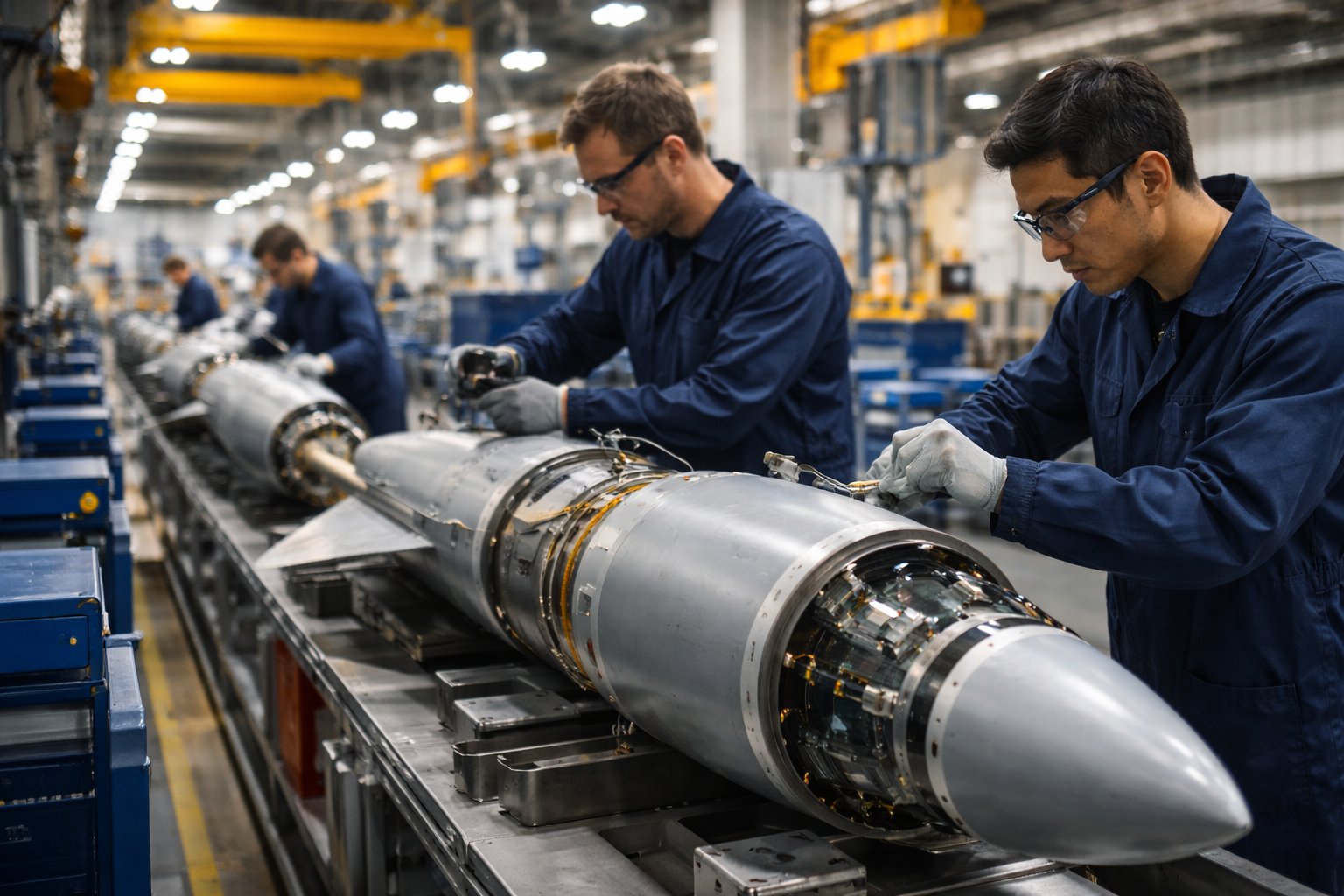
EPAWSS is already in full-rate production for the US Air Force’s F-15EX and selected F-15E aircraft, allowing the Korean programme to draw on manufacturing processes, suppliers, and test equipment that have moved beyond development. Hardware is produced at BAE Systems facilities in Nashua, New Hampshire, and Austin, Texas, where radio-frequency components, processors, electronic assemblies, and completed systems pass through specialised inspection and calibration.
Although an established production base reduces programme risk, the F-15K presents a distinct integration task. South Korea’s aircraft carry their own mission computers, communications equipment, weapons, displays, identification systems, and software baselines, all of which must exchange information with EPAWSS without compromising aircraft safety or existing capability.
Engineers will need to accommodate antennas, apertures, wiring, processors, cooling equipment, and power supplies within an airframe whose available space was determined decades ago. Structural alterations must remain within fatigue limits, while antenna placement has to provide the required coverage without causing unacceptable aerodynamic or electromagnetic interference.
Cooling can become particularly restrictive as older aircraft receive more digital equipment. High-performance processors and radio-frequency electronics generate heat, yet additional cooling hardware adds weight and consumes electrical power that may already be allocated to radar, displays, communications, and defensive systems.
Alongside the physical installation, aircraft software must manage threat indications, countermeasure status, pilot controls, and interaction with the wider mission system. Ground laboratories and hardware-in-the-loop rigs will allow faults to be identified before flight, although representative range testing will remain necessary to confirm system behaviour against realistic emitters.
Electronic-warfare equipment also depends upon mission data that changes throughout the aircraft’s life. Radar waveforms, seeker behaviour, operating frequencies, and threat tactics evolve continually, requiring engineers to update signal libraries and algorithms without introducing instability elsewhere in the system.
Two aircraft fitted with identical hardware can therefore deliver different operational performance when their software or mission data diverges. Configuration control must record precisely which hardware, firmware, algorithms, and threat files are installed across the fleet, particularly when aircraft are upgraded in batches over several years.
Production quality is unusually demanding in radio-frequency systems, where receiver sensitivity, antenna performance, timing, signal purity, and thermal stability can all affect detection range. Components that pass conventional electrical checks may still require calibration against tightly controlled reference equipment before entering an aircraft set.
The supply chain includes specialist semiconductors, high-frequency components, power amplifiers, connectors, processors, and ruggedised circuit boards, many of which are shared with radar, communications, missiles, and commercial electronics. Obsolescence can emerge before the upgrade programme finishes, forcing redesign or lifetime purchasing while the fleet is still being modified.
Export controls and classified technology create another layer of industrial management. Sensitive hardware, software, and technical data must remain protected during manufacture, transport, integration, and maintenance, while Korean organisations need sufficient access to support the fleet without depending on overseas intervention for every fault.
Training and support equipment will consequently form a sizeable part of the programme. Technicians require fault-isolation tools, test sets, controlled software loaders, repair documentation, and replacement modules, while engineers need secure facilities for mission-data work and system evaluation.
Such activity will continue long after the final aircraft leaves the modification line. Electronic warfare develops through repeated software releases, intelligence updates, component replacements, and changes prompted by new weapons or sensors, turning the programme into a continuing engineering workload rather than a finite installation contract.
The same pressure is driving investment in dedicated electronic-attack fleets, including the planned expansion of the US Air Force’s EA-37B force. South Korea’s approach embeds stronger defensive electronic warfare into aircraft already carrying air-combat and strike missions, allowing a large existing fleet to remain relevant without waiting for complete platform replacement.
Combat-aircraft operators are increasingly directing modernisation spending towards sensors, electronic warfare, processors, communications, and software because new-aircraft production capacity remains limited and expensive. That creates sustained work for electronics manufacturers, although it also concentrates demand within a relatively narrow group of qualified suppliers.
Fitting all 59 F-15Ks should provide South Korea with a common configuration rather than dividing the fleet between several defensive standards. Commonality reduces training and spares complexity, provided modification batches remain closely controlled and early aircraft receive later software or hardware changes.
For BAE Systems and Boeing, the programme establishes another substantial EPAWSS customer and strengthens the production case beyond the US fleet. Its industrial performance will be judged through accepted hardware, modification throughput, software stability, and the speed with which Korean aircraft can receive updated protection as the electromagnetic environment changes.