IN Brief:
- Arion-SMET has been selected for a South Korean Army unmanned ground-vehicle requirement, subject to final contracting.
- The electric 6×6 platform supports logistics, casualty evacuation, reconnaissance, communications, and armed configurations.
- Operational fielding will require stable production baselines, common payload interfaces, battery support, and controlled software development.
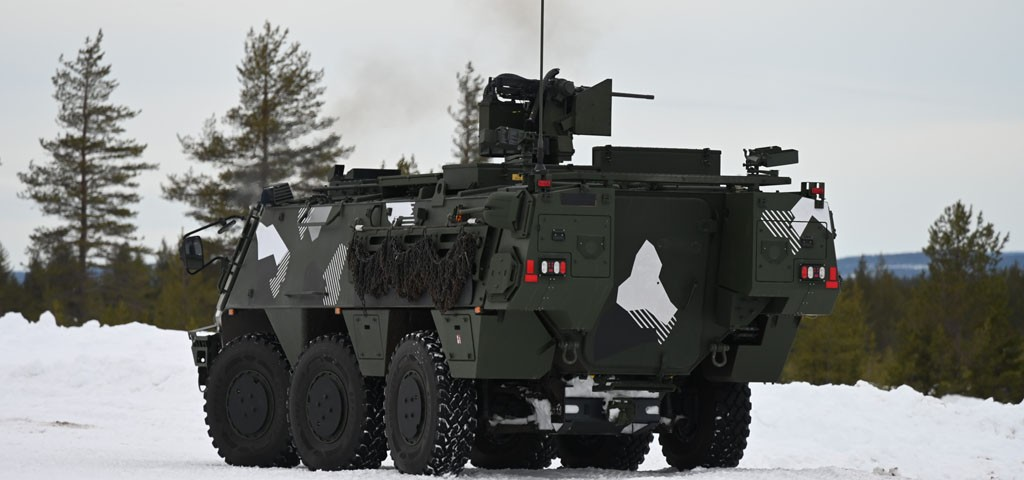
Hanwha Aerospace’s Arion-SMET has been selected for a South Korean Army unmanned ground-vehicle requirement, bringing the electric 6×6 platform closer to operational fielding once the final contract is completed.
Developed for logistics, casualty evacuation, reconnaissance, communications relay, and other missions that expose personnel to fire or observation, the vehicle can also accept a remote weapon station. The configuration and fleet size intended for the army have not yet been disclosed.
Arion-SMET has already completed evaluation work with South Korean and US forces, giving its development team experience outside controlled factory trials. Selection for an operational requirement, however, changes the engineering discipline around the platform.
Vehicles maintained by their designers can tolerate frequent adjustments, specialist diagnostic work, and hand-built components. A military fleet needs interchangeable parts, reproducible performance, repair procedures, operator training, controlled software releases, and enough documentation for technicians who were never part of the development programme.
The underlying technologies are individually familiar, but their integration remains demanding. Batteries, electric motors, suspension, brakes, cameras, computers, communications equipment, navigation sensors, and mission payloads must continue working through vibration, shock, mud, water, dust, temperature variation, and electromagnetic interference.
Remote operation adds further dependencies. Communications links must deliver sufficient bandwidth and low enough latency for safe control, yet the vehicle also needs predictable behaviour when the signal degrades, disappears, or is deliberately attacked.
Autonomous functions require similar discipline. Route-following, obstacle avoidance, convoy behaviour, and return-to-base modes must remain bounded by clear safety rules, particularly when vehicles are moving near troops, civilian traffic, ammunition, or crewed platforms.
Battery performance will shape daily operations as much as autonomy. Range varies with payload, terrain, gradient, temperature, sensor use, communications load, and driving behaviour, making controlled-test figures a poor substitute for fleet data gathered under representative conditions.
Charging equipment, replaceable modules, battery-health monitoring, and recovery procedures will therefore form part of the fielded system. A vehicle that exhausts its energy reserve away from a support point can quickly become an obstacle or a recovery burden.
Controlling variety across the fleet
Hanwha must now freeze enough of the design for efficient production while retaining a route for improved processors, sensors, radios, algorithms, and mission payloads. Autonomy hardware changes more quickly than conventional vehicle components, and repeated redesign can disrupt tooling, spares, training, and technical publications.
Freezing the platform too early creates a different problem. Computing systems may become obsolete before the fleet reaches full strength, while interfaces designed around a current sensor or radio can restrict later upgrades.
A modular architecture can ease that pressure only when the interfaces themselves are rigorously controlled. Mechanical mounting points, electrical supply, data protocols, cooling capacity, software permissions, and safety limits must remain stable enough for payload developers to work without repeatedly altering the base vehicle.
The army will also need to limit the number of operational variants. Logistics carriers, casualty-evacuation platforms, reconnaissance vehicles, communications nodes, and armed UGVs may share a common chassis, but each introduces different payload, power, cooling, software, and operator requirements.
Too much variation within a modest fleet can consume the manufacturing savings created by common components. A smaller number of base configurations, supported by removable mission kits, would allow chassis, running gear, battery packs, controllers, and core electronics to be produced in longer batches.
South Korea’s established land-systems sector gives Hanwha access to vehicle engineering, military electronics, precision manufacture, and export-support experience. Robotic ground vehicles nevertheless introduce a production model built around faster software cycles, smaller mechanical platforms, and a larger proportion of commercially derived components.
Similar constraints are appearing as European developers expand UGV output. Trinity Robotics’ work to increase Konyk ONE production has exposed the recurring need for batteries, motors, radios, operators, manufacturing staff, and repeatable quality control.
South Korea will operate within a more conventional acquisition system, although serial production still has to avoid the bespoke engineering that characterises many early UGV programmes. A fleet assembled from successive prototype standards would impose a disproportionate burden on maintainers and spares holdings.
Training equipment will become another production line in its own right. Operators need control stations, simulation systems, mission-planning tools, and realistic exercises, while technicians require diagnostic software and access to logs alongside mechanical tools.
Commanders must also understand how degraded communications, difficult terrain, bad weather, and civilian movement affect the vehicle’s behaviour. Those operational limits need to be represented in manuals and training rather than discovered after deployment.
Manufacturing data from the first production batch will shape later vehicles. Failure rates, energy consumption, sensor contamination, connector damage, and software faults should feed directly into controlled design changes, without leaving early examples stranded on incompatible standards.
Arion-SMET has demonstrated sufficient mobility and flexibility to reach selection. The programme will now be judged by whether Hanwha can turn that capability into a fleet of interchangeable, repairable, and supportable vehicles rather than a collection of sophisticated individual machines.