IN Brief:
- OPTICS11 will develop and deliver an operational containerised anti-submarine warfare capability.
- Fibre-optic passive sonar can be deployed from several suitable host-vessel types.
- Standardised mechanical, electrical, data, handling, and software interfaces will determine practical portability.
The Dutch Ministry of Defence has selected OPTICS11 to develop and deliver a containerised anti-submarine warfare system for operation from crewed and uncrewed vessels.
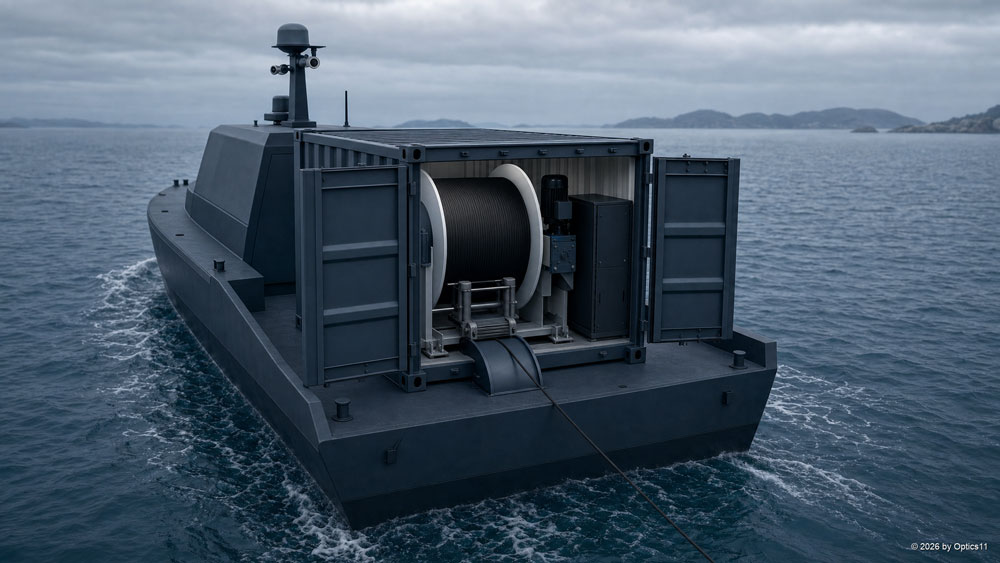
The “ASW in a box” concept packages a passive towed-array sonar, handling equipment, processing hardware, and supporting systems into a transportable configuration rather than fixing the complete capability permanently within a specialist warship.
OPTICS11 uses fibre-optic acoustic sensing, enabling a relatively thin and low-power array suitable for hosts with less space, electrical capacity, and payload margin than a conventional frigate. Containerisation also allows the mission equipment to be produced, transported, and upgraded separately from the vessel.
Moving the sonar between platforms still requires disciplined integration. Each host needs sufficient deck strength, power, communications, navigation data, control authority, and safe working space to deploy and recover the array without compromising other equipment or vessel operations.
Handling machinery must manage cable tension, sea state, vessel manoeuvre, tow depth, and the risk of damage during launch or recovery. The container has to protect precision optical and electronic hardware from corrosion, saltwater, shock, vibration, transport loads, and prolonged exposure on deck.
Passive sonar does not transmit energy; it listens for machinery, propeller, flow, and other underwater signatures. Detection performance therefore depends on array sensitivity, the acoustic environment, host-vessel self-noise, signal processing, tow geometry, and access to reliable classification data.
A compact system operating from several vessel types will encounter different noise profiles. Propellers, diesel engines, pumps, electrical machinery, and hull flow can obscure weak contacts, requiring each host installation to be characterised and its operating procedures adjusted accordingly.
Modularity moves rather than removes integration
Navies are pursuing modular mission systems because shipbuilding cycles remain poorly matched to the pace of change in autonomous and undersea technology. A containerised system can receive new processors, software, or sensor components without opening major sections of the host vessel.
The trade-off appears in the interfaces. Container dimensions may be standard, while power quality, data connections, cooling, deck loads, cable routes, navigation feeds, and launch-and-recovery arrangements vary considerably between ships.
The partnership between Lockheed Martin and Ultra Maritime to expand the anti-submarine warfare supply chain reflects increasing demand for arrays, processing, sonobuoys, and networked underwater sensing. OPTICS11’s contract brings fibre-optic arrays and compact handling systems into the same expanding market.
Below the surface, the AUKUS UUV programme’s move towards production is increasing demand for persistent autonomous platforms. Containerised sonar offers a potential complementary layer aboard smaller crewed or uncrewed vessels operating above them.
Series production requires more than winding an existing sensor onto a reel. Fibre-optic lines must retain consistent acoustic sensitivity while tolerating bending, tension, water ingress, and repeated handling, and the associated interrogators, connectors, processors, and calibration processes must remain controlled across each delivered set.
Software will carry a substantial portion of the capability. Acoustic processing must separate contacts from environmental noise, while classification tools require representative data and carefully validated updates. A new software release cannot be allowed to produce inconsistent performance across systems installed aboard different hosts.
Containerisation could support exports if OPTICS11 keeps the physical and digital interfaces manageable. Customers might pair the system with locally produced patrol vessels, auxiliaries, or uncrewed craft, avoiding a requirement to select the sonar during the original ship design.
Persistent operation will expose weaknesses not apparent during a short demonstration. Fibre, connectors, winches, seals, and electronics face corrosion, fatigue, biofouling, rough handling, and recovery damage, while uncrewed hosts add communications and remote-maintenance constraints.
A modular installation may also generate more noise than a purpose-built ASW vessel, and smaller hosts may be unable to tow an array effectively in poor conditions. Those limitations define the operating envelope and the supporting equipment required; they do not remove the value of a deployable capability.
The Dutch programme should now generate evidence on installation time, host compatibility, array handling, acoustic performance, communications, crew burden, and maintenance. Such data will determine whether the system remains a specialised national capability or develops into a repeatable export product.
Should the concept succeed, anti-submarine sensing becomes more portable across the fleet. The industrial value will reside in the fibre-optic array, processing software, handling equipment, and interface discipline that allows each container to work from several platforms without a bespoke integration programme every time.